

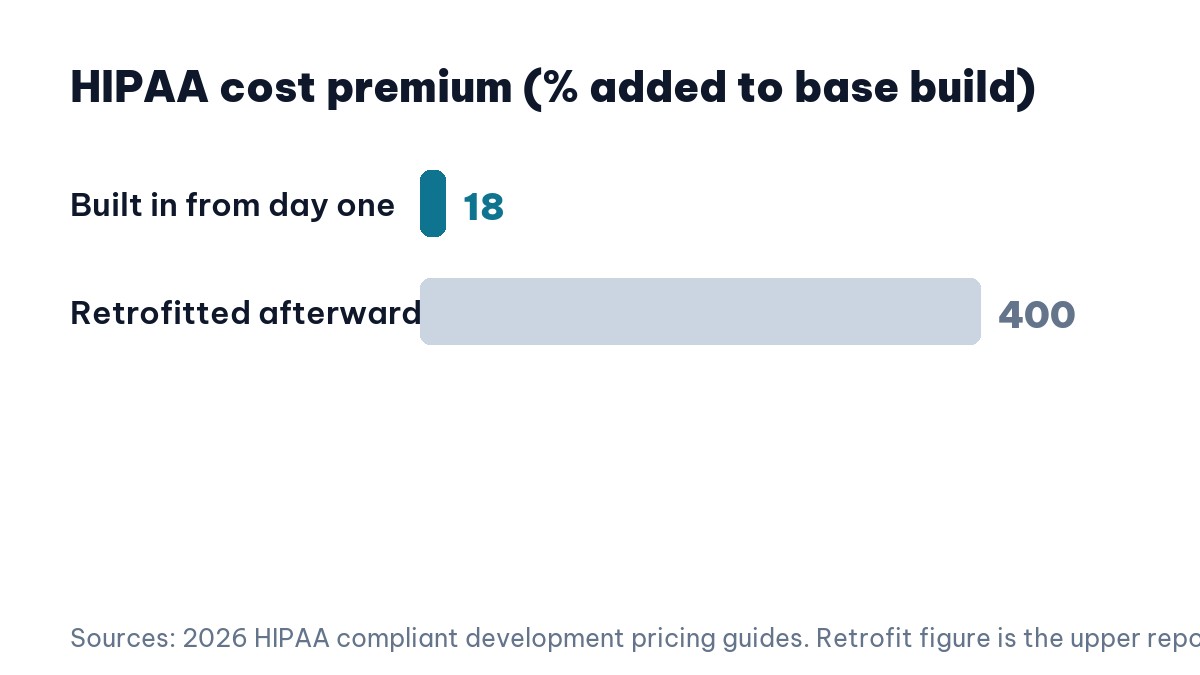
Healthcare software development carries a compliance premium that varies enormously depending on one decision: whether you designed for it or retrofitted it. Built in from the start, reported premiums sit around 12-18%. Bolted on afterwards, the same work is reported at 300-500% of that cost. The requirements did not change – only the timing did.
Key takeaways
- Typical 2026 ranges: $40,000-$100,000 for a HIPAA-compliant MVP, $100,000-$250,000 mid-complexity, $250,000-$500,000+ for EHR-integrated platforms.
- The HIPAA premium runs 12-18% designed in, commonly quoted at 20-30% overall – and 300-500% as a retrofit.
- Offshore teams bill $30-$80 per hour against $150-$250+ for US agencies, which is why most healthcare software development budgets now include offshore capacity.
- Isolating protected health information behind one boundary is the highest-value early decision.
- A signed business associate agreement must exist before any vendor access to PHI, not after.
Table of contents
- Healthcare Software Development Costs in 2026
- The HIPAA Premium and Why Timing Decides It
- Healthcare Software Development Starts by Isolating PHI
- Outsourcing Healthcare Software Development Safely
- Business Associate Agreements
- EHR Integration: The Line Item That Moves Most
- Healthcare Software Development Needs Domain Fluency
- Security Testing and Audit Line Items
- Healthcare Software Development Mistakes That Multiply the Bill
- FAQ
Healthcare Software Development Costs in 2026
Published 2026 guidance clusters into three bands. A lean HIPAA-compliant MVP – one workflow, minimal integration – runs roughly $40,000 to $100,000. A mid-complexity product with several roles and real reporting lands between $100,000 and $250,000. Enterprise platforms with EHR integration, AI components and multi-platform delivery start around $250,000 and pass $500,000.
Read those bands as ranges of scope rather than of vendor quality. The same telehealth product can sit at either end depending on how many roles it serves, whether it touches billing, and how many external systems it must speak to.
Rate is the other half. US agencies bill $150-$250 or more per hour for regulated work; offshore teams with HIPAA experience bill $30-$80. That gap is why almost every healthcare software development budget over $100,000 now contains some offshore capacity, whether or not the buyer describes it that way.
The HIPAA Premium and Why Timing Decides It
Compliance premiums get quoted as a single number, which hides the most important variable. Designed in from day one, reported premiums sit at 12-18%; agency pricing guides commonly quote 20-30% for a full build including security testing and audit support.
The practical consequence is that the cheapest moment to ask “does this handle PHI?” is before the first architecture diagram is drawn, and the most expensive moment is after a customer asks for your security documentation.
Retrofit the same requirements into a finished system and reported costs reach 300-500% of that figure. The reason is structural rather than punitive: retrofitting means re-architecting data flows, rewriting access control, adding audit trails to code that never had them, and re-testing everything downstream. You are not adding a feature – you are rebuilding foundations under a standing house.
Healthcare Software Development Starts by Isolating PHI
The single highest-leverage decision in healthcare software development is how much of your system can see protected health information. Every service that touches PHI must be documented, access-controlled, logged, tested and defended – every year, permanently.
Isolate it. Keep PHI behind one narrow boundary, pass references rather than payloads, and design reporting to work on de-identified data wherever the clinical question allows. Teams that do this pay the compliance premium on a small part of their estate. Teams that let PHI spread pay it on all of it, forever.
Outsourcing Healthcare Software Development Safely
Regulated healthcare products are built by distributed teams routinely. The question is never geography; it is whether access, evidence and accountability are controlled.
Six controls carry most of the weight: a signed business associate agreement before any access; production credentials that are logged, rotated and individually attributable; no PHI copied into development or test environments, ever; named engineers with background checks; breach notification timelines measured in hours; and documented offboarding so access dies with the engagement. Our security guide for outsourcing covers the general case.
Business Associate Agreements
The BAA is the contract that makes a vendor accountable for PHI under HIPAA. It is not paperwork to complete during onboarding – it must exist before the first credential is issued, because the exposure begins with access, not with the first commit.
Read what it actually says. Who is covered – the company, or named individuals? What are the notification timelines? What happens to data at termination? A vendor unfamiliar with these questions is telling you something useful about their experience with healthcare software development.
EHR Integration: The Line Item That Moves Most
Integration with electronic health record systems is where estimates go wrong most often. Standards like HL7 and FHIR promise interoperability, and they deliver it partially – each implementation carries local conventions, optional fields used differently, and sandbox environments that differ from production.
Budget integration as discovery rather than as a fixed task, and get access to the actual target environment before anyone quotes a number. Our guide to legacy system modernisation covers the same pattern in adjacent territory: the standard tells you the shape of the work, not its size.
Healthcare Software Development Needs Domain Fluency
Clinical workflows are unforgiving of engineers who have never seen one. A nurse interrupted mid-task, a form that must be completable in ninety seconds, a result that must never be silently discarded – these are not edge cases, they are the product.
Domain fluency also shows up in what a team refuses to build. Engineers who have worked in clinical settings push back on interfaces that bury a critical alert three taps deep, because they have watched what happens when someone misses one.
Look for teams that have shipped in regulated domains before, and give them access to real clinical users early. The failure mode is not bad code; it is software that is technically correct and unusable in the ninety seconds a clinician actually has.
Security Testing and Audit Line Items
Two costs commonly appear as separate lines and should be planned rather than discovered. Security and penetration testing is typically quoted at $15,000-$40,000, and formal compliance audits at $10,000-$50,000, depending on scope and assessor.
Both scale with how much of your system sits in scope – which loops back to isolation. Reduce the surface early and both numbers fall, year after year. That compounding is the real argument for architecture-first work in healthcare software development, more than any single-year saving.
Healthcare Software Development Mistakes That Multiply the Bill
Treating compliance as a launch-phase activity. It is a property of the system; scheduling it as a stage is how the retrofit multiple gets incurred.
Copying production data into a test environment to reproduce a bug. It is the most common finding in healthcare audits and the easiest to prevent with a decision made on day one.
Underestimating documentation. Regulated work produces evidence as a deliverable, and a team that has never assembled an evidence pack will discover halfway through that the artefacts they need were never captured.
Assuming a vendor’s general security posture covers HIPAA specifically. ISO 27001 or SOC 2 experience is genuinely relevant, but it is not the same standard, and the gaps are exactly where audits land.
One organisational note worth adding. Healthcare buyers – hospitals, insurers, clinical networks – run procurement processes that ask for evidence long before they ask for a demo. Security questionnaires, data-flow diagrams, subprocessor lists and incident histories arrive early and often. Teams that treated documentation as an afterthought lose deals not because the product is weak, but because they cannot answer in the format the buyer requires. Build the evidence trail while you build the product, and the sales cycle shortens by months.
FAQ: Healthcare Software Development
How much does it cost in 2026?
$40,000-$100,000 for a HIPAA-compliant MVP, $100,000-$250,000 mid-complexity, $250,000-$500,000+ for EHR-integrated enterprise builds.
How much does HIPAA add?
12-18% designed in from day one, commonly 20-30% across a full build, and 300-500% as a retrofit.
Can it be outsourced safely?
Yes, with a signed BAA, logged and rotated access, no PHI in development environments, and named engineers.
Do I need a BAA?
Yes, before any vendor access to PHI exists – not after onboarding.
What is the most common mistake?
Letting PHI spread across every service, which enlarges the compliance surface permanently.
Healthcare software development rewards decisions made before the first sprint and punishes those deferred to the last one. Isolate the data, sign the agreement, and treat the compliance premium as the price of a product a hospital can actually buy. See our transparent 2026 rate card →