

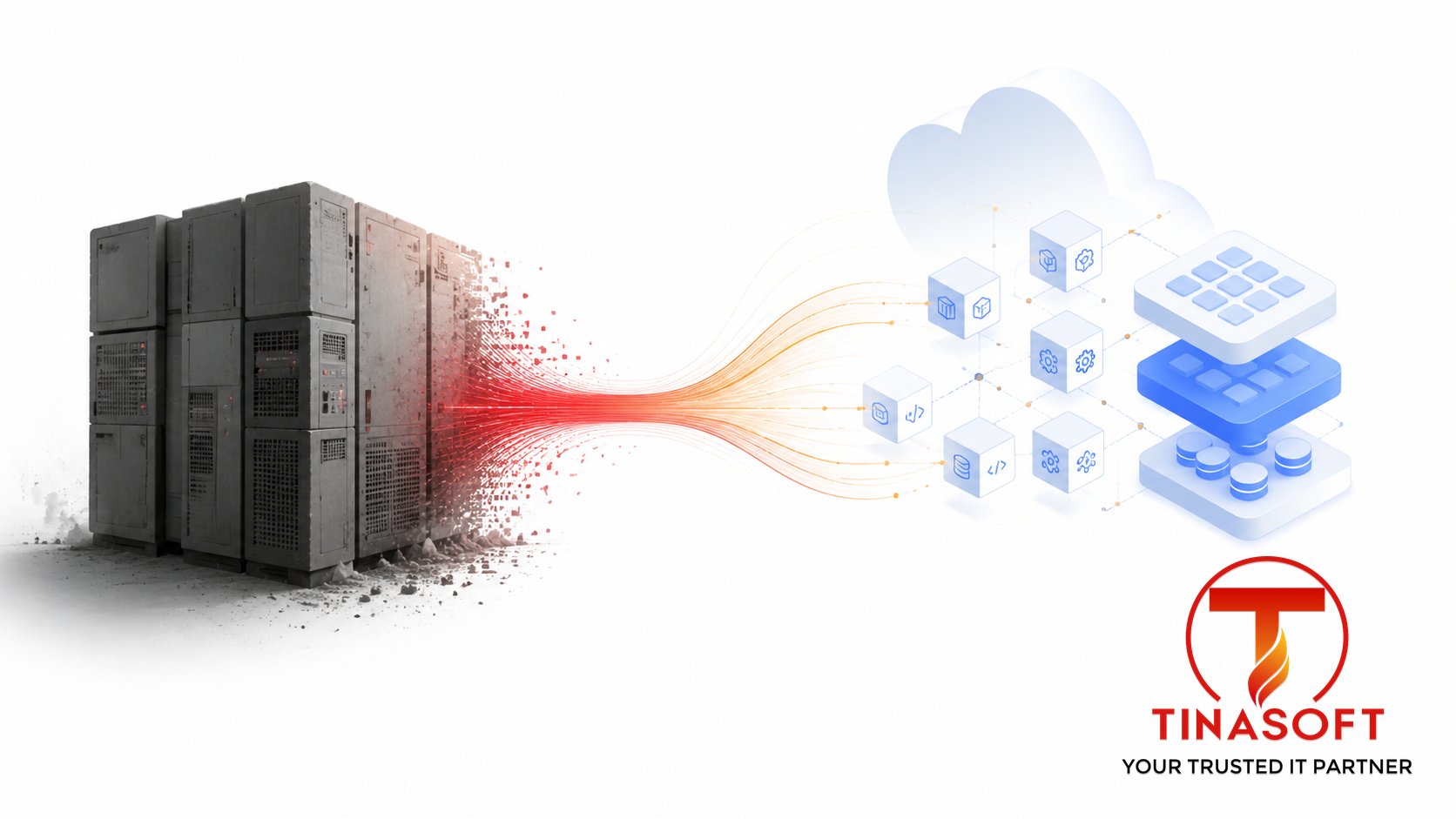
Legacy system modernization sits on almost every CTO’s 2026 roadmap — and almost every roadmap stalls at the same question: how do you replace software the business depends on every day without breaking it? The good news is that legacy system modernization no longer has to mean a risky, all-or-nothing rewrite. This guide covers the five real modernization approaches, what each one costs in 2026, a phased roadmap that avoids downtime, and the mistakes that turn a modernization project into a second legacy system.
Why Legacy System Modernization Is Back at the Top of the Agenda
Two forces are pushing legacy system modernization back onto priority lists this year. First, AI adoption exposes how rigid old architectures really are. A monolith built a decade ago usually can’t expose the clean APIs a modern AI feature needs, so every new capability turns into a multi-month integration project instead of a two-week sprint. Second, the maintenance bill keeps climbing. Gartner’s research on IT spending has long shown that a large majority of enterprise IT budgets goes toward simply keeping existing systems running, leaving little room for the features that actually grow the business. McKinsey’s work on technical debt reaches a similar conclusion: unmanaged debt can consume a significant share of the engineering budget before a single new feature ships.
There’s a talent dimension too. Engineers who know COBOL, classic ASP, or unsupported framework versions are retiring faster than they’re being replaced, and few senior developers want to spend their career maintaining a stack nobody is hiring for. Every year a modernization decision is deferred, the pool of people who can safely touch the system gets smaller — and the eventual project gets riskier.
What Actually Counts as a “Legacy System”
“Legacy” doesn’t just mean old. A five-year-old system running on a current framework with good test coverage isn’t legacy. A two-year-old system nobody dares touch is. Here’s how to tell the difference:
| Signal | Why it matters |
|---|---|
| Running on an unsupported framework/OS version | No security patches; every year of delay increases breach exposure |
| Single point of failure, no horizontal scaling | Growth is capped by the architecture, not the market |
| No automated test coverage | Every change is a gamble; teams become afraid to touch the code |
| Business logic lives only in one person’s head | Bus-factor risk; onboarding new engineers takes months |
| Blocks new integrations or AI features | Turns product roadmap items into multi-quarter infrastructure projects |
| Vendor with no active support contract | No path to fix critical bugs when they surface |
5 Legacy System Modernization Approaches — Which One Fits You
Most modernization programs don’t pick just one approach — they mix these five across different modules, based on how much business value each one still creates.
| Approach | What it means | Typical timeline | Best when |
|---|---|---|---|
| Rehost (lift-and-shift) | Move as-is to modern cloud infrastructure, minimal code change | 4–8 weeks | Infrastructure, not code, is the bottleneck |
| Replatform | Move plus targeted changes to use managed services (database, containers) | 2–4 months | App logic is sound but operational burden is heavy |
| Refactor | Restructure code, keep business logic, modularize the monolith | 3–6+ months, phased | Business logic still delivers value but the codebase is unmaintainable |
| Rebuild | Rewrite from scratch, keeping the original requirements | 6–12 months | The platform can’t support current or future needs at all |
| Replace | Swap for a commercial or SaaS product | 1–3 months | The functionality is now a commodity (generic CRM, HRM, etc.) |
Most refactor and rebuild projects that succeed use the strangler fig pattern: build the new module alongside the old one, route a slice of live traffic to it, validate the behavior matches, then cut over completely — module by module, instead of a big-bang rewrite that goes live all at once.
What Legacy System Modernization Really Costs in 2026
Cost depends entirely on scope, but here’s the range we typically see for a mid-size business application, based on Tinasoft’s current project and staffing rates:
| Approach | Typical range | Main cost driver |
|---|---|---|
| Rehost | $10K–$30K | Infrastructure migration + regression testing |
| Replatform | $30K–$80K | Managed service integration, data migration |
| Refactor (phased) | $60K–$250K+ | Ongoing senior team over 3–6+ months |
| Rebuild | $150K–$500K+ | Full re-architecture, parallel run, QA |
| Replace (SaaS/COTS) | $5K–$40K + subscription | Licensing, data migration, customization limits |
The number that trips up most budgets isn’t on this table: running the old and new systems in parallel. Reconciling data between two live systems, retraining staff on new workflows, and the temporary productivity dip during cutover routinely add 15–30% on top of the build cost. Skip that line item at your own risk — historical research from the Standish Group’s CHAOS studies has consistently found that a large share of major IT projects run over budget, over schedule, or fail to deliver the expected scope, and unplanned parallel-run costs are a recurring cause.
A Phased Roadmap That Avoids a “Big Bang” Rewrite
- 1. Audit and inventory. Map every system, dependency, and integration — and capture the institutional knowledge that only lives in one person’s head — before anyone touches code.
- 2. Prioritize by business risk, not by what’s technically messiest. Score each module on revenue impact × failure probability, and modernize the highest-risk pieces first.
- 3. Pick the approach per module. Rehost the low-value pieces, refactor the ones that still create advantage, replace the commodity functions — don’t force one strategy on the whole system.
- 4. Apply the strangler fig pattern. Build the new module alongside the old, route a slice of traffic, validate against production behavior, then cut over.
- 5. Run old and new in parallel with reconciliation checks before decommissioning anything — don’t trust a single migration run with live business data.
- 6. Decommission the legacy piece only after a defined stability window (typically one full business cycle) with zero rollback incidents.
Common Mistakes That Turn Modernization Into a Second Legacy System
- Treating it as a rewrite project instead of a business-continuity project. No rollback plan means one bad deploy takes down operations.
- Modernizing everything at once. A big-bang cutover multiplies risk instead of reducing it.
- No data migration validation. Silent data loss during cutover is one of the most common (and most expensive) modernization failures.
- Hiring a team unfamiliar with the old stack. Undocumented business rules get ported incorrectly when nobody can read the legacy code.
- Skipping test coverage before touching code. Without a safety net, every refactor is a guess.
- Underestimating change management. Retraining staff on a new workflow takes longer than the engineering work itself.
How Tinasoft Approaches Legacy System Modernization
We’ve run 300+ projects for 100+ global clients, and the modernization engagements that go well share the same pattern: senior-led teams (70%+ senior engineers on every project), a phased strangler-fig rollout instead of a big-bang cutover, and weekly demos so you see working software — not a status report — every step of the way. Every engagement starts with an NDA and IP assignment, and milestone payments are tied to delivered, working modules, not hours logged. AI-augmented delivery lets our teams read and map legacy business logic faster, which is often the slowest part of a refactor. If you’re evaluating vendors for a modernization project, our guide on how to choose the right software outsourcing partner covers the questions to ask before you sign anything.
FAQ
How long does legacy system modernization take?
It depends on the approach: a rehost can take 4–8 weeks, while a full rebuild of a complex system can take 6–12 months. Most successful programs phase the work module by module rather than targeting one single go-live date.
Should I refactor or rebuild my legacy system?
Refactor if the business logic still works and the problem is code structure. Rebuild only if the platform itself can’t support current or future requirements — rebuilding is more expensive and riskier, so it should be the last option, not the first.
What is the strangler fig pattern?
It’s a modernization technique where you build the new system alongside the old one and gradually route traffic to it, module by module, until the legacy system can be safely retired — instead of a single risky cutover.
How much does legacy system modernization cost in 2026?
For a mid-size business application, budgets typically range from $10K for a simple rehost to $500K+ for a full rebuild, plus 15–30% for parallel-run and data migration costs that are easy to underestimate.
Can legacy modernization be outsourced safely?
Yes, with the right safeguards: an outsourcing partner with senior engineers who can read old code, an NDA and IP assignment in place, milestone-based payment, and weekly demos so you can catch issues before they compound.
Build vs. Modernize: When Is It Actually Time to Start Over?
Not every legacy system deserves a rescue plan. Before committing budget to legacy system modernization, run a quick gut check: if the system still fits the business model it was built for, and the pain is purely technical (slow deploys, brittle code, scaling limits), modernization is almost always the right call — the business logic inside represents years of accumulated, hard-won knowledge that a rewrite would throw away. If the business model itself has changed — you’ve pivoted, entered a new market, or the original system was built for a process that no longer exists — a fresh build (or our related guide on build vs buy decisions) may serve you better than modernizing something that no longer matches how the company actually operates. The test is simple: are you fighting the code, or are you fighting the business requirements the code was written for? Only the first problem is solved by modernization.
Ready to Modernize Without the Risk?
Legacy system modernization doesn’t have to mean betting the business on a single cutover weekend. With a phased roadmap, the right approach per module, and a senior team that plans for rollback from day one, you can retire technical debt without stopping the business that depends on it. See our transparent 2026 pricing for staffing, project teams, and modernization engagements.