

Fintech software development is not ordinary software development with a compliance checklist bolted on at the end. Regulation shapes the architecture, the release process and the paperwork trail from the first sprint. Buyers who discover this late pay for it twice – once building, once rebuilding.
Key takeaways
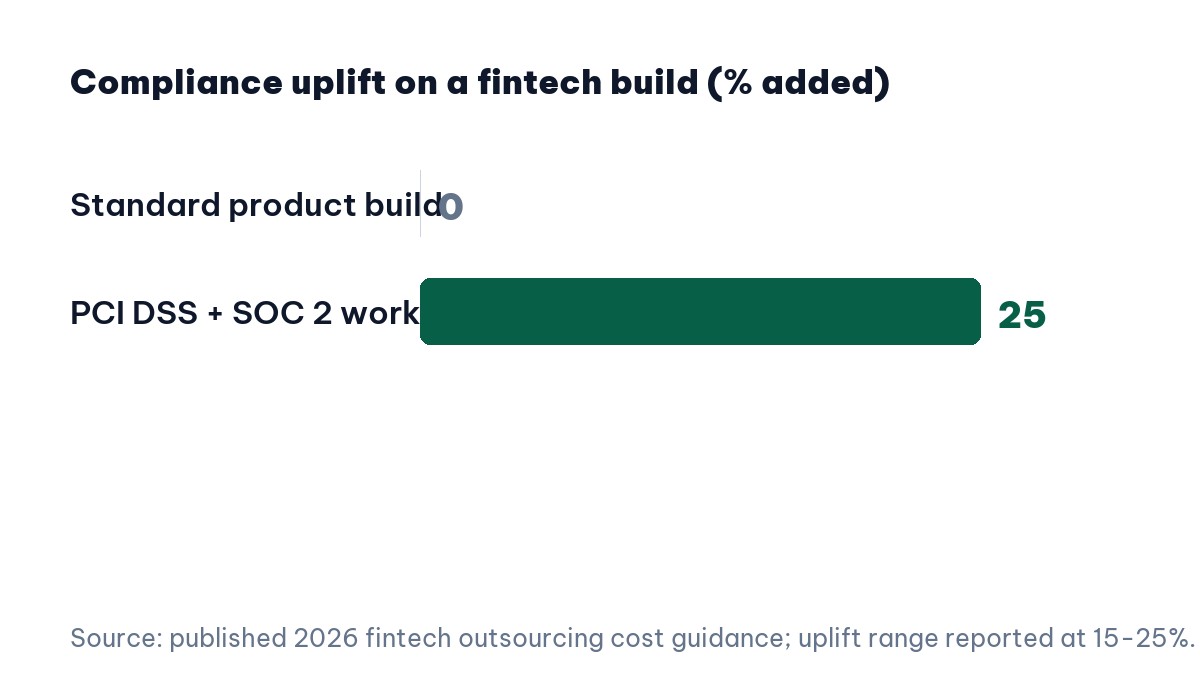
- Compliance work adds roughly 15-25% to a comparable non-regulated build when PCI DSS and SOC 2 are in scope.
- PCI DSS v4.0.1 is fully mandatory in 2026 – the older version’s transition period has ended.
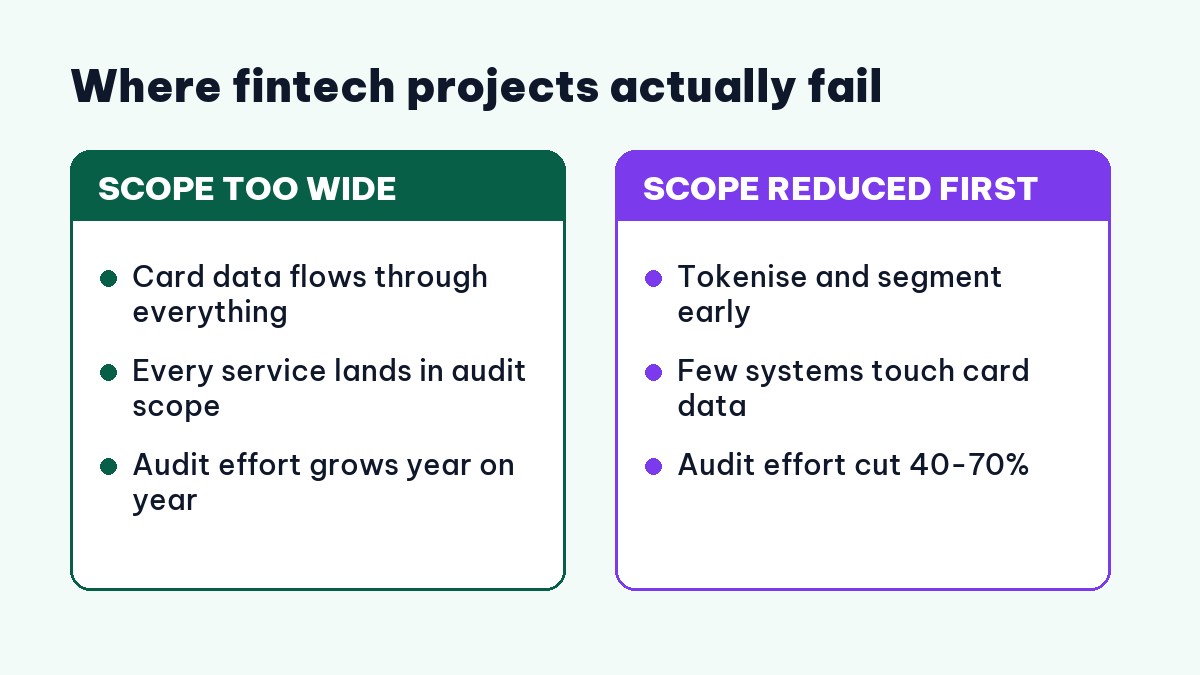
- Scope reduction is the highest-leverage decision in fintech software development: tokenisation and segmentation can cut audit effort by 40-70%.
- Card-brand fines run from roughly $5,000 to $100,000 per month per acquirer, before breach costs.
- Regulated work can be outsourced safely, but only with logged access, named engineers and contractual audit rights.
Table of contents
- What Fintech Software Development Actually Costs
- Scope Reduction: The Decision That Saves the Most
- The Standards That Apply
- Fintech Software Development Starts With Architecture
- Can Fintech Software Development Be Outsourced?
- Access Control Is the Real Risk Boundary
- Contract Terms for Fintech Software Development
- How to Evaluate a Vendor’s Regulated Experience
- Expensive Mistakes in Fintech Software Development
- FAQ
What Fintech Software Development Actually Costs
Start from the honest baseline: a regulated build costs more than an equivalent unregulated one, and anyone quoting otherwise has not read the requirements. Published 2026 guidance puts the uplift at roughly 15-25% where PCI DSS and SOC 2 work is in scope.
It is worth being precise about what drives the range. A wallet product that never touches raw card numbers sits at the low end; a platform that stores card data, operates in several jurisdictions and sells to enterprises needing SOC 2 evidence sits at the top. The variable is exposure, not ambition.
That premium does not buy features. It buys architecture controls, evidence collection, penetration testing, access management and the audit support that turns all of it into something an assessor accepts. Enterprise programmes covering regulated platforms across multiple regions commonly run from $400,000 into seven figures annually.
Scope Reduction: The Decision That Saves the Most
Here is the counterintuitive part. The cheapest way to reduce compliance cost is not to negotiate rates – it is to reduce how much of your system falls under the standard at all.
Compliance cost scales with surface area. Every service that can see sensitive data is a service someone must document, test, monitor and defend in an audit – every year, forever.
Tokenise card data so raw numbers never reach your services. Segment the network so most systems cannot reach the ones that do. Isolate the payment path behind a narrow, well-defined boundary. Teams that do this report cutting audit effort by 40-70%, because most of the estate simply falls out of scope. Teams that skip it pay for a growing audit every single year.
The Standards That Apply
Four frameworks cover most fintech products. PCI DSS governs payment card data and is mandatory at v4.0.1 in 2026, following the end of the transition from the previous version. SOC 2 Type II attests to operational and security controls over time, and enterprise customers increasingly ask for it before signing. ISO/IEC 27001 covers information security management. GDPR and equivalent regimes govern personal data.
The overlap between them is larger than it looks: access control, logging, change management and vendor oversight appear in all four with different wording. Building those four capabilities properly once covers most of the ground, which is why mature teams treat them as engineering foundations rather than as audit chores.
You do not need all four. You do need to know which apply before the architecture is fixed, because retrofitting a control into a running system costs multiples of designing it in.
Fintech Software Development Starts With Architecture
In an unregulated product you can defer architecture decisions and refactor later. In fintech software development, several of those decisions are effectively permanent, because changing them means re-certifying.
Where card data lives, how audit logs are written and retained, how access is granted and revoked, how environments are separated – these belong in the first design conversation. A vendor who wants to “start coding and sort compliance later” is quoting you a lower number for a more expensive project.
Can Fintech Software Development Be Outsourced?
Yes – regulated products are built by distributed teams every day. The question is never location; it is whether access, evidence and accountability are controlled.
What must stay close: decisions with regulatory consequences, the relationship with your assessor, and anything requiring physical presence for audit. What travels well: the engineering itself, including the security work, provided the controls below are real. Our guide to security in software outsourcing covers the general case; fintech simply raises the evidentiary bar.
Access Control Is the Real Risk Boundary
Distance is not the risk. Unmanaged access is. Six questions expose most of the exposure: who holds production credentials, how often are they rotated, is every access logged and reviewed, what happens on an engineer’s last day, is customer data ever copied into development, and who approves a change reaching production?
Notice that none of those questions is about where an engineer physically sits. They are about whether access is deliberate, revocable and observable – properties a well-run distributed team can satisfy more rigorously than an informal in-house setup.
Ask for written answers. In regulated work, “we take security seriously” is not an answer – a documented procedure with named owners is.
Contract Terms for Fintech Software Development
Six clauses matter more than the rate. Named engineers with allocation percentages and background checks. Code and repository ownership from the first commit. Defined production-access controls with logging. Breach notification timelines measured in hours. Audit rights that let you or your assessor inspect. And an exit plan documented well enough that another team could take over.
The economic argument for these is blunt: card-brand fines alone run from roughly $5,000 to $100,000 per month per acquirer, and forensics plus notification after a breach can reach seven figures. Against those numbers, negotiating clauses is cheap.
How to Evaluate a Vendor’s Regulated Experience
Claims are easy; specifics are not. Ask which standards their previous fintech software development work was assessed against, and who performed the assessment. Ask how they handled scope reduction on a past payment system. Ask what their engineers may and may not do in a production environment.
One practical filter: ask to see a redacted evidence pack from a past assessment. Vendors who have genuinely been through it have the artefacts and can show the shape of them. Vendors who have not will offer a case description instead.
The revealing question is about failure: ask what went wrong on their last regulated project and what changed afterwards. Teams with real experience answer specifically. Teams without it answer in adjectives. Our vendor evaluation guide covers the wider diligence checklist.
Expensive Mistakes in Fintech Software Development
Treating compliance as a phase. It is a property of the system, not a stage before launch, and bolting it on at the end is the most reliable way to double the bill.
Letting scope sprawl. Every additional service that touches card data enlarges the audit forever, not just once.
Assuming the assessor will interpret an ambiguity in your favour. They will not, and the time to resolve ambiguity is before the evidence is collected, not during the assessment.
Copying production data into test environments, usually to reproduce a bug quickly. It is the most common finding in fintech audits and the easiest to prevent with a decision made on day one.
FAQ: Fintech Software Development
How much more does it cost than a standard build?
Roughly 15-25% more where PCI DSS and SOC 2 are in scope. The uplift buys controls, evidence and audit support, not features.
Can regulated work be outsourced safely?
Yes, with logged and rotated production access, named engineers, no production data in development, and contractual audit rights.
Does PCI DSS apply to my product?
If any system stores, processes or transmits cardholder data, yes. v4.0.1 is mandatory in 2026.
How do I reduce audit effort?
Tokenise, segment and isolate early. Teams doing this report 40-70% less audit effort because most systems leave scope.
What belongs in the contract?
Named engineers, code ownership from commit one, access controls, breach timelines, audit rights, and a documented exit plan.
Fintech software development rewards decisions made early and punishes those deferred. Reduce scope before you write code, control access before you grant it, and treat the compliance uplift as the price of a product enterprises can actually buy. See our transparent 2026 rate card →