

The question of when to outsource software development is usually argued as a cost comparison, which is why it is usually argued badly. Rates are the least interesting variable. Four tests – core versus context, speed, duration and reversibility – answer it far more reliably than any spreadsheet.
Key takeaways
- Outsource context, keep core: whatever makes you different from competitors stays in-house.
- Hiring takes months end to end; a vendor squad starts in weeks – speed is often the real decision.
- Short and bounded favours outsourcing; permanent and continuous eventually favours hiring.
- Reversibility matters: outsourcing decisions unwind faster than hiring decisions, which is worth something under uncertainty.
- The condition on all of it is ownership – your repository, your accounts, documented architecture.
Table of contents
- Test 1: Core Versus Context
- Test 2: When to Outsource Software Development for Speed
- Test 3: When to Outsource Software Development by Duration
- Test 4: Which Decision Can You Unwind?
- When to Outsource Software Development as a Startup
- What Should Never Be Outsourced
- Conditions That Decide When to Outsource Software Development Safely
- When to Outsource Software Development: Warning Signals
- When to Bring It Back In-House
- FAQ
Test 1: Core Versus Context
Core is the work that makes customers choose you: the matching algorithm, the underwriting model, the thing a competitor cannot copy by reading your marketing site. Context is everything else that must exist for the business to run – admin panels, integrations, internal tooling, the mobile shell around the clever part.
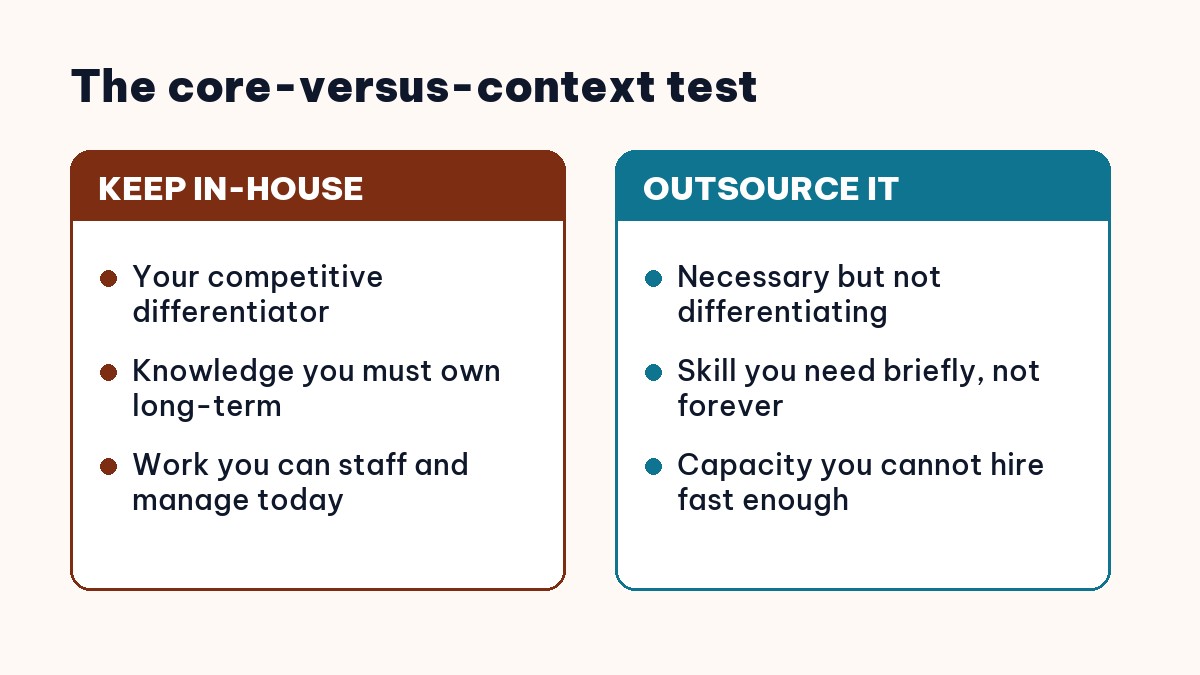
The test is simple to apply: if this capability disappeared tomorrow, would customers still have a reason to choose you? If the answer is no, it is core. If the answer is yes, it is context – however technically demanding it happens to be.
Keep core. Outsource context. The mistake is not outsourcing too much – it is outsourcing the one capability that was the reason customers preferred you, and discovering two years later that nobody inside the company understands it.
Test 2: When to Outsource Software Development for Speed
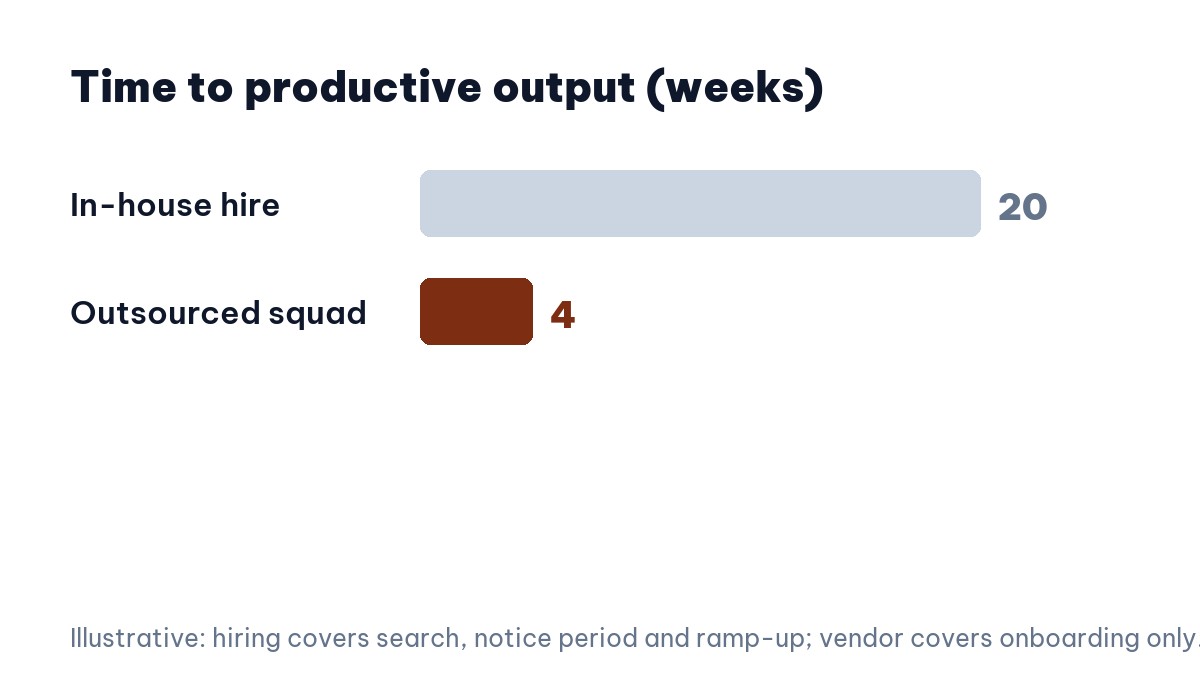
Count the real hiring timeline honestly: writing the role, searching, interviewing, an offer, a notice period, then ramp-up. Four to six months to productive output is normal for a senior engineer, longer in a tight market. A vendor squad with an existing bench starts in two to four weeks.
The comparison is also not one-for-one. Hiring adds permanent capacity you keep; a vendor adds capacity you rent. Speed favours renting, but only renting solves an urgent problem while you run the slower hiring process in parallel – and doing both at once is a perfectly reasonable plan.
If the opportunity has a window – a compliance deadline, a customer commitment, a competitor moving – that difference is not a convenience. It is the entire decision, and it is the most common legitimate answer to when to outsource software development.
Test 3: When to Outsource Software Development by Duration
Work that lasts three months and disappears should never become a permanent salary. Work that will run continuously for five years will, at some point, be cheaper and stronger in-house.
Most real situations sit in between, which is where a dedicated development team fits: continuous enough to need stability and accumulated context, uncertain enough that you do not want to convert it into permanent headcount yet.
Test 4: Which Decision Can You Unwind?
Under uncertainty, prefer the reversible option. Ending a vendor engagement takes a notice period and a handover. Unwinding a bad hire takes far longer, costs more, and damages the team while it happens.
That asymmetry is worth real money when you are not yet sure the work will persist. It is also why starting with a paid pilot rather than a twelve-month contract is nearly always the right opening move – you are buying evidence before you buy commitment.
When to Outsource Software Development as a Startup
For an early-stage company the honest answer depends on the founding team. If a technical founder can build the first version, build it – the learning is worth more than the time saved. If not, outsourcing the initial product is a legitimate way to reach market, and our MVP guide covers how to scope it.
The non-negotiable condition is ownership. Your repository, your cloud accounts, your domain, documented architecture, no proprietary vendor frameworks. Get that wrong and you have not outsourced a build – you have rented your own product.
What Should Never Be Outsourced
Three things. The capability that differentiates you. Knowledge you cannot afford to lose if a contract ends. And decisions with regulatory consequences, which stay yours regardless of who writes the code.
The regulatory point deserves emphasis: you can outsource the engineering work behind a regulated system, but never the accountability for it. Auditors and customers hold you responsible, and pointing at a supplier has never been an accepted answer.
Notice that none of these is about task difficulty. Plenty of hard engineering can be outsourced safely; plenty of easy work should not be, because of what it teaches you about your own customers.
Conditions That Decide When to Outsource Software Development Safely
Outsourcing does not fail randomly. It fails under predictable conditions: unclear scope, invisible progress, and no named accountability. Reverse all three and most engagements work.
Concretely: specify what is out of scope as explicitly as what is in; require a demo of working software every sprint; and put named engineers with allocation percentages in the contract. The full control list is in our outsourcing risk guide.
When to Outsource Software Development: Warning Signals
Some situations predict failure regardless of vendor quality. You cannot describe what success looks like. Nobody internally has capacity to answer questions within a day. Requirements change faster than a sprint. Or the motivation is purely cost, with no view on what the capacity is for.
Cost-only motivation deserves particular suspicion. Teams that outsource purely to reduce a number tend to under-invest in the specification and oversight that make the arrangement work, then conclude that outsourcing does not work. The saving was real; the conditions for capturing it were never put in place.
In those cases the answer to when to outsource software development is: not yet. Fix the clarity problem first, because handing an unclear brief to anyone – internal or external – produces the same result at different prices.
When to Bring It Back In-House
Three triggers. The work has become core – what started as context now differentiates you. The volume has become permanent and predictable enough to justify salaries. Or coordination cost has grown until managing the vendor costs more than managing employees would.
None of those triggers is a failure. A vendor relationship that ends because the work became core has done exactly what it was supposed to do – carried the load while the answer was still uncertain.
Plan that transition rather than announcing it: a documented handover, a period of overlap, and a codebase you already owned. If you set the ownership conditions correctly at the start, bringing work in-house is a project. If you did not, it is a rebuild.
A final framing that helps in board discussions: outsourcing is a capacity decision, not an identity decision. Companies do not become less technical by renting engineers for context work, any more than they become less serious by renting office space. What makes a company technical is owning the thinking behind the product – and that is precisely the part these four tests tell you to keep.
FAQ: When to Outsource Software Development
When should a company outsource?
When the work is necessary but not differentiating, when capacity is needed faster than hiring allows, or when a skill is needed briefly rather than permanently.
Should a startup outsource its MVP?
Often yes if the founders lack engineering depth – provided you own the repository, accounts and documented architecture.
What should never be outsourced?
Your differentiator, knowledge you cannot afford to lose, and decisions carrying regulatory consequences.
Is outsourcing cheaper than hiring?
Per hour often yes; over years an in-house team can win for stable work. The larger differences are speed and reversibility.
Model failure or vendor failure?
If scope was clear and progress visible weekly and it still failed, it was the vendor. If neither was true, the model was never tested.
Answer the four tests and the decision stops being a debate about rates. That is all that when to outsource software development really requires: knowing what is core, how fast you need it, how long it lasts, and how easily you could change your mind. See our transparent 2026 rate card →