

The staff augmentation vs outsourcing question is not about cost, headcount or location. It is about one thing: who manages the work day to day. Get that answer right and the rest of the engagement follows naturally. Get it wrong and you will pay a premium for capacity you cannot actually direct.
Key takeaways
- Augmentation rents engineers into your process; outsourcing hands over a scope with an accountable owner.
- Augmentation carries the lower hourly rate but transfers the management cost onto your team, where it stays invisible.
- The model breaks past roughly four or five augmented engineers per available manager.
- In staff augmentation vs outsourcing, you are choosing which risk to own: delivery risk or vendor-selection risk.
- Hybrid setups work, provided every engineer has exactly one manager.
Table of contents
- Staff Augmentation vs Outsourcing: The Real Difference
- The Cost Comparison Nobody Runs Properly
- Staff Augmentation vs Outsourcing: The Hidden Management Load
- Staff Augmentation vs Outsourcing on Risk
- When Staff Augmentation Is the Right Answer
- When Outsourcing Is the Right Answer
- The Dedicated Team Model Between Them
- Running Staff Augmentation vs Outsourcing Side by Side
- Staff Augmentation vs Outsourcing: Four Questions to Decide
- FAQ
Staff Augmentation vs Outsourcing: The Real Difference
In staff augmentation you rent people. Engineers join your standups, use your board, follow your process, and report to your managers. You decide what they work on each morning and you are accountable for whether it ships.
In outsourcing you hand over a scope of work. The vendor assembles the team, runs delivery, manages quality and is accountable for the result. You define what needs to exist and by when; how it gets built is their problem to solve.
Everything else people argue about in the staff augmentation vs outsourcing debate – rates, contracts, location, team size – is downstream of that single split.
The Cost Comparison Nobody Runs Properly
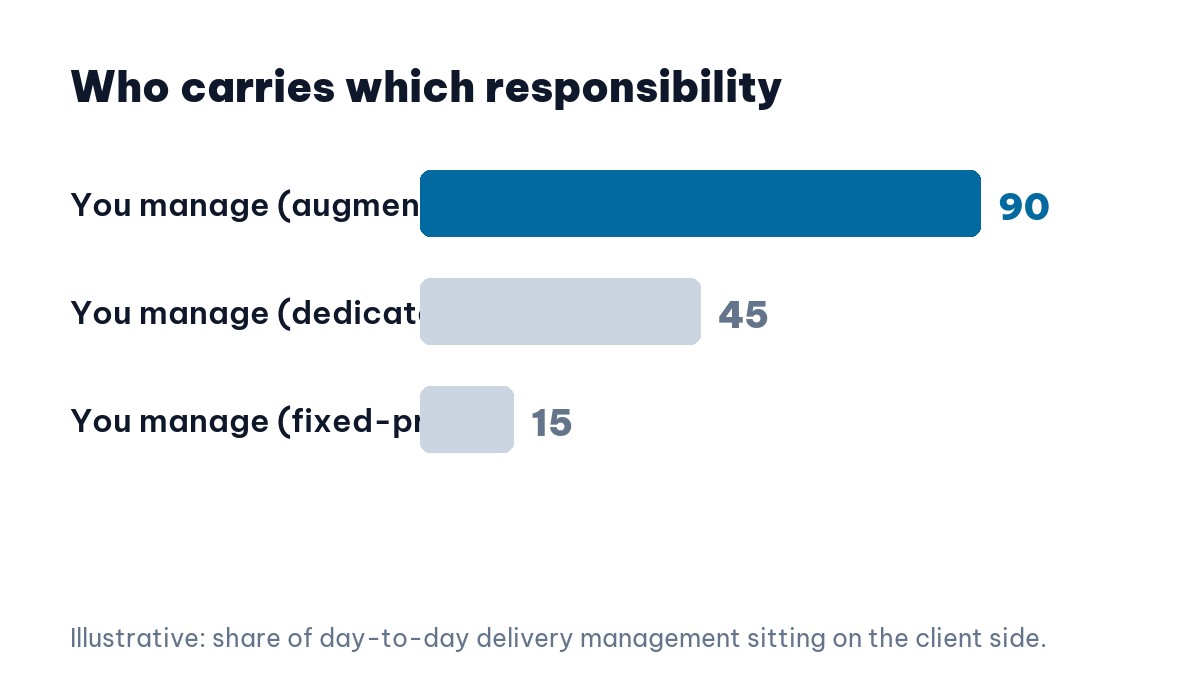
Augmentation quotes are lower per hour, and that is real. What the comparison usually misses is the management load moving onto your side of the ledger: planning, task breakdown, code review, quality assurance, unblocking, and the context-switching cost paid by whoever does it.
There is a second line most comparisons omit: ramp-up. Every engineer, borrowed or dedicated, spends the first weeks learning your domain rather than producing. In augmentation you pay that cost each time a contractor rotates; in a stable outsourced team you pay it once. Over a year, that difference alone can outweigh the hourly gap.
Run the honest version. Take the hourly difference, multiply by the hours, then subtract the fraction of an engineering manager’s salary the augmented model consumes. On a squad of four or more, that subtraction usually erases the gap. Below that, augmentation often stays genuinely cheaper.
Staff Augmentation vs Outsourcing: The Hidden Management Load
A useful rule of thumb: one engineering manager can meaningfully direct four to five borrowed engineers. Beyond that, priorities blur, questions queue and people wait – and waiting engineers bill exactly the same as working ones.
This is where augmentation quietly fails. It rarely collapses; it degrades. Velocity slips, quality wobbles, and because nobody outside your team is accountable, there is no vendor review to surface it. The team ends up with unmanaged outsourcing while still paying augmentation’s management tax internally.
Staff Augmentation vs Outsourcing on Risk
Neither model removes risk; they relocate it. With augmentation you own delivery risk – if the work is late, that is your process, your prioritisation, your call. With outsourcing you own vendor-selection risk: pick well and you have a partner, pick badly and you have a dispute.
Which risk you should prefer depends on what your organisation is actually good at. Companies with strong engineering management usually prefer to own delivery risk, because they trust their own process more than a contract. Companies without that bench are better served buying the outcome. There is no universally safer answer in staff augmentation vs outsourcing – only a better fit.
When Staff Augmentation Is the Right Answer
Augmentation gets unfairly dismissed as the junior option. It is not – it is the precise option, and when it fits, nothing else is as efficient.
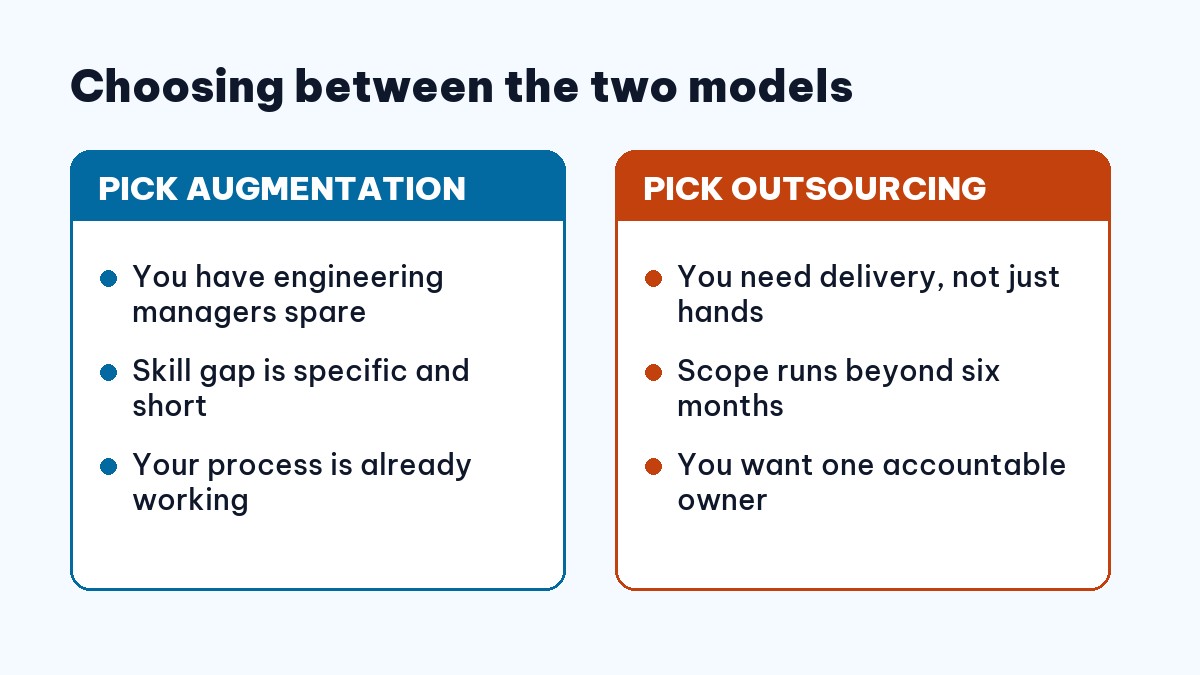
Four situations make augmentation the clear choice. You have engineering managers with spare capacity. The gap is a specific skill for a bounded period – a mobile developer for one release, a data engineer for a migration. Your process already works and you want people inside it, not beside it. Or the work is too entangled with in-house systems to hand over cleanly.
When Outsourcing Is the Right Answer
The mirror image. You need delivery rather than hands. The scope is separable enough to own end to end. Your managers are already stretched. Or the work runs long enough that a stable team with accumulated context beats a rotating cast of contractors.
There is also an organisational argument that rarely gets said out loud: handing over a whole area forces you to define what success looks like. Teams often discover the scope was never clear only when someone outside the building asks them to write it down.
Duration matters more than most buyers expect. Anything beyond six months of continuous work rewards a team that remembers why decisions were made – which is exactly what an accountable vendor is set up to provide, and what borrowed individuals are not.
The Dedicated Team Model Between Them
There is a third option that muddles the binary usefully. A dedicated development team gives you a fixed group working only on your product, where you set priorities and the vendor owns delivery discipline, HR and team stability.
It is the middle of the staff augmentation vs outsourcing spectrum: more control than fixed-price outsourcing, far less management overhead than augmentation. For product companies with a roadmap measured in years, it is usually where the comparison lands.
Running Staff Augmentation vs Outsourcing Side by Side
Plenty of companies do, and it works under one rule: every engineer has exactly one manager. A dedicated squad owns a product area under the vendor’s delivery lead, while one or two augmented specialists sit inside your in-house team for a specific gap.
In practice the split is easiest to hold when the boundaries are drawn around product areas rather than around skills. One team owns checkout end to end; another owns the mobile app. Draw the line around skills instead – “the vendor does backend, we do frontend” – and every feature becomes a negotiation across two management structures.
What fails is the ambiguous middle – engineers nominally managed by a vendor but taking daily direction from you. That arrangement produces the overhead of both models and the accountability of neither, and it is the single most common way these engagements go wrong.
Staff Augmentation vs Outsourcing: Four Questions to Decide
First: do you have management capacity to spare right now, honestly measured? If not, augmentation will disappoint you regardless of the rate.
Second: is the work separable enough that someone could own it end to end? If yes, outsourcing is available to you; if it is deeply entangled with in-house systems and tribal knowledge, it may not be.
Third: how long will this run? Short and specific favours augmentation. Long and continuous favours a dedicated team.
Fourth: which failure would hurt more – a vendor that underdelivers, or your own managers stretched past the point of doing either job well? Answer those four and the staff augmentation vs outsourcing decision usually makes itself, without a spreadsheet.
One last practical note: whichever way you go, write the review point into the calendar now. Three months in, ask whether the model is still the right one. Teams change shape faster than contracts do, and the answer that was correct in January is often wrong by June.
FAQ: Staff Augmentation vs Outsourcing
What is the difference?
Augmentation rents engineers who work inside your process under your managers. Outsourcing hands a scope to a vendor accountable for delivery.
Which is cheaper?
Augmentation has the lower rate; outsourcing often has the lower total cost once management overhead is counted honestly.
When does augmentation stop working?
Past roughly four or five augmented engineers per available manager, when coordination becomes the bottleneck.
Can you combine both?
Yes, provided every engineer has exactly one manager. The ambiguous middle is what fails.
Does augmentation carry more risk?
It relocates risk. You own delivery risk instead of vendor-selection risk, and it fails quietly because no one outside your team is accountable.
Decide who manages the work, and the model chooses itself. Everything else in staff augmentation vs outsourcing is a consequence of that one answer. See our transparent 2026 rate card →