

A software discovery phase is the short, paid stage before development where assumptions are replaced with evidence. It is also the stage buyers most often try to skip, because it produces documents instead of screens. That trade looks efficient in week one and expensive by month four. This guide explains what a software discovery phase should deliver, how long it should take, and how to turn its output into a scope you can actually sign.
Key takeaways
- PMI research found 37% of organisations cite inaccurate requirements gathering as the primary cause of project failure.
- A software discovery phase should end with a prioritised scope, architecture decisions, a risk list and an evidence-based estimate.
- Its length should follow uncertainty, not project size – for a first release, usually weeks rather than months.
- The deliverables must be yours and usable by any team, which also makes discovery a low-risk test of a vendor.
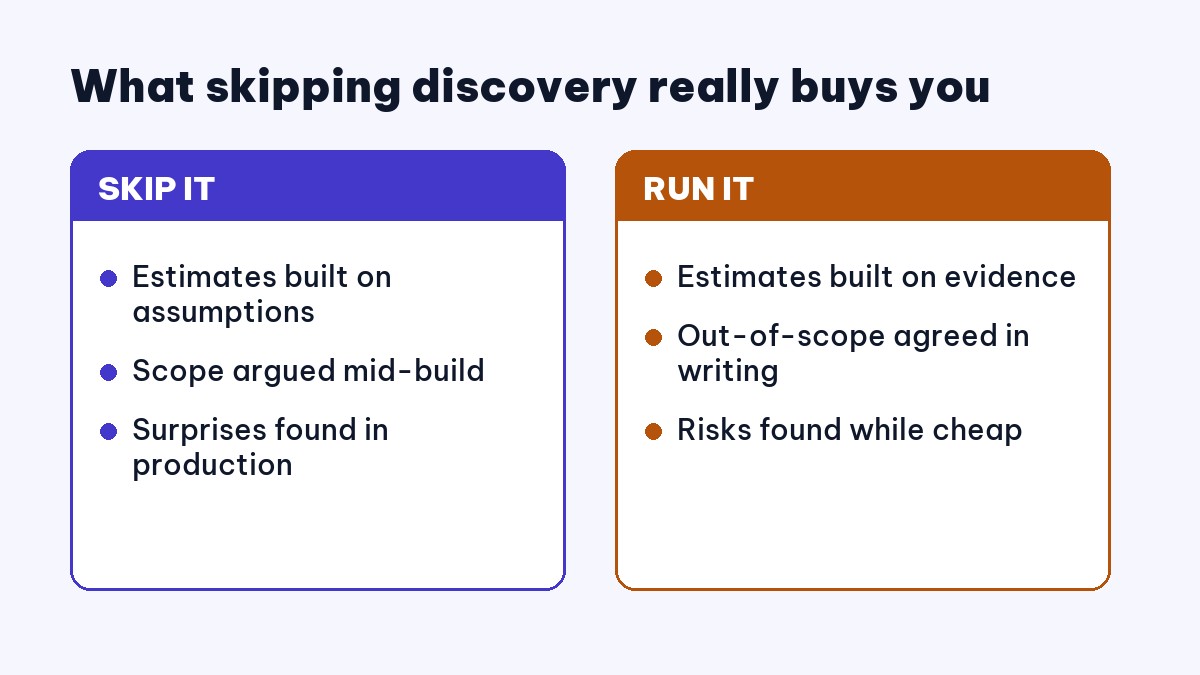
- Skipping discovery does not remove the questions; it moves them into development, where every answer costs more.
Table of contents
- What a Software Discovery Phase Actually Produces
- Why Requirements Fail Before Code Starts
- Software Discovery Phase Deliverables Worth Paying For
- How Long a Software Discovery Phase Should Take
- Who Needs to Be in the Room
- Running a Software Discovery Phase With a Vendor
- Warning Signs of a Weak Discovery
- When It Is Reasonable to Skip
- Turning a Software Discovery Phase Into a Signed Scope
- FAQ
What a Software Discovery Phase Actually Produces
The point of discovery is not documentation for its own sake. It is to answer the questions that would otherwise be answered expensively during the build: who the product is for, what the first release must do and what it must not, which technical decisions are hard to reverse, and where the real risks sit.
A good software discovery phase ends when those answers are written down clearly enough that two different teams would estimate roughly the same thing. If two competent vendors reading your discovery output would build very different products, the discovery is not finished.
Why Requirements Fail Before Code Starts
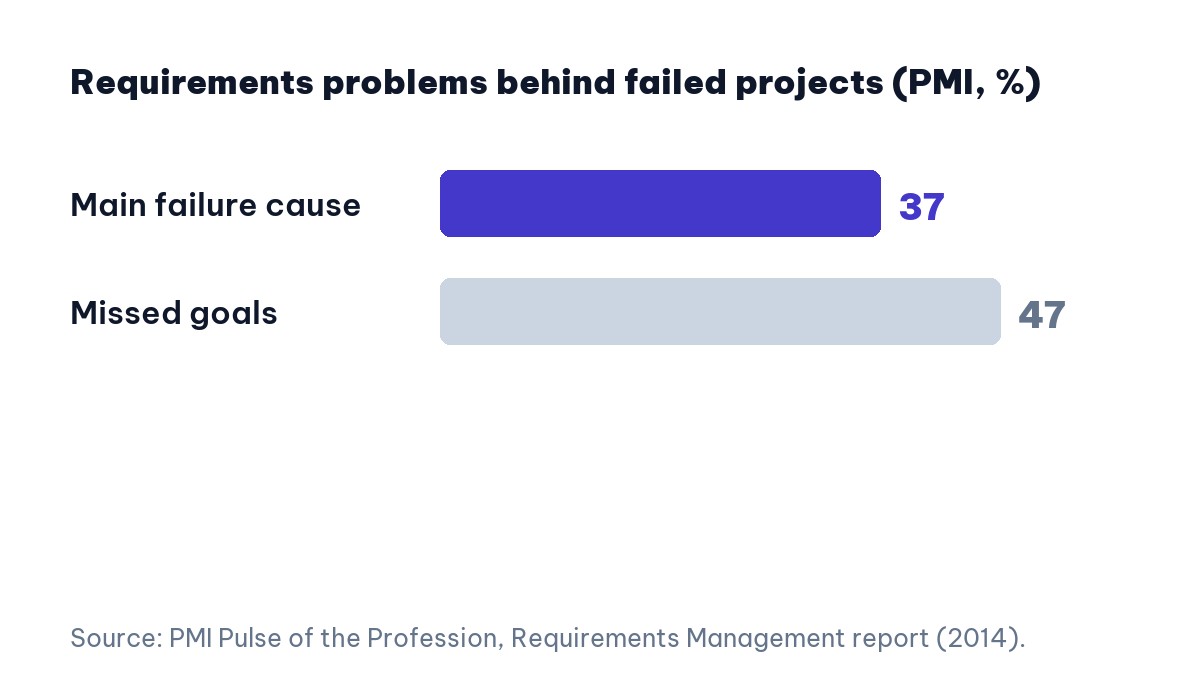
Most project failures are decided long before anyone writes code. PMI’s Pulse of the Profession research on requirements management found that 37% of organisations cite inaccurate requirements gathering as the primary cause of project failure, and that 47% of unsuccessful projects missed their goals because of poor requirements management.
The mechanism is simple. A requirement such as “users can export reports” sounds complete until someone asks which formats, how many rows, filtered by what, visible to whom. Each unanswered question becomes a decision made later by someone with less context – usually a developer under deadline, choosing the interpretation that is fastest to build.
Software Discovery Phase Deliverables Worth Paying For
Five outputs justify the cost. A prioritised scope for the first release, including an explicit list of what is out of scope. User flows for the journeys that generate value, not every screen. The architecture decisions that are expensive to change later – data model, integrations, hosting, authentication. A risk register naming the unknowns and how each will be resolved. And an estimate with its assumptions written beside it.
Clickable prototypes are useful when the risk is usability or stakeholder alignment. They are rarely worth building when the real risk is an integration nobody has tested. Match the deliverable to the uncertainty rather than to a template.
How Long a Software Discovery Phase Should Take
Length should follow uncertainty, not ambition. A familiar product type built by a team that knows the domain needs little discovery. A new domain, an unproven integration or a regulated environment needs more, regardless of how small the first release is.
For most first releases, a software discovery phase is measured in weeks rather than months. If discovery keeps extending, that is information in itself: either the problem is not yet well enough understood to build, or the process has turned into a way of postponing a decision nobody wants to make.
Who Needs to Be in the Room
Discovery fails when the people who decide are absent. On the client side you need someone who can say yes or no to scope, someone who understands the users or customers, and whoever owns the systems the product must integrate with. On the delivery side you need the engineers and designer who will build it, not only a salesperson or account manager.
That last point matters. When the people who estimate are not the people who build, the estimate becomes a promise nobody on the delivery team made, and it tends to be treated that way.
Time commitment matters as much as attendance. Discovery sessions compete with everyone’s normal work, and a decision-maker who joins for ten minutes and leaves will still shape the product – just later, and more expensively, through change requests. Block the time in calendars before the phase starts, as you would for any other critical milestone.
Running a Software Discovery Phase With a Vendor
Having the eventual delivery team run discovery transfers knowledge far better than handing a specification from one firm to another. The condition is ownership: every deliverable should be yours, written plainly enough that any competent team could pick it up.
That condition turns discovery into something useful beyond the documents – a low-risk trial of the working relationship. You learn how the team asks questions, whether they push back on weak requirements, and whether their written communication is clear, all before committing to a long engagement. At Tinasoft, a free technical consultation comes before anything is signed, and a paid pilot of a few weeks is available for teams that want to see the working rhythm before a longer commitment.
Warning Signs of a Weak Discovery
Four signs suggest the phase is producing comfort rather than clarity. The scope list has no out-of-scope section. Every risk is marked low. The estimate arrives without assumptions attached. And nobody on the delivery side has disagreed with anything you said.
That last sign is the most telling. Discovery that uncovers no disagreement has almost certainly not looked hard enough, because real products always contain trade-offs someone has to argue about.
A short review at the midpoint helps as well. Ask the team what has changed in their understanding since the start. If the answer is nothing, either the brief was unusually complete or nobody has challenged it yet.
When It Is Reasonable to Skip
Discovery is not mandatory for everything. A small, well-understood change to an existing system, a domain the team has built many times, or a deliberately throwaway prototype can reasonably go straight to building – especially when being wrong is cheap to fix. Be honest about which situation you are in: teams tend to rate their own domain knowledge higher than it proves to be once real edge cases appear.
The honest test is the cost of being wrong. If a misunderstanding would cost a few days, skip discovery and iterate. If it would cost a rebuild, a missed launch or a failed audit, the weeks spent on discovery are the cheapest insurance in the project. For early products, our MVP development guide covers how to keep that first scope deliberately small.
Turning a Software Discovery Phase Into a Signed Scope
The final step is contractual. A software discovery phase that ends in a slide deck has not finished its job; it should end in a scope that can be priced, with the assumptions and exclusions carried directly into the agreement.
This is where the choice of commercial model becomes clearer. Well-defined, stable scope can support a fixed price; scope that is still expected to move fits time and materials better. Our comparison of fixed price and time and materials explains that trade-off, and the software outsourcing contract guide covers how to write the exclusions so they hold up later.
FAQ: Software Discovery Phase
What is a software discovery phase?
A short, paid stage before development that turns assumptions into a prioritised scope, architecture decisions, a risk list and an evidence-based estimate.
Why does it matter?
PMI found 37% of organisations cite inaccurate requirements as the primary cause of project failure. Discovery is where those requirements get fixed.
How long should it take?
As long as it takes to remove the biggest uncertainties. For most first releases, weeks rather than months.
Can I skip it?
When scope is small, the domain familiar and mistakes cheap. Not when being wrong means a rebuild or a missed launch.
Should the building vendor run discovery?
It often works best, provided the deliverables belong to you and any team could use them.
A software discovery phase does not delay a project; it relocates the hard questions to the point where answering them is cheapest. Treat its output as the foundation of the contract, not as paperwork before the real work begins. See our transparent 2026 rate card →