

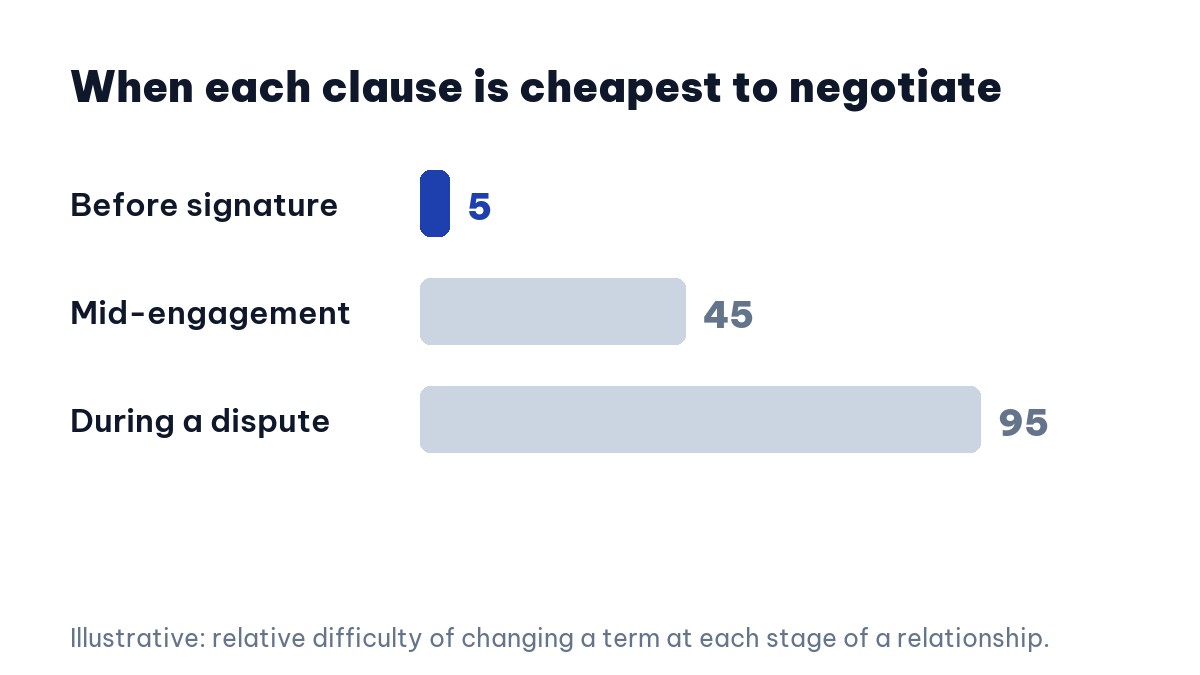
A software outsourcing contract is not read while things are going well. It is read at the worst moment of the relationship – a missed deadline, a disputed invoice, an early exit – and by then every term is fixed. The eleven clauses below are the ones that decide how that moment goes, and each of them costs almost nothing to negotiate before signature.
Key takeaways
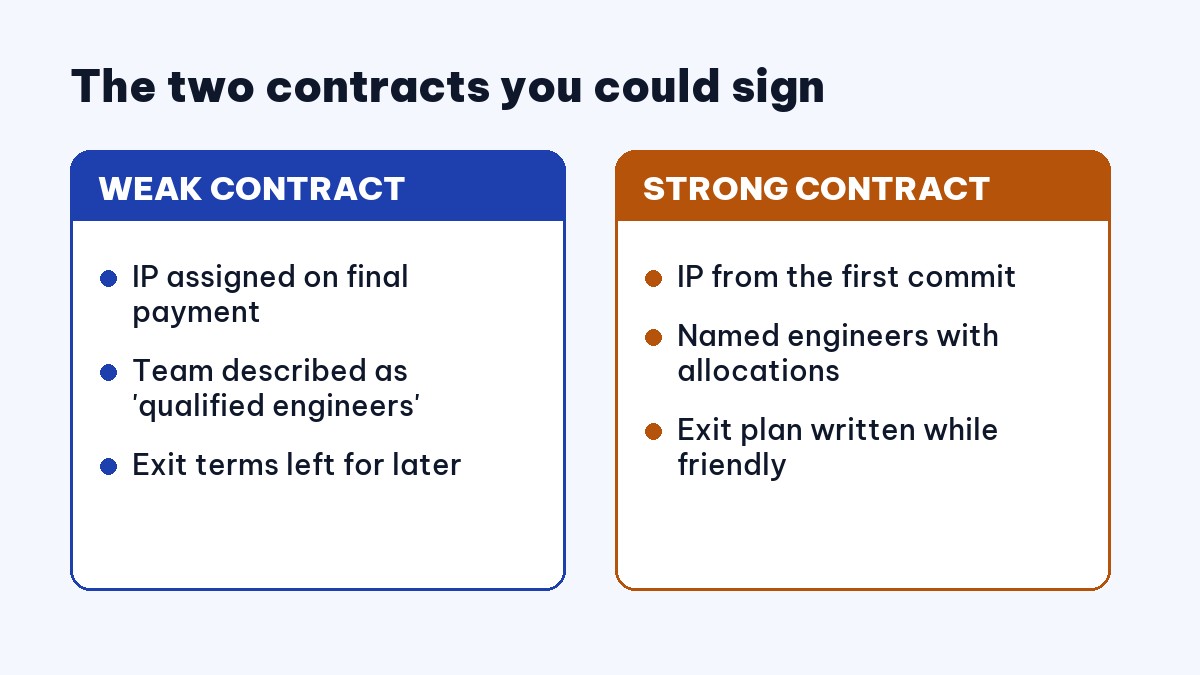
- IP timing is the single most consequential term: own the code from the first commit, not on final payment.
- “Qualified engineers” is not a team. Name people with allocation percentages or the word “dedicated” means nothing.
- Acceptance criteria turn “done” from an opinion into a test.
- Write the exit plan while everyone is still friendly – it is the only time it gets written fairly.
- Every clause in a software outsourcing contract is cheap before signature and expensive during a dispute.
Table of contents
- 1. Software Outsourcing Contract Scope and Exclusions
- 2. IP Ownership: The Software Outsourcing Contract Trap
- 3. Named Engineers, Not “Qualified Resources”
- 4. Acceptance Criteria in a Software Outsourcing Contract
- 5. The Change Process
- 6. Confidentiality and Data Protection
- 7. Warranty and Post-Launch Support
- 8. Liability in a Software Outsourcing Contract
- 9. Payment Milestones
- 10-11. Ending a Software Outsourcing Contract Cleanly
- FAQ
1. Software Outsourcing Contract Scope and Exclusions
Most disputes trace back to a sentence both sides read differently. The remedy is a scope section that lists exclusions as explicitly as inclusions – the features not in this phase, the platforms not supported, the integrations not included, the volumes not tested for.
A practical way in: write the exclusion list first, before the inclusion list. It forces both sides to say out loud what they were each quietly assuming, and it takes an afternoon rather than a negotiation round.
Exclusions feel adversarial to write and prevent almost every argument that follows. A vendor who resists writing them down is telling you they intend to resolve ambiguity later, when the resolution favours whoever is billing.
2. IP Ownership: The Software Outsourcing Contract Trap
Read your draft carefully for when intellectual property transfers. A very common formulation assigns it on final payment – which means that until the last invoice clears, the code may not be yours.
If the engagement ends at month seven of twelve, that clause decides who holds the leverage. Negotiate assignment from the first commit, host the repository under your own organisation, and require written confirmation of the licences covering any third-party or open-source components. Our IP protection guide works through the detail.
3. Named Engineers, Not “Qualified Resources”
A software outsourcing contract that promises “qualified engineers” promises nothing measurable. Some vendors quietly share engineers across clients, which reintroduces exactly the context-switching that a dedicated arrangement exists to remove.
This clause is also what makes every other quality commitment enforceable. Acceptance criteria and warranties assume a stable team; without named people, the vendor can satisfy the letter of the contract with an entirely different set of engineers each quarter.
Name the individuals and their allocation percentages, and add a clause requiring notice and approval before substitution. The reaction to this request is diagnostic: vendors confident in their retention agree quickly, while those planning to staff you from whoever is free will explain why naming people is impractical.
4. Acceptance Criteria in a Software Outsourcing Contract
Without acceptance criteria, “done” is an opinion – and the moment it matters most is the moment both sides have the strongest incentive to hold different ones.
The most common gap is silence on review time. If the contract does not say how long you have to test a deliverable, a vendor can reasonably treat acceptance as automatic – and often the draft says exactly that in a sentence nobody read.
Define what a deliverable must do to be accepted, how it will be demonstrated, how long you have to review, and what happens when something fails. Objective criteria protect the vendor as much as the buyer; they turn a subjective argument into a repeatable test.
5. The Change Process
Requirements will change. A contract that pretends otherwise simply pushes the conversation into email, where it becomes unattributable.
Define who may request changes, who approves them, how they are priced, and what happens to the schedule. The purpose is not to discourage change – it is to make each change a visible decision with a price attached rather than a silent absorption that surfaces later as slippage.
6. Confidentiality and Data Protection
Confidentiality clauses are usually present and usually generic. The valuable additions are specific: whether production data may ever be copied into development environments, who may hold production credentials, how access is logged and revoked, and what the breach notification timeline is in hours.
If personal data is involved, the applicable regime – GDPR or its equivalents – has to be named along with the transfer mechanism. Our security guide lists the questions to resolve before signature.
7. Warranty and Post-Launch Support
What happens when a defect appears three weeks after launch? A warranty period – commonly 30 to 90 days – covering defects against the agreed specification at no additional cost is standard, and its absence is a negotiating point.
Separate warranty from support explicitly. Warranty covers what was built incorrectly; support covers keeping a correct system running. Conflating them produces arguments in which both parties are technically right.
8. Liability in a Software Outsourcing Contract
Most vendors cap liability at fees paid, which is normal and usually reasonable. What matters is what sits outside the cap: breaches of confidentiality, data protection failures and IP infringement typically should not be capped at the value of a few invoices.
Insurance is the other half of this conversation. Ask what professional indemnity and cyber cover the vendor carries, and at what limits. A cap that exceeds their insurance is a number on paper rather than a recoverable amount.
Match the cap to actual exposure. If a failure in your product could cost customers real money, a cap equal to one month of fees is not a commercial position – it is an unpriced risk you have agreed to carry.
9. Payment Milestones
Tie payments to demonstrated outcomes rather than to elapsed calendar time. Milestones linked to accepted deliverables keep both sides aligned; milestones linked to dates reward the passage of time regardless of progress.
For monthly team engagements the equivalent discipline is a checkpoint: a scheduled decision point at which continuing is an active choice. That structure is what stops inertia from becoming a procurement strategy.
10-11. Ending a Software Outsourcing Contract Cleanly
Termination should be symmetrical – commonly 30 days’ notice either way – with defined grounds for immediate termination on material breach. But notice period is the smaller half of the clause.
The exit plan is the larger half and the one most often omitted: current source code delivered, documentation current, credentials and infrastructure transferred, and a knowledge transfer period with named people. Write it at signature, because it is the only moment both parties have an equal interest in it being fair.
Handover obligations should also name a format. “Documentation” satisfied by a folder of outdated diagrams is technically compliance and practically useless; specify that a new team must be able to build, deploy and roll back using only what is delivered.
A useful test for any software outsourcing contract: if this vendor disappeared on Friday, could another team deploy on Monday using only what the contract entitles you to? If the answer is no, the gap is your real exposure, and our risk guide covers how it accumulates.
FAQ: Software Outsourcing Contract
What should the contract include?
Scope with exclusions, IP from the first commit, named engineers, acceptance criteria, change process, data protection, warranty, liability, milestones, termination and an exit plan.
When does IP transfer?
Negotiate from the first commit. Assignment on final payment leaves you exposed if the engagement ends early.
How are scope changes handled?
A written process with named approvers, pricing before work starts, and an explicit schedule impact.
What is a fair termination clause?
Symmetrical notice plus defined handover obligations: code, documentation, credentials and knowledge transfer.
Are acceptance criteria necessary?
Yes – they turn “done” from an opinion into a test, which protects both sides equally.
None of this requires distrust. A good software outsourcing contract simply writes down what both parties already intend, at the only moment when writing it down is cheap. See our transparent 2026 rate card →