

Offshore development rates vary by a factor of seven across common destinations, and almost every buyer reads the resulting table wrong. The number on a rate card is the least informative figure in a vendor comparison. What matters is what the premium buys – overlap hours, seniority depth, stability – and whether you actually need it.
Key takeaways
- 2026 senior midpoints: US $150-250, Singapore agencies S$175-240, Australia ~$110, Poland $55-100, Vietnam $30-40, India $25-45, Philippines $20-32.
- Agency rates always sit above the contractor rates most published tables quote.
- Offshore development rates track local salary competition, not engineering difficulty.
- Cheaper does not mean weaker: variation between firms inside a country exceeds variation between countries.
- Timezone overlap decides more engagements than price does.
Table of contents
- Offshore Development Rates by Country in 2026
- Why Offshore Development Rates Differ So Much
- How to Read Offshore Development Rates Honestly
- Southeast Asia: Vietnam and the Philippines
- India: Scale and Its Trade-offs
- Eastern Europe and the EU Premium
- Latin America for US Buyers
- Do Lower Offshore Development Rates Mean Lower Quality?
- Choosing on More Than Offshore Development Rates
- FAQ
Offshore Development Rates by Country in 2026
Senior developer benchmarks, drawn from 2026 published rate guides and vendor rate cards. United States: $150-250 and above. Singapore: S$175-240 at specialist agency level. Australia: around $110, with agencies quoting higher. Poland: $55-100, with market medians nearer $37-50.
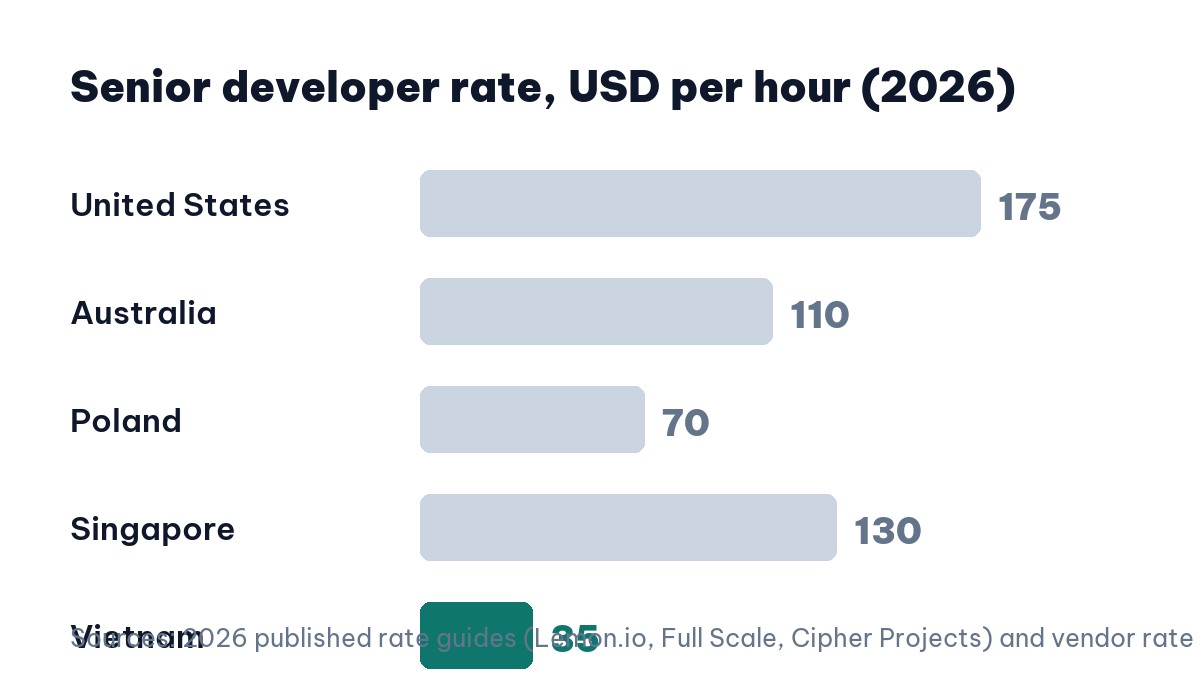
Vietnam: $30-40. India: $25-45, spanning a very wide quality band. Philippines: $20-32, the lowest of the common destinations. Latin America generally sits between Eastern Europe and Asia.
The spread within a single country deserves emphasis. In most markets the difference between the cheapest and most expensive credible vendor is two to three times – larger than the gap between neighbouring countries on this list. A shortlist built from a map rather than from vendors is a shortlist built on the wrong axis.
Read these as midpoints, not quotes. Every market has firms above and below its band, and the spread inside a country is frequently wider than the gap to the next country.
Why Offshore Development Rates Differ So Much
Rates track what it costs to retain an engineer against local alternatives. In Poland, that means competing with German and Nordic employers hiring remotely, which sets a high floor. In the US, it means competing with big tech.
Rates also move over time, and not uniformly. Markets that become popular see salaries rise as global employers arrive, which is why a country that looked inexpensive three years ago may not be today – and why a rate table is a snapshot rather than a strategy.
Currency, cost of living and the depth of the senior bench do the rest. None of these factors say anything about how well a given team builds software – a point worth holding onto when a table makes one country look like a bargain and another like a rip-off.
How to Read Offshore Development Rates Honestly
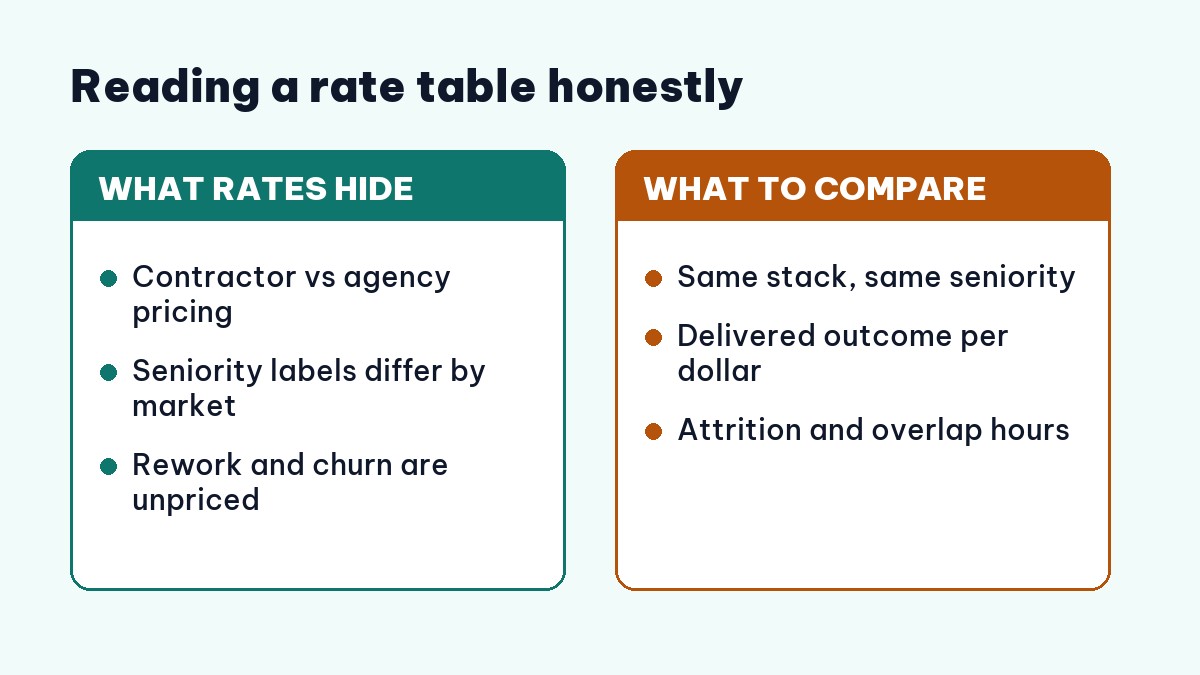
Three corrections make published offshore development rates comparable. First, check whether the figure is contractor or agency. Agency rates include management, QA, bench cover and benefits, and they sit meaningfully higher everywhere.
Second, check what “senior” means locally. Titles inflate at different speeds in different markets, and a “senior” with four years in one country is not the same hire as a “senior” with ten in another.
Third, check specialisation. A scarce stack commands a premium over a market’s senior baseline; a commodity stack sits below it. Comparing a Python senior in one country against a WordPress senior in another produces a number that means nothing.
Southeast Asia: Vietnam and the Philippines
Vietnam sits at $30-40 for senior engineers, with an industry that grew around product and export software development. Its structural advantages are timezone – full overlap with Singapore, five to six live hours with Australia – and lower attrition, commonly 10-15% at well-run firms against 20-30% in larger markets.
Vietnam also benefits from an industry structure oriented toward export software work rather than domestic services, which concentrates senior experience in the kind of product engineering foreign buyers are usually purchasing.
The Philippines is cheaper at $20-32 and leads the region on spoken English, with a 1.3 million-strong IT-BPM sector. Its depth is strongest in customer-facing and service-heavy roles rather than in complex product engineering, a distinction we work through in our Vietnam versus Philippines comparison.
India: Scale and Its Trade-offs
India offers the deepest talent pool on earth and the widest quality range, with senior rates from $25 to $45 depending enormously on the firm. Both the best and the weakest vendors you will ever meet operate in the same market.
Scale is a real advantage where it applies: for a programme that needs forty engineers next quarter, few markets can staff it at all, and India can. For a squad of five, that advantage is irrelevant and the selection problem dominates.
That range makes diligence non-negotiable rather than optional. The trade-offs to price are attrition, which runs higher in saturated hubs, and timezone, which works well for European buyers and requires structured handoffs for the US – covered in our Vietnam versus India comparison.
Eastern Europe and the EU Premium
Poland is the most expensive Eastern European destination at $55-100 for senior specialists, and it is also among the strongest. EU membership, GDPR alignment by default and same-day travel from Western Europe are structural advantages nothing outside the bloc can price-match.
For EU-facing companies with data residency obligations, that premium removes an entire category of legal work. For an Australian or Singaporean buyer it buys almost nothing, since the timezone overlap is close to zero, as our Vietnam versus Poland comparison sets out.
Latin America for US Buyers
Latin American rates sit between Eastern Europe and Asia, and the argument is almost entirely timezone: same-day working hours with the US, no overnight handoff, and short flights for the occasional in-person session.
For a US buyer who values live collaboration over cost, that is a coherent trade. For one whose work is well specified and suits an overnight cycle, Asian offshore development rates deliver more engineering per dollar.
Do Lower Offshore Development Rates Mean Lower Quality?
No, and this is the most persistent misreading of any rate table. Rate reflects local salary competition. Quality reflects hiring standards, engineering culture and retention – none of which correlate neatly with geography.
The practical consequence: destination choice is the smaller decision and vendor choice is the larger one. Run identical diligence everywhere – named engineers, your repository, sprint demos, a paid pilot – as set out in our outsourcing risk guide.
Choosing on More Than Offshore Development Rates
Three variables usually outrank price. Overlap hours: if you need four live hours daily, geography decides before the rate card does. Attrition: a cheaper team that turns over annually costs more than a slightly pricier stable one, because you pay for context twice.
Contract terms belong on this list too. A slightly higher rate with code ownership from the first commit and named engineers is a better commercial position than a lower rate with neither, and that difference never appears in a rate comparison.
And domain depth: paying 20% more for a team that has built your kind of system before is almost always cheaper than paying less to fund someone’s learning curve on your budget.
A final practical exercise, worth an hour before any shortlist is drawn. Write down the four constraints that are genuinely fixed for your team: the minimum live overlap you need each day, the data-residency obligations you actually carry, the domain experience the work requires, and the budget ceiling that is real rather than aspirational.
Most of the time, two of those four eliminate more than half the map before price enters the conversation at all – which is the correct order to make the decision in.
FAQ: Offshore Development Rates by Country
What are the 2026 rates?
Senior midpoints: US $150-250, Singapore S$175-240, Australia ~$110, Poland $55-100, Vietnam $30-40, India $25-45, Philippines $20-32.
Which country offers best value?
It depends on timezone and domain. Vietnam and India lead on cost per senior engineer; Poland for EU work; the Philippines for English-heavy service roles.
Why do rates differ?
Local salary competition, currency, cost of living and senior bench depth – not the difficulty of the work.
Is cheaper lower quality?
No. Variation between firms inside a country exceeds variation between countries.
How do I compare quotes?
Same seniority, same stack, contractor versus agency clarified, plus overlap hours and attrition.
Use offshore development rates to narrow a shortlist, never to make the decision. The rate tells you what an hour costs; it tells you nothing about how many hours the work will take. See our transparent 2026 rate card →