

Switching software vendors mid-project is one of the most expensive decisions a product team makes, and one of the most often delayed. By the time most companies act, the relationship has been failing quietly for months. This guide covers when switching software vendors is the right call, what to secure before anyone is told, and how to hand over a system without losing the knowledge you already paid for.
Key takeaways
- Only around 31% of software projects finish fully successfully (Standish CHAOS) – a struggling engagement is common, and staying in one out of sunk cost is the avoidable part.
- The largest cost of switching software vendors is lost context, not the new vendor’s rate.
- Secure the repository, infrastructure, credentials, documentation and data access before announcing the change.
- Research on vendor switching finds transitions depend heavily on knowledge transfer and on the outgoing vendor’s willingness to train its replacement – so pay for the overlap.
- Write the exit clauses into the next contract, so any future switch is routine rather than a rescue.
Table of contents
- Switching Software Vendors: When It Is the Right Call
- The Signals That Come Before a Switch
- What Switching Software Vendors Actually Costs
- Secure Five Assets Before You Announce Anything
- Knowledge Transfer When Switching Software Vendors
- Run the Outgoing and Incoming Teams in Parallel
- The First 30 Days With the New Vendor
- Switching Software Vendors Without Repeating the Mistake
- Contract Clauses That Make Switching Software Vendors Easier
- FAQ
Switching Software Vendors: When It Is the Right Call
Not every bad month justifies a switch. Deadlines slip on healthy projects too, and a vendor who raises a problem early is often a better partner than one who never raises any. The real question is whether the problem can be fixed inside the current relationship.
Three patterns suggest it cannot. The same issue has been raised three times and met with the same promise each time. Senior engineers have been replaced by juniors without anyone discussing it with you. And demonstrations of working software have been replaced by status reports and percentages.
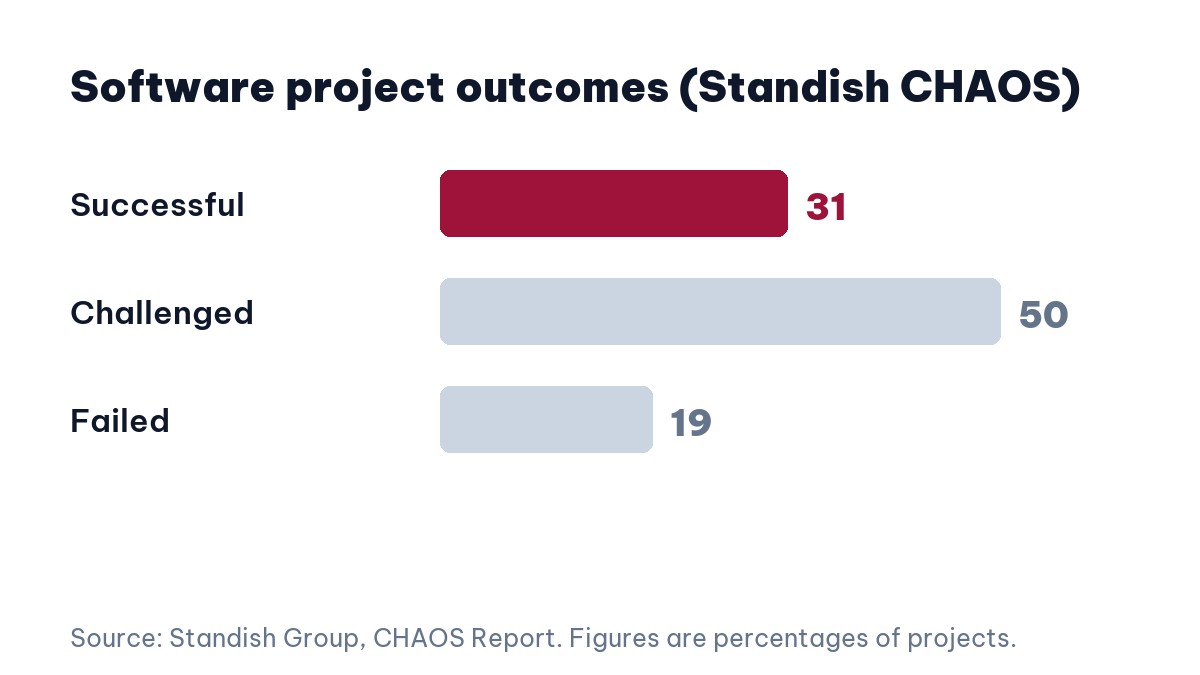
For perspective, the Standish Group’s CHAOS research finds that only around 31% of software projects finish fully successfully, roughly half are challenged, and about one in five fail. Difficult engagements are ordinary. If one of the three patterns is recent, raise it directly with a date attached. If all three have persisted for a quarter, you are no longer managing a vendor – you are subsidising one.
The Signals That Come Before a Switch
Relationships rarely fail loudly. The early signals are textural: estimates that stop changing even as scope grows, questions answered with reassurance rather than specifics, unfamiliar names appearing in the commit history, and demos postponed “until the next sprint” more than once.
Any one of these is worth a conversation the same week. Several together are the leading edge of a failure that has not yet been admitted – and, importantly, the best moment to start preparing quietly, while the outgoing team is still cooperative and nobody is negotiating an exit.
What Switching Software Vendors Actually Costs
The new vendor’s invoice is the smallest part of the bill. The larger costs are the weeks the incoming team spends learning a system it did not build, the features re-implemented because nobody can explain why the original works the way it does, and the dip in delivery while two teams overlap.
That is why rates matter less than context during a transition. A vendor that is noticeably cheaper per hour but needs months to understand the codebase is not cheaper in the first year. Treat the handover as a project in its own right, with milestones, an owner and a budget, rather than as an administrative step squeezed between feature releases.
Secure Five Assets Before You Announce Anything
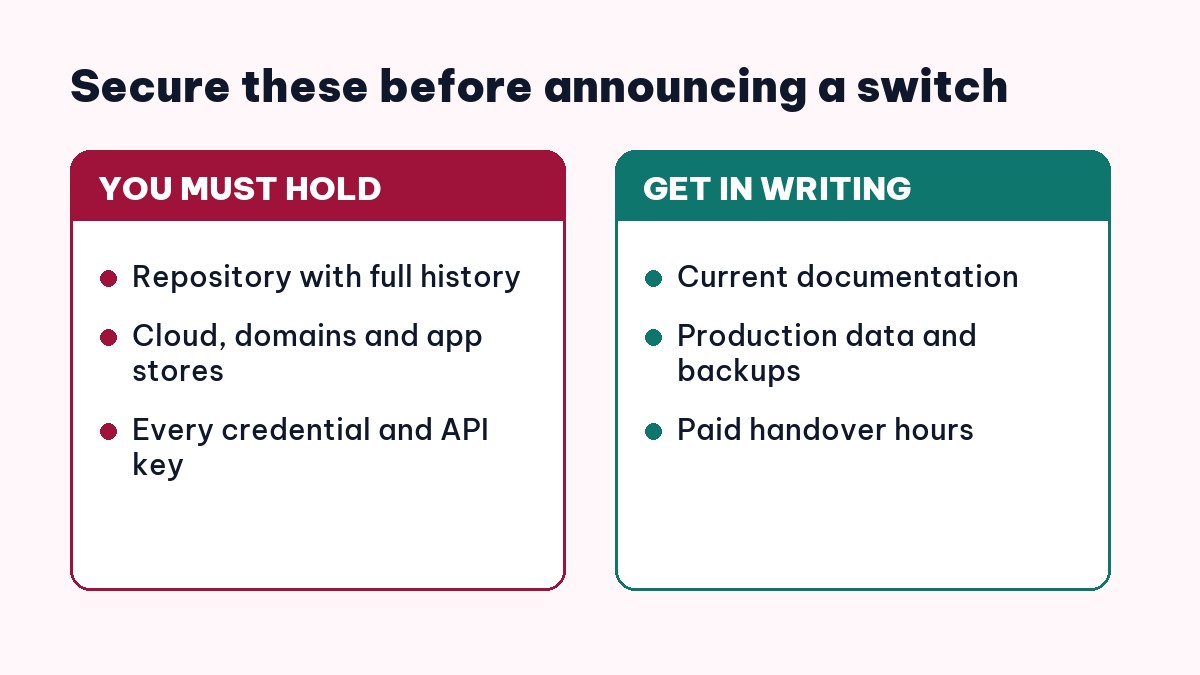
Before the outgoing vendor learns a change is coming, confirm you hold five things. Repository access under your own organisation, including full history. Infrastructure accounts – cloud, domains, app store listings, email sending services – registered in your name. Every credential and API key, with a plan to rotate them. The current documentation, however thin it is. And direct access to production data and its backups.
This is not an accusation. Most vendors behave professionally at the end of a contract. But a transition is the moment your leverage is lowest, and the academic literature on vendor switching names opportunistic behaviour by the outgoing vendor as a recognised risk. Securing access first means you never have to find out which kind of vendor you had.
Knowledge Transfer When Switching Software Vendors
Code transfers in an afternoon. Knowledge does not. The incoming team needs the reasons behind decisions: why a payment job retries the way it does, which customer depends on a legacy export nobody else uses, what was tried and abandoned months ago and why.
A peer-reviewed multi-case study of vendor switching, built on 22 interviews with 27 people across three projects, found that the success of these transitions depends heavily on knowledge transfer and on the outgoing vendor’s willingness to train its own replacement. Plan for both. Pay for structured handover sessions, record them, and ask the incoming team to write back what they understood so gaps surface while someone can still fill them.
Run the Outgoing and Incoming Teams in Parallel
The cleanest handovers overlap. For a short period both teams work on the same system: the outgoing engineers explain, the incoming engineers do the typing. Questions are answered by the people who actually know, while they still have a reason to answer.
Pay the outgoing vendor explicitly for that overlap and define what it includes. Asking a departing team to train its replacement for free is how you end up with a single video call and a folder of outdated diagrams. The overlap cost is small next to the cost of rediscovering the system by trial and error.
The First 30 Days With the New Vendor
Resist the urge to demand new features in the first month. The incoming team’s first job is to make the system safe to change: build it from scratch, reproduce a deployment, map what is tested and what is not, and list every risk they find.
Ask for that list in writing by the end of the second week. A vendor that reports no risks in an inherited codebase has either not looked closely or is telling you what you want to hear. Our guide to technical debt in software outsourcing describes what that first audit should cover.
Switching Software Vendors Without Repeating the Mistake
The uncomfortable question is why the last engagement failed. If the honest answer includes unclear scope, progress nobody could see, or a contract that rewarded hours rather than outcomes, the new vendor will inherit exactly the same conditions and produce a similar result.
So change the operating model, not only the name on the invoice: named engineers with allocation percentages, sprint demos of working software, milestone checkpoints and a paid pilot before any long commitment. The full set of controls is in our guide to software outsourcing risks.
Team stability matters more here than anywhere. A replacement vendor that rotates engineers recreates the knowledge loss you are trying to escape. At Tinasoft, employee retention above 90% across a team of more than 300 people is what we point to when a company comes to us mid-project – stable people are what make inherited context stick.
Contract Clauses That Make Switching Software Vendors Easier
Write the exit while everyone is still on good terms, because that is the only time it gets written fairly. Four clauses carry most of the protection: code and repository ownership from the first commit; a defined handover obligation with paid hours, triggered on termination; documentation maintained as a deliverable rather than a courtesy; and infrastructure held in your own accounts from day one.
None of this signals an expectation of failure. It makes the relationship easier to trust, because both sides know a clean exit exists. The wider contract structure is covered in our software outsourcing contract guide.
FAQ: Switching Software Vendors
When should you switch vendors mid-project?
When repeated issues go unresolved, senior engineers are swapped out without discussion, and demos give way to status reports – all persisting for about a quarter.
What is the biggest cost of switching?
Lost context. The new team must learn a system it did not build, and unexplained parts tend to get rebuilt.
What should I secure first?
Repository with full history, infrastructure accounts, credentials, documentation, and production data access.
How long should the teams overlap?
Long enough for the incoming team to deploy independently while the outgoing team can still answer questions – and paid.
How do I avoid the same failure again?
Change the operating model: named engineers, sprint demos, milestones, a paid pilot and exit clauses from day one.
Switching software vendors is survivable, and often the right decision, when it is prepared rather than improvised. Secure access first, pay for knowledge transfer, and fix the conditions that caused the last failure before the new team inherits them. See our transparent 2026 rate card →