

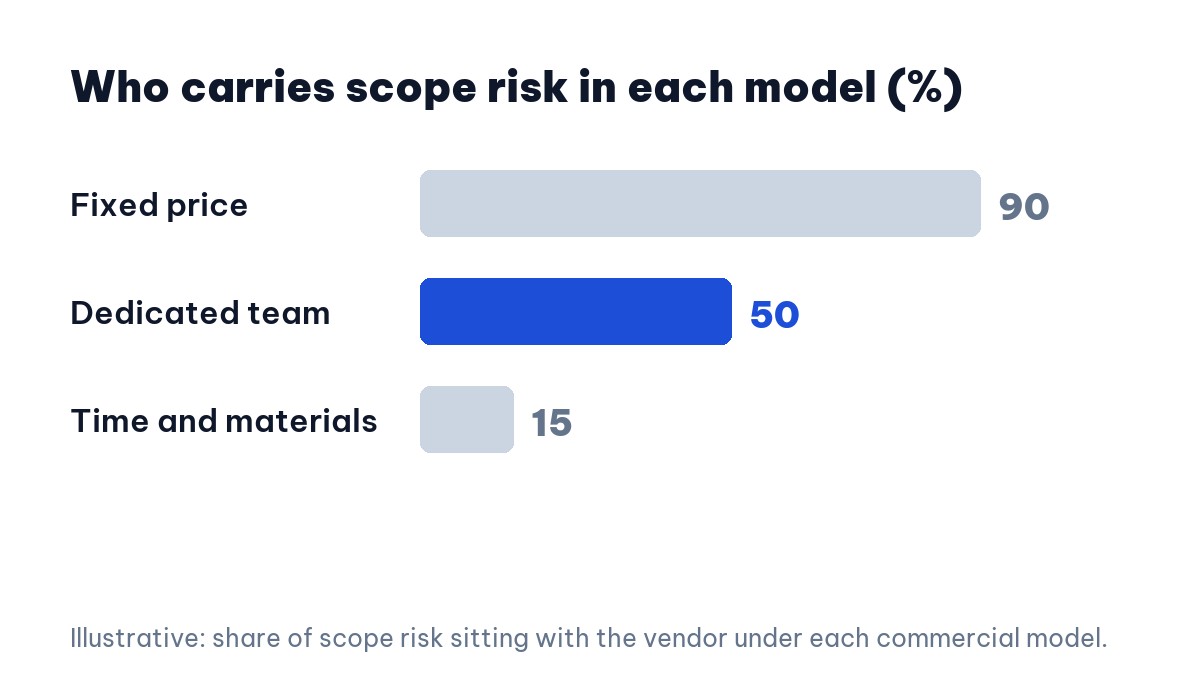
All software outsourcing pricing models answer one question: who carries the risk when reality differs from the plan? Fixed price puts it on the vendor and charges you for it. Time and materials puts it on you and charges less. A dedicated team splits it. Everything else is a variation, and choosing well means choosing which risk you would rather own.
Key takeaways
- Fixed price does not remove risk – it prices it into a buffer you never see and converts changes into negotiations.
- Time and materials is the most honest model and the least forgiving of weak management.
- A dedicated team retainer suits continuous product work with a roadmap beyond six months.
- No model is inherently cheapest; rework and team stability move total cost more than the model does.
- If you cannot write down what is out of scope, you are not ready for fixed price.
Table of contents
- The Three Software Outsourcing Pricing Models
- Fixed Price Among Software Outsourcing Pricing Models
- Time and Materials: Honest and Unforgiving
- The Dedicated Team Retainer
- Software Outsourcing Pricing Models and Risk Transfer
- Hybrid Structures That Work
- Which Software Outsourcing Pricing Models Cost Least?
- How to Choose Between Software Outsourcing Pricing Models
- Red Flags in Any Pricing Structure
- FAQ
The Three Software Outsourcing Pricing Models
Fixed price: the vendor commits to a defined scope for a defined fee. Time and materials: you pay for hours worked at agreed rates. Dedicated team: you pay a monthly retainer for a fixed group of named engineers working only on your product.
It is worth noticing what none of them determine: the quality of the engineers, the clarity of your requirements, or whether anyone will demonstrate working software each sprint. Those are set elsewhere, and they matter more than the commercial wrapper around them.
Vendors dress these up with different names, but the underlying structure is always one of the three, and the differences that matter are about control and risk rather than about price.
Fixed Price Among Software Outsourcing Pricing Models
Fixed price buys budget certainty, which is genuinely valuable when a board has approved a number. What it costs is flexibility, and the cost is larger than most buyers expect.
To quote a fixed figure against uncertainty, a vendor must include a buffer. You never see its size, and if the project goes smoothly the buffer is simply margin. More consequentially, every change becomes a commercial event: the conversation shifts from “is this the right thing to build?” to “is this in scope?” – a question that has never improved a product.
There is a second-order effect worth naming. Under fixed price, a vendor who discovers a better approach halfway through has a financial reason not to raise it, because the change costs them time they have already sold. That incentive is invisible and it works against you every week.
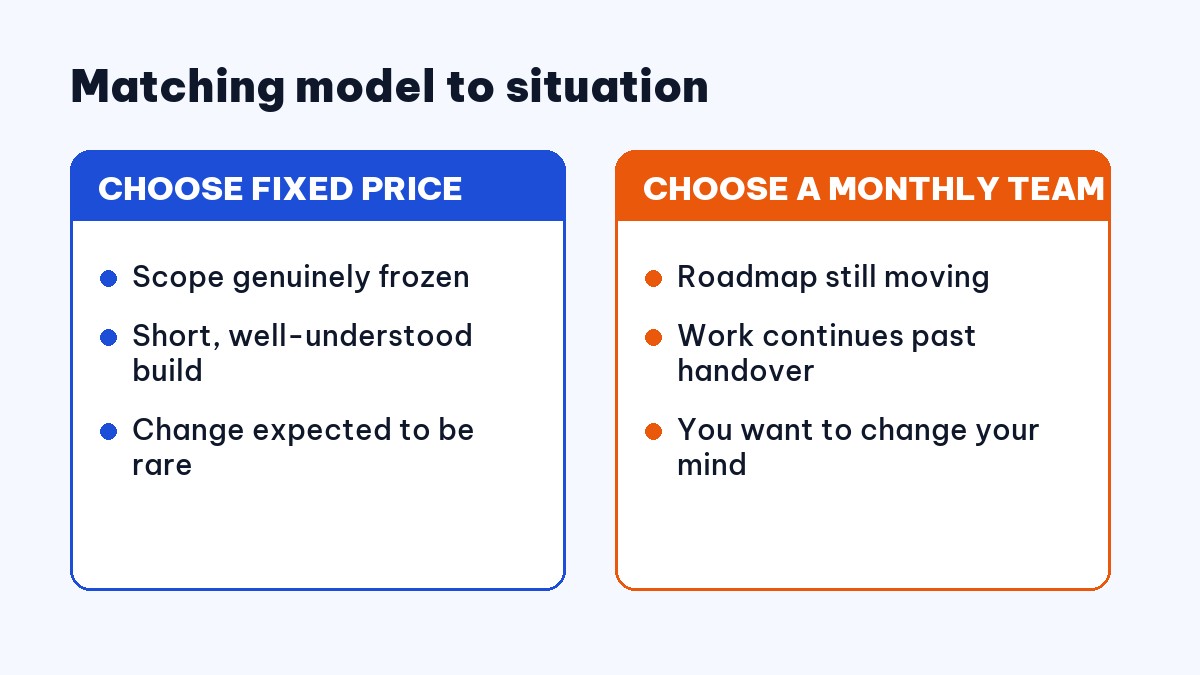
It fits genuinely frozen scope: a short, well-understood build, integrations already mapped, change expected to be rare. Regulatory work with a statutory deliverable is the clearest example.
Time and Materials: Honest and Unforgiving
Time and materials removes the buffer and the scope argument at once. You pay for what is done, you can change direction whenever you like, and nobody has to negotiate a change request to fix something obviously wrong.
It is also the easiest model to start quickly, which is why it suits discovery phases where the goal is to learn what should be built rather than to build it.
The trade is that nothing structural stops the meter. This model rewards buyers with real management capacity and punishes those without it, because there is no vendor-side accountability for whether the hours produce anything valuable. Add a not-to-exceed ceiling and a regular checkpoint and it becomes considerably safer without losing its advantages.
The Dedicated Team Retainer
A monthly fee for named engineers working only on your product. You own priorities; the vendor owns delivery discipline, HR and team stability. It is the model most product companies converge on, because it matches how product work actually behaves – continuously.
The retainer also changes the vendor relationship in a subtle way: because revenue continues only while you stay, the incentive is to keep you satisfied month after month rather than to reach a final invoice. That alignment is easy to underrate until you have experienced the alternative.
Its economic advantage is context. In project-shaped models you pay the onboarding tax each phase; in a retainer you pay it once and it compounds in your favour, as our guide to dedicated development teams explains in detail.
Software Outsourcing Pricing Models and Risk Transfer
Think of each model as a position on a single axis. At one end, the vendor carries scope risk and charges a premium for it. At the other, you carry it and pay less per hour. A retainer sits between: you carry scope risk, the vendor carries staffing and delivery-capability risk.
One caution: risk that has been transferred is not risk that has disappeared. A vendor who underpriced a fixed-scope build will manage that loss somehow – usually by staffing more juniors or by defending scope harder – and both outcomes land back on you.
The right position depends on which risk your organisation is better equipped to hold. Companies with strong engineering management usually prefer to own scope risk, because they trust their own process more than a contract. Companies without that bench are better served buying the outcome.
Hybrid Structures That Work
Two hybrids come up repeatedly and both are sensible. The first is a fixed-price discovery phase followed by a retainer for the build – you buy certainty where uncertainty is highest and flexibility where it is most useful.
The second is a retainer with a not-to-exceed ceiling per quarter, which gives finance a predictable number without converting every change into a negotiation. What does not work is a fixed price on a scope nobody has written down, which is simply an argument scheduled for later.
Which Software Outsourcing Pricing Models Cost Least?
None of them, reliably. The variables that actually move total cost are rework and team stability, and neither is determined by the commercial structure.
A fixed-price project delivered by a rotating cast will cost more than a slightly pricier retainer with the same five engineers for two years – because the second one stops paying for context that keeps evaporating. Compare total cost of a delivered outcome, not rate cards.
How to Choose Between Software Outsourcing Pricing Models
Three questions decide most cases. Can you write down what is out of scope? If not, fixed price will fail regardless of the vendor. Do you have management capacity to direct work weekly? If not, time and materials will disappoint you.
And how long will this work continue? Anything beyond six months of continuous development favours a retainer, because the value of accumulated context begins to exceed the value of commercial precision. Our guide to engagement models works through the adjacent question of who manages the work.
Red Flags in Any Pricing Structure
A fixed price quoted without a written scope. The number is a guess, and the argument is scheduled rather than avoided.
Rates quoted without seniority attached. “$35 per hour” means nothing until you know whether that is a senior engineer or a blended average across a team you have not met.
Payment tied to calendar dates rather than accepted deliverables. Time passes regardless of progress, and any structure that pays for the former will eventually get you less of the latter.
FAQ: Software Outsourcing Pricing Models
What are the main models?
Fixed price, time and materials, and dedicated team retainer. Everything else is a variation on these three.
Is fixed price lower risk?
It lowers budget risk and raises scope risk, with a hidden buffer priced in and changes turned into negotiations.
When does time and materials fit?
Exploratory work where you have real management capacity. Add a ceiling and checkpoints to make it safer.
What is a dedicated team retainer?
A monthly fee for named engineers on your product; you set priorities, the vendor owns delivery discipline.
Which is cheapest?
None inherently – rework and team stability move total cost far more than the commercial model does.
Pick the model that matches how much certainty you genuinely have, not the one that sounds safest in a board paper. That is the whole of what software outsourcing pricing models require. See our transparent 2026 rate card →