

AI development outsourcing has a peculiar cost profile: the impressive part is cheap and the boring part is expensive. Calling a model is nearly free. Knowing whether its answer is good, what to do when it is wrong, and what a thousand requests cost – that is where the budget goes, and it is the part most proposals leave out.
Key takeaways
- Vietnam rates in 2026: $25-40/hour general development, $45-65/hour for AI and ML specialists.
- Project bands run from under $20,000 for a prototype to $150,000-$400,000+ for enterprise AI platforms.
- A five-person dedicated team typically costs $15,000-$25,000 per month.
- Most AI development outsourcing failures are prototypes that never acquired an evaluation set, a fallback path, or a cost model.
- For business applications, use an existing model and spend the budget on data, evaluation and integration.
Table of contents
- AI Development Outsourcing Costs in 2026
- Why AI Specialists Cost More
- AI Development Outsourcing: The Prototype-to-Production Gap
- Evaluation Comes Before Optimisation
- AI Development Outsourcing and Unit Economics
- Build a Model or Use One?
- Your Data Is the Actual Asset
- How to Evaluate AI Development Outsourcing Vendors
- Mistakes in AI Development Outsourcing
- FAQ
AI Development Outsourcing Costs in 2026
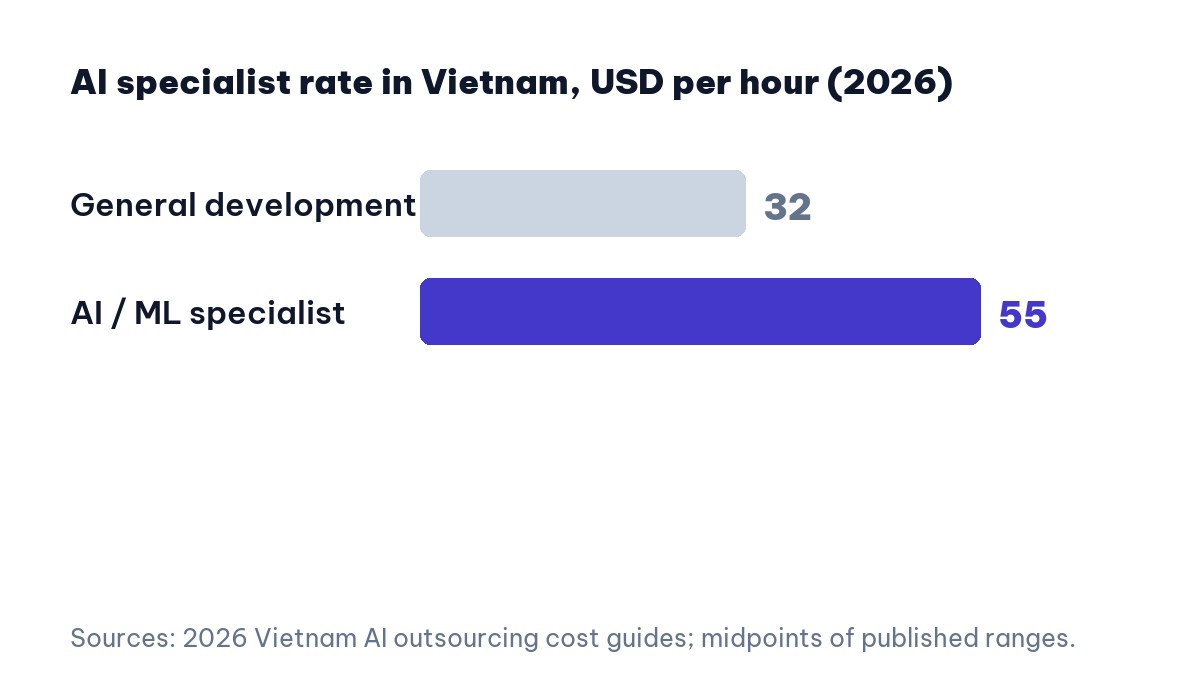
Vietnamese rates in 2026 put general development at $25-40 per hour, with AI and ML specialists at $45-65 and senior engineers reaching $70 in scarce specialisations. A five-person dedicated team lands between $15,000 and $25,000 per month depending on the seniority mix.
Project sizes vary more than rates. A prototype answering one question on one dataset can come in under $20,000. A production feature inside an existing product typically runs into the low six figures. Enterprise platforms with data pipelines, retraining, monitoring and governance sit at $150,000-$400,000 and above.
The wide range is not vagueness. It reflects whether the deliverable is a demonstration or a system that keeps working when nobody is watching it.
Why AI Specialists Cost More
The premium over general development is roughly 40-60%, and it is driven by scope as much as scarcity. Production AI work spans data engineering, evaluation design, model serving, latency and cost control, monitoring for drift, and the fallback behaviour when a prediction is wrong.
There is also a hiring effect. Because the label “AI engineer” now covers everything from prompt writing to distributed training, titles carry less information than usual, and the only reliable filter is what someone has kept running rather than what they have built once.
That is a wider surface than most application roles cover. The bench of engineers who have experimented with models is large; the bench that has kept one running in front of paying customers for a year is considerably smaller, and that is what the rate reflects.
AI Development Outsourcing: The Prototype-to-Production Gap
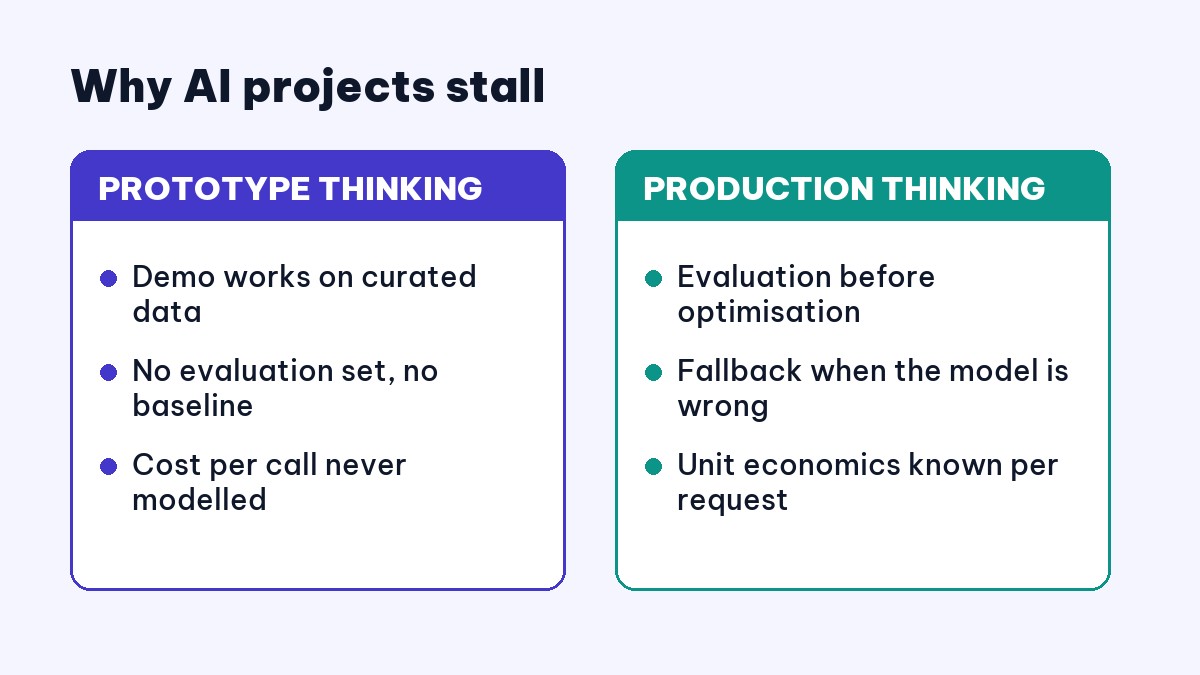
Most stalled AI initiatives are not model failures. They are prototypes that were never designed to become systems, and the gap shows up in three specific absences.
No evaluation set, so nobody can say whether a change made the system better or worse. No fallback path, so a wrong answer reaches the user with the same confidence as a right one. No cost model, so the unit economics are discovered in the first month’s invoice rather than in the design.
Closing those three gaps is usually the bulk of an AI development outsourcing budget, and a proposal that does not mention them is quoting for the demo.
Evaluation Comes Before Optimisation
The most valuable early artefact is not a model. It is a set of examples with known correct answers, agreed with the people who will judge the output.
Fifty carefully chosen examples beat five thousand scraped ones. What matters is that the set covers the cases you actually care about, including the awkward ones people avoid demonstrating.
Without it, every subsequent decision is a matter of taste, and teams end up optimising for whichever example someone demonstrated most recently. With it, changes become measurable and disagreements become empirical. Build the evaluation set first, even though it feels like a detour from the interesting work.
AI Development Outsourcing and Unit Economics
Traditional software has near-zero marginal cost per request. AI features do not. Every call consumes tokens or compute, and a feature that is delightful at a thousand users a day can be uneconomic at a hundred thousand.
Caching, smaller models for easy cases and shorter context windows are the usual levers, and all three are architectural rather than incidental – which is why they belong in the design conversation rather than in a later optimisation sprint.
Model this before you build. What does one request cost? How many requests does a typical user generate? What is the ceiling if usage triples? Answering those three questions in design is what separates a feature you can price from one you have to withdraw.
Build a Model or Use One?
For the overwhelming majority of business applications, use an existing model and spend the budget on everything around it. Training from scratch is justified when your data is genuinely proprietary, the domain is narrow, and no available model performs adequately – three conditions that rarely hold together.
Fine-tuning sits in between and is often reached for too early. Try prompt design, retrieval over your own documents, and better evaluation first; they are cheaper, faster to iterate, and frequently sufficient. A vendor who proposes training a model in the first conversation is selling capability rather than solving a problem.
Your Data Is the Actual Asset
Models are commodities that improve monthly regardless of what you do. Your proprietary data, and the pipeline that keeps it clean and current, is the part competitors cannot copy.
This has a practical consequence for how you contract the work: insist that pipelines, prompts, evaluation sets and labelled data are yours, in your repository, in open formats. Losing access to a vendor-hosted evaluation harness is a far more painful lock-in than losing access to code.
Budget accordingly. Data collection, labelling, cleaning and pipeline work commonly consumes more of an AI project than model work does, and it is the portion that retains value when today’s best model is superseded. Our guide to dedicated teams covers why this kind of continuous work suits a stable squad rather than a project engagement.
How to Evaluate AI Development Outsourcing Vendors
Four questions separate production experience from enthusiasm. What do you currently have running in production, and for how long? How do you measure whether it is working? What happens when the model is wrong? And what does a single request cost?
Vendors with real experience answer in numbers and describe failures they have handled. Those without answer in capabilities and technology names. The same diligence applies as for any engagement – named engineers, your repository, a paid pilot – as set out in our risk guide.
Mistakes in AI Development Outsourcing
Starting with the technology rather than the decision it should improve. “We need AI” is not a requirement; “we need to route these tickets without a human reading each one” is.
Treating accuracy as binary. Useful systems are wrong sometimes; what matters is whether being wrong is cheap and recoverable, which is a design question rather than a model question.
Promising accuracy figures before seeing the data. Any number quoted before a vendor has examined your actual inputs is a guess dressed as a commitment, and it sets an expectation the project will be measured against unfairly.
Skipping the human review path. Almost every successful production system keeps a person in the loop somewhere, and designing that path deliberately is what makes the rest of it deployable.
FAQ: AI Development Outsourcing
How much does it cost in 2026?
$25-40/hour general, $45-65/hour for AI specialists in Vietnam. Projects run from under $20,000 to $400,000+; a five-person team is $15,000-$25,000 monthly.
Why do AI specialists cost more?
Wider scope – data, evaluation, serving, cost control, monitoring – and a small bench with genuine production experience.
Why do AI projects fail?
They are demos, not systems: no evaluation set, no fallback for wrong answers, no cost model per request.
Build a model or use one?
Use one, for nearly all business applications. Spend the budget on data, evaluation and integration instead.
How do I evaluate a vendor?
Ask what runs in production, how they measure it, what happens when it is wrong, and what a request costs.
AI development outsourcing succeeds when it is treated as engineering rather than as a demonstration. Define the decision, build the evaluation set, model the unit economics, and the interesting part becomes the easy part. See our transparent 2026 rate card →