

Ecommerce software development budgets are almost always allocated to the wrong half of the problem. The storefront – catalogue, cart, checkout – is the visible part and the smaller part. The money and the risk sit in what happens after the customer clicks pay: inventory, payments, tax, shipping, returns, and every system those touch.
Key takeaways
- Most of the effort in a custom commerce build lands in integrations and operations, not in the pages customers see.
- Use a platform until it blocks something commercially important – “we want it custom” is not that.
- Returns, refunds and partial fulfilment are the most underestimated part of ecommerce software development.
- A focused first release typically takes three to six months when the integration surface is mapped first.
- Vendor experience matters more than technology choice: the value is knowing which edge cases exist.
Table of contents
- Platform or Custom Ecommerce Software Development?
- Where the Budget Actually Goes
- Payments Are Not One Integration
- Inventory Truth and Ecommerce Software Development
- Ecommerce Software Development and the Returns Problem
- B2B Commerce Breaks Platform Assumptions
- Performance Is a Revenue Feature
- Outsourcing Ecommerce Software Development
- Ecommerce Software Development Mistakes
- FAQ
Platform or Custom Ecommerce Software Development?
Start with the platform. Shopify, WooCommerce and their peers solve catalogue, cart, checkout, payments and a large part of tax and shipping for a fraction of what custom work costs, and they keep solving them while you sleep.
Custom becomes justified at a specific moment: when something commercially important cannot be expressed on the platform without fighting it. Contract pricing per customer, complex bundles or configurable products, unusual fulfilment models, B2B approval workflows, or a catalogue whose structure simply does not fit the platform’s data model.
“We want it custom” is not that moment. Neither is “the theme is limiting”. A useful test: name the revenue you cannot capture on the platform today. If you can name it in numbers, custom ecommerce software development is a business decision. If you cannot, it is an aesthetic one.
Where the Budget Actually Goes
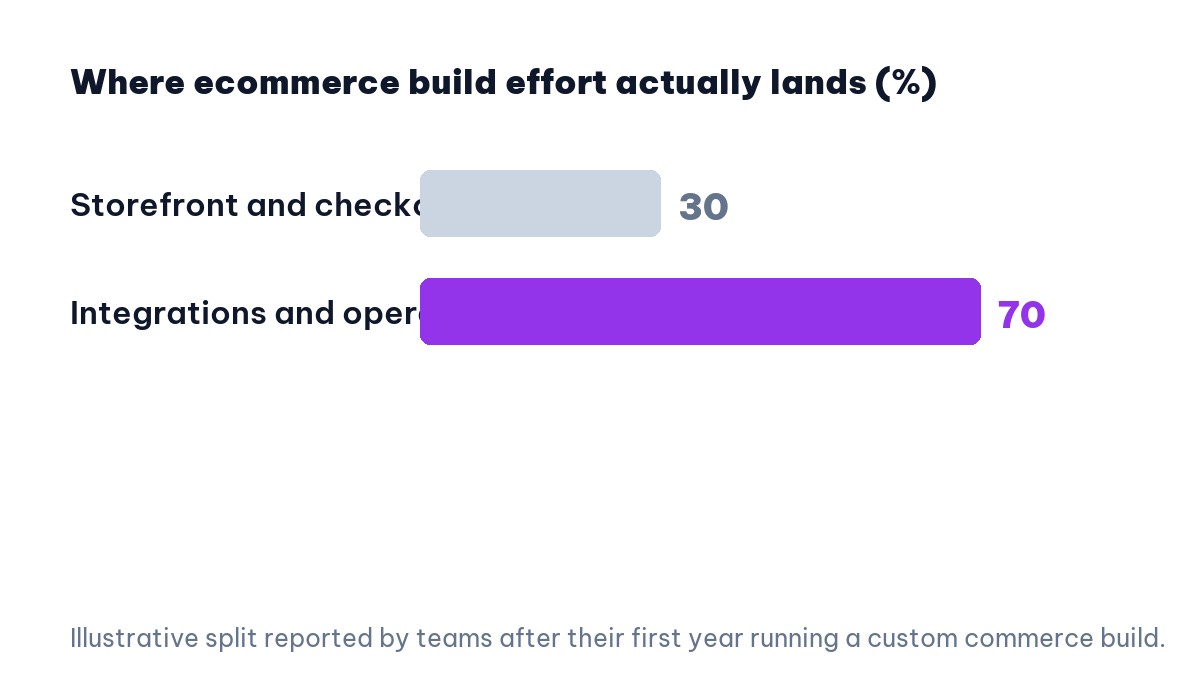
Teams consistently report the same surprise after their first year: the storefront was the easy part. Product pages, cart and checkout are well-understood problems with known patterns. The integration and operations layer is where the estimates break.
That layer includes payment providers and their failure states, inventory synchronisation across channels, tax calculation by jurisdiction, shipping rates and label generation, ERP or accounting handoff, fraud screening, and the reconciliation that has to happen when any of those disagree with each other.
Scope a commerce project as an order lifecycle rather than as a set of pages, and the estimate becomes honest. Scope it as pages, and the missing two-thirds arrive in month three as “unexpected” work.
Payments Are Not One Integration
A payment integration is often written into a plan as a single line. In practice it is a family of behaviours: authorisation, capture, partial capture, refund, partial refund, chargeback, retry on soft decline, currency handling, and the reconciliation report finance will ask for in month two.
Regional payment methods add another dimension. A checkout that works in one market may convert poorly in another simply because the method customers trust is missing, and adding one is rarely a configuration change.
Each has a failure mode with money attached, which is why payments deserve their own design conversation rather than a checkbox. The cost of getting this wrong is not a bug ticket – it is a customer charged twice and a support conversation you cannot automate.
Inventory Truth and Ecommerce Software Development
The hardest question in commerce engineering is deceptively simple: how many do we have? Once stock exists in a warehouse, on a marketplace, in a physical shop and in a pending order, “available” becomes a calculation rather than a number.
Reservation windows are the usual mechanism – stock held for the minutes between add-to-cart and payment – and they need a rule for expiry that finance and operations both agree with.
Decide early which system holds the truth, how often others reconcile against it, and what happens when two channels sell the last unit within the same second. Oversells are not an edge case – they are the default outcome of an unanswered question, and they cost goodwill rather than code.
Ecommerce Software Development and the Returns Problem
Returns touch payments and inventory simultaneously, which makes them the most common source of post-launch defects. A returned item has to be received, inspected, restocked or written off, refunded partially or fully, and reflected in accounting – and the customer needs to see a sensible status the entire time.
Exchanges are worse again, because they are a return and a new order that must not double-charge or double-count stock. If your business expects exchanges at any volume, price that flow explicitly.
Almost nobody demos this flow, and almost every commerce team spends its first post-launch quarter fixing it. Design it before launch and you buy back that quarter.
B2B Commerce Breaks Platform Assumptions
B2B is where platforms most often stop fitting. Customer-specific pricing, negotiated contracts, purchase orders, credit terms, multi-user accounts with approval limits, quotes that convert to orders – none of these are exotic in B2B and few are natural on consumer platforms.
The same applies to marketplace or multi-vendor models, where commission, payout scheduling and seller onboarding become first-class parts of the system rather than add-ons.
If your business is B2B, evaluate that list explicitly before choosing an approach. It is the most reliable predictor of whether ecommerce software development will be a configuration exercise or a build.
Performance Is a Revenue Feature
In commerce, speed is not a technical nicety. Page load time affects conversion directly, and the effect compounds on mobile and on slower connections – which is where a large share of traffic lives.
Treat performance as a requirement with a number attached rather than as something to optimise later. Later usually means after the architecture has made it expensive, a pattern we cover in our guide to technical debt.
Outsourcing Ecommerce Software Development
Commerce suits outsourcing well because the domain is well understood – the edge cases are known to people who have met them before, and that experience is exactly what you are buying.
Screen for it directly. Ask how they handled partial fulfilment, what their approach to inventory reconciliation is, and what happens on a soft decline. Vendors who have run commerce in production answer immediately; those who have only built storefronts change the subject to technology. The wider diligence checklist is in our outsourcing risk guide.
Ecommerce Software Development Mistakes
Launching without the reconciliation report finance needs. It always gets requested, and building it after the fact means backfilling data that was never captured.
Treating tax as a formula. Jurisdiction rules change, and hard-coding them creates a maintenance obligation nobody signed up for; a tax service is nearly always cheaper than owning that logic.
Skipping observability. When an order fails silently between two systems, the only thing that shortens the investigation is a trace you designed in advance.
Ignoring the admin experience. The people who process orders every day use the software more than any customer does, and their efficiency is a direct operating cost.
One planning habit is worth adopting regardless of platform choice. Before any build begins, write the full order lifecycle on a single page: created, paid, allocated, picked, shipped, delivered, returned, refunded, cancelled – and next to each state, name the systems that must agree and the person who resolves a disagreement. It takes an afternoon and it consistently surfaces two or three integrations nobody had budgeted. Teams that skip it are not saving time; they are deferring the same conversation to a point where it costs a release instead of an afternoon.
FAQ: Ecommerce Software Development
Platform or custom?
Platform until it blocks something commercially important you can name in numbers. Custom when pricing, catalogue or fulfilment cannot be expressed on it.
What drives the cost?
Integrations and operational edge cases – payments, inventory, tax, shipping, returns – not the storefront.
How long does a build take?
Three to six months for a focused first release when the integration surface is mapped before development starts.
What is most underestimated?
Returns, refunds and partial fulfilment, which touch payments and inventory at the same time.
Can it be outsourced?
Yes – provided the vendor has run commerce in production and can describe the edge cases without prompting.
Scope ecommerce software development as an order lifecycle rather than a set of pages, and most of the usual surprises stop being surprises. The storefront is the demo; the operations layer is the product. See our transparent 2026 rate card →