

Vietnam vs Poland outsourcing is a geography question disguised as a cost question. Poland sells proximity to Europe, EU membership and senior depth. Vietnam sells cost efficiency and Asia-Pacific working hours. Both have real engineering benches – the decision turns on where your customers and your compliance obligations sit.
Key takeaways
- Senior rates: roughly $30-40/hour in Vietnam against $55-100/hour at Poland’s senior end, with Polish market medians around $37-50.
- Poland is the most expensive Eastern European destination – a consequence of EU salary levels, not of vendor margin.
- Poland wins decisively on EU data residency and Western European overlap; Vietnam wins decisively on APAC hours.
- The rate gap in Vietnam vs Poland outsourcing does not reflect a quality gap; variation between firms exceeds variation between countries.
- For US buyers neither is ideal: Poland is 3-5 hours from the East Coast, Vietnam requires structured handoffs.
Table of contents
- Vietnam vs Poland Outsourcing: 2026 Rates
- Why Poland Costs What It Costs
- EU Membership and Data Residency
- Vietnam vs Poland Outsourcing on Time Zones
- Talent Depth and Seniority
- Team Stability: The Metric Behind the Rate
- What US Buyers Should Know
- Vietnam vs Poland Outsourcing and the Quality Question
- Vietnam vs Poland Outsourcing: How to Decide
- FAQ
Vietnam vs Poland Outsourcing: 2026 Rates
Polish developers bill roughly $25-65 per hour across seniority levels, with senior specialists commonly quoted at $55-100 and market medians around $37-50, per Lemon.io’s Poland rate data. Vietnamese senior engineers bill around $30-40.
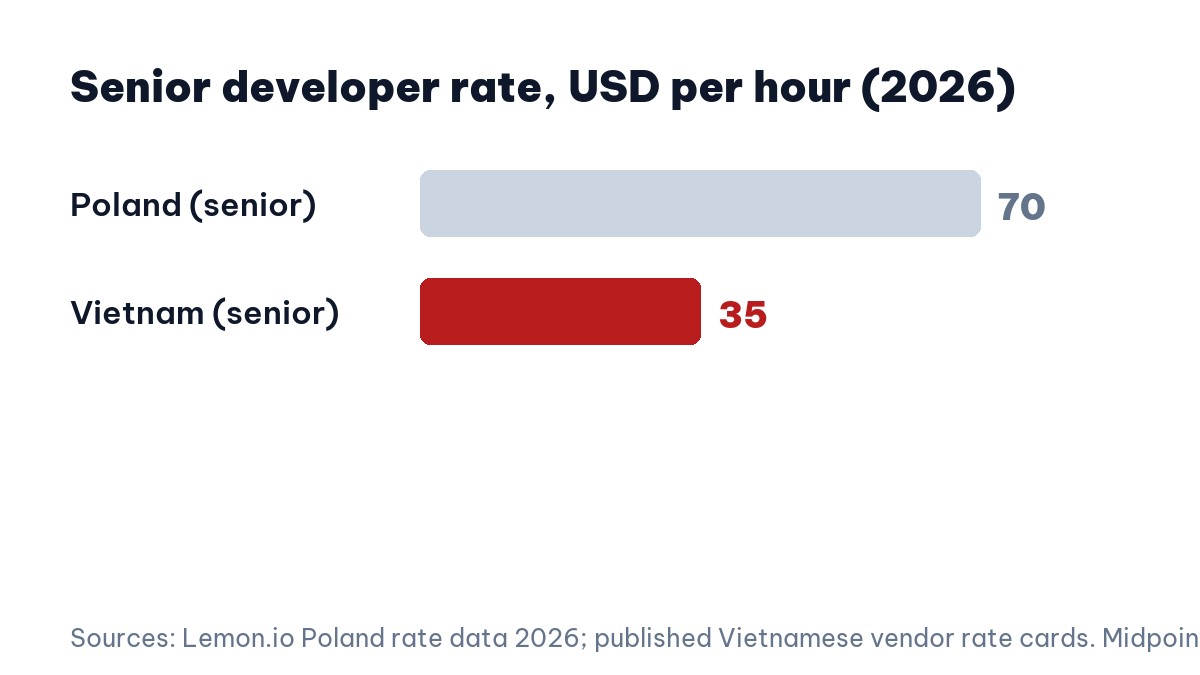
Two cautions when reading any rate table. First, published ranges usually describe contractor or marketplace rates, while agency rates sit higher because they include management, QA and bench cover. Second, specialisation shifts the number more than seniority labels do – compare the same stack on both sides or the comparison means little.
On one engineer the difference looks manageable. On a squad of five over a year, it is a six-figure decision – which is why the honest comparison is not rate against rate, but rate against what the higher rate is actually buying you.
Why Poland Costs What It Costs
Poland is an EU member state with EU salary expectations, and it competes for engineers against German, Nordic and UK employers hiring remotely. That competition sets the floor. Add strong senior English, GDPR alignment as a default rather than a project, and genuine architectural seniority, and the premium is explicable rather than arbitrary.
It is also worth noting what the premium does not buy: immunity from the ordinary failure modes. Scope ambiguity, key-person dependency and weak documentation cost exactly as much in Krakow as anywhere else.
Poland is the most expensive destination in Eastern Europe, and it is also among the strongest. Those two facts are the same fact.
EU Membership and Data Residency
This is Poland’s structural advantage and it is not something Vietnam can price its way around. If your contracts commit you to processing personal data inside the EU, or your enterprise customers require it, a Polish supplier removes an entire category of legal work.
The same logic applies to procurement preferences. Some enterprise buyers simply prefer suppliers inside their own legal bloc, and that preference is a commercial fact whether or not the law requires it.
Be precise about whether that requirement is real, though. Many teams assume EU residency is mandatory when the actual obligation is adequate safeguards, which standard contractual clauses can satisfy. Check the commitment before it decides the vendor.
Vietnam vs Poland Outsourcing on Time Zones
Poland (UTC+1/+2) shares a working day with Western Europe and sits three to five hours ahead of the US East Coast – workable with an early start on one side.
Vietnam (UTC+7) shares a full working day with Singapore and Hong Kong, gives five to six live hours with Sydney and Melbourne, and requires structured handoffs for the US. For an Australian or Singaporean buyer, Poland offers almost no live overlap – the reverse of the European picture. In Vietnam vs Poland outsourcing, timezone is usually the variable that decides before cost does.
Talent Depth and Seniority
Both markets are deep. Poland’s engineering culture is strongly represented in enterprise Java, .NET, cloud architecture and embedded work, with a mature consulting layer. Vietnam’s base grew around product engineering and export software development, with particular density in mobile, web platforms and increasingly data and AI work.
Neither country is a monoculture. Both have firms that do serious platform engineering and firms that mainly resell junior capacity, and a country name on a proposal tells you nothing about which one you are talking to.
One nuance from the Polish market worth borrowing: specialisation moves rates more than titles do. A senior in a scarce stack commands a premium over the senior baseline; a senior in a commodity stack sits below it. Compare like for like, not label for label.
Team Stability: The Metric Behind the Rate
Rate is what you pay per hour; stability decides how many of those hours produce something. Vietnam’s annual attrition runs 10-15% at well-managed firms, and at Tinasoft employee retention stays above 90% across a team of more than 300 people.
Poland’s challenge is different: its engineers are directly recruitable by Western European employers offering remote contracts, which puts constant upward pressure on both salaries and mobility. Neither market is fragile – but the forces acting on them are not the same, and stability is worth asking about in both.
What US Buyers Should Know
For an American buyer, neither destination is ideal and both are workable. Poland gives three to five hours of overlap with the East Coast, enough for a real morning conversation. Vietnam gives a genuine overnight cycle: work handed off in the evening arrives finished in the morning, which suits well-specified work and punishes vague work.
A practical middle path some US buyers take is to place architecture and product decisions with a small local or European core, and sustained engineering capacity in Asia. It costs more to coordinate than a single-site team, but less than paying Western rates for the whole build.
The deciding factor is usually how your team writes things down. Strong written practice makes the overnight model an advantage; weak written practice makes it a bottleneck, as our guide to managing offshore teams sets out.
Vietnam vs Poland Outsourcing and the Quality Question
The uncomfortable truth for both sides of this debate: the quality range inside each country is wider than the gap between them. There are excellent Polish firms and mediocre ones; the same is true in Vietnam.
Which means destination choice is the smaller decision and vendor choice is the larger one. Ask for named engineers, repository access from day one, sprint demos of working software and a paid pilot before any long commitment – in Warsaw exactly as in Hanoi. Our risk guide lists the full set of controls.
Vietnam vs Poland Outsourcing: How to Decide
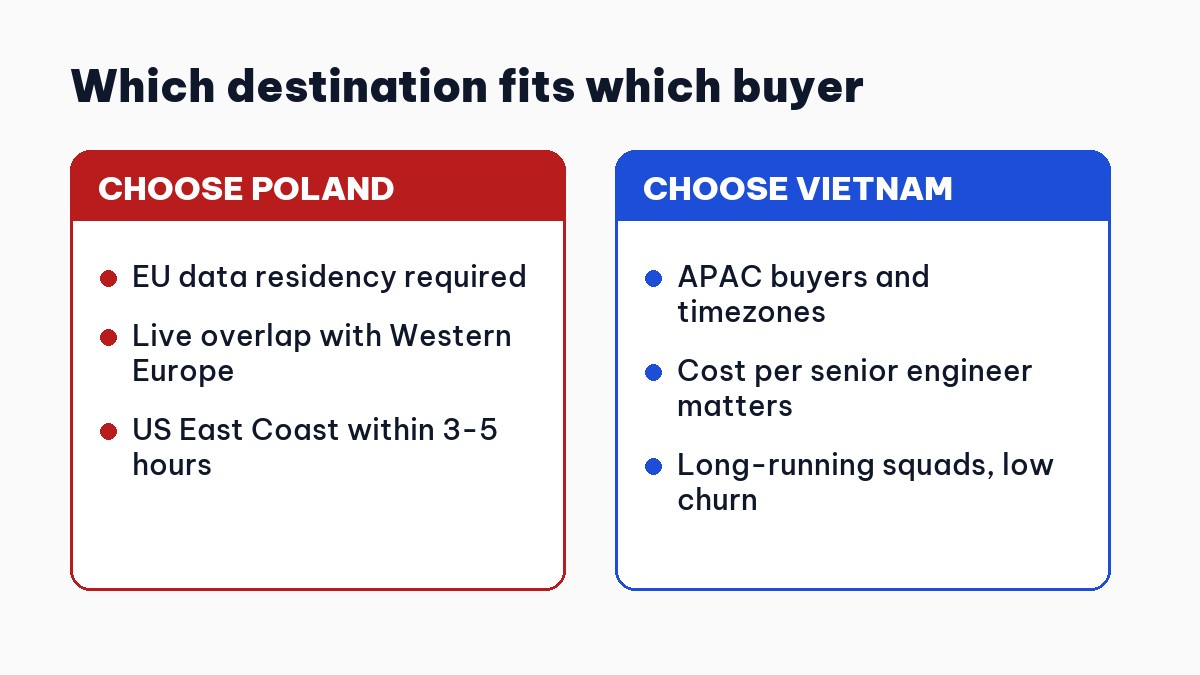
Three questions settle it. Where do your customers and your data-residency obligations sit? EU answers point to Poland; APAC answers point to Vietnam.
Second, how much live overlap does your team actually need? If the answer is four or more hours daily, geography decides for you and the rate card is irrelevant.
Third, how long will the team exist? For a build measured in months, rate difference matters less than ramp-up speed. For a product measured in years, the compounding effect of both cost and retention becomes the dominant term – and that is where the Vietnam vs Poland outsourcing arithmetic usually favours the lower-cost, lower-churn option, provided the timezone works.
FAQ: Vietnam vs Poland Outsourcing
Is Vietnam cheaper than Poland?
Yes – roughly $30-40/hour for senior engineers against $55-100 at Poland’s senior end, with Polish medians near $37-50.
Why is Poland expensive?
EU salary levels, competition from Western European remote employers, built-in GDPR alignment and strong architectural seniority.
Which is better for European clients?
Poland, in most cases: shared working hours, EU data residency, same-day travel.
Which is better for APAC clients?
Vietnam: full overlap with Singapore, five to six live hours with Australia. Poland offers almost none.
Does the price gap mean a quality gap?
No. Variation between firms inside each country exceeds variation between the countries.
Vietnam vs Poland outsourcing is decided by where your customers, your data and your working hours live – not by which country sounds cheaper. Answer the geography first, then run the same vendor diligence in either place. See our transparent 2026 rate card →