

To manage offshore development team work successfully, you need an operating system, not goodwill. The teams that fail rarely fail on talent – they fail because nobody designed how decisions get made, how progress becomes visible, and who answers questions when the client is asleep. This playbook covers the rituals, metrics and contract terms that make the difference.
Key takeaways
- Manage outcomes – working software demonstrated each sprint – not hours logged or tickets closed.
- Three to four overlapping hours is the practical minimum; Vietnam gives full-day overlap with Singapore and five to six hours with Australia.
- Write decisions down. Anything that exists only in a call is lost the moment someone rotates off.
- Track team stability alongside delivery – engineers still on your product after six months is a leading indicator of everything else.
- The most expensive mistake when you manage offshore development team capacity is treating engineers as ticket-takers with no business context.
Table of contents
- Manage Offshore Development Team by Outcomes, Not Activity
- Timezone Overlap: The Constraint Behind Everything
- Manage Offshore Development Team Through Writing
- The Four Rituals That Carry the Week
- Metrics to Manage Offshore Development Team Delivery
- Manage Offshore Development Team Context, Not Just Tickets
- Contract Terms to Manage Offshore Development Team Risk
- The First 90 Days: Manage Offshore Development Team Ramp-Up
- Mistakes That Quietly Kill Offshore Teams
- FAQ
Manage Offshore Development Team by Outcomes, Not Activity
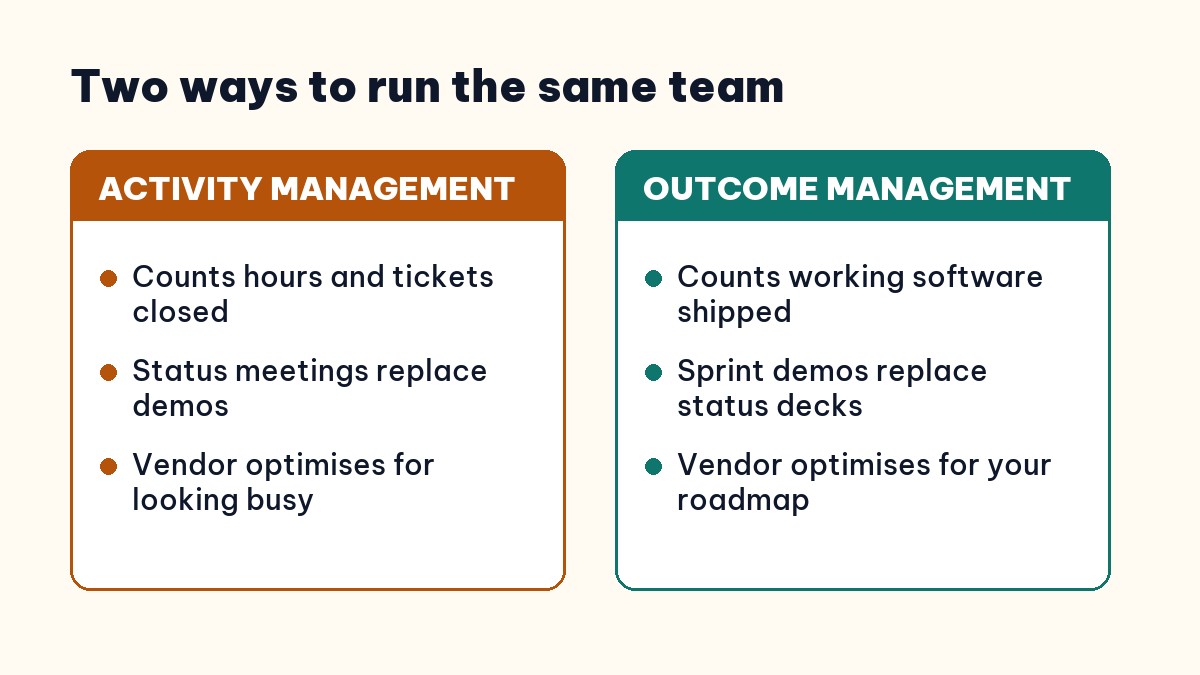
The first decision determines everything else: are you buying hours or results? Buy hours and you will spend your week auditing timesheets, and your vendor will optimise for looking busy. Buy results and the conversation becomes what shipped and what it changed.
Outcome management is concrete, not philosophical. Every sprint ends with a demonstration of software running – not slides describing software. Anyone on your side can open the repository and watch commits land. Progress is something you observe rather than something you are told about.
Timezone Overlap: The Constraint Behind Everything
Three to four live hours per day is the practical floor for a squad you interact with daily. Below that, every clarification costs a full day and the team starts guessing rather than asking – which is how small misunderstandings become rebuilt features.
Geography decides how hard it is to manage offshore development team communication. Vietnam sits one hour behind Singapore, giving a fully shared working day, and five to six live hours with Sydney and Melbourne. For US buyers the model shifts to structured handoffs, which works when the written layer is strong. Our Vietnam versus India comparison looks at how much this single variable moves delivery speed.
Manage Offshore Development Team Through Writing
Distributed teams run on written artefacts. A decision that lives only in someone’s memory of a call is a decision that will be relitigated in six weeks, usually after the person who made it has moved on.
Three habits carry most of the weight. Decisions get recorded with their reasoning, not just their conclusion – the why is what future engineers need. Requirements state what is out of scope as explicitly as what is in. And every meeting produces a written summary within the hour, in a place the whole team can search.
The Four Rituals That Carry the Week
A short daily standup inside the overlap window, used for unblocking rather than reporting. A sprint demo of working software, attended by whoever cares about the outcome. A written weekly summary covering what shipped, what slipped and why. And a monthly conversation about the working relationship itself, separate from feature discussions.
Those four rituals are the whole calendar. Anything else you are tempted to add is usually a symptom – a recurring meeting invented because something was not visible enough. Fix the visibility instead of adding the meeting.
That fourth ritual is the one most teams skip and most need. Process friction compounds quietly, and if there is no scheduled place to name it, it surfaces as a resignation or a missed release instead of a conversation.
Metrics to Manage Offshore Development Team Delivery
Four numbers tell you most of what matters: shipped increments per sprint, defect escape rate, cycle time from ticket to production, and team stability. The last one is the most predictive and the least tracked – if the same engineers are still on your product after six months, the other three usually take care of themselves.
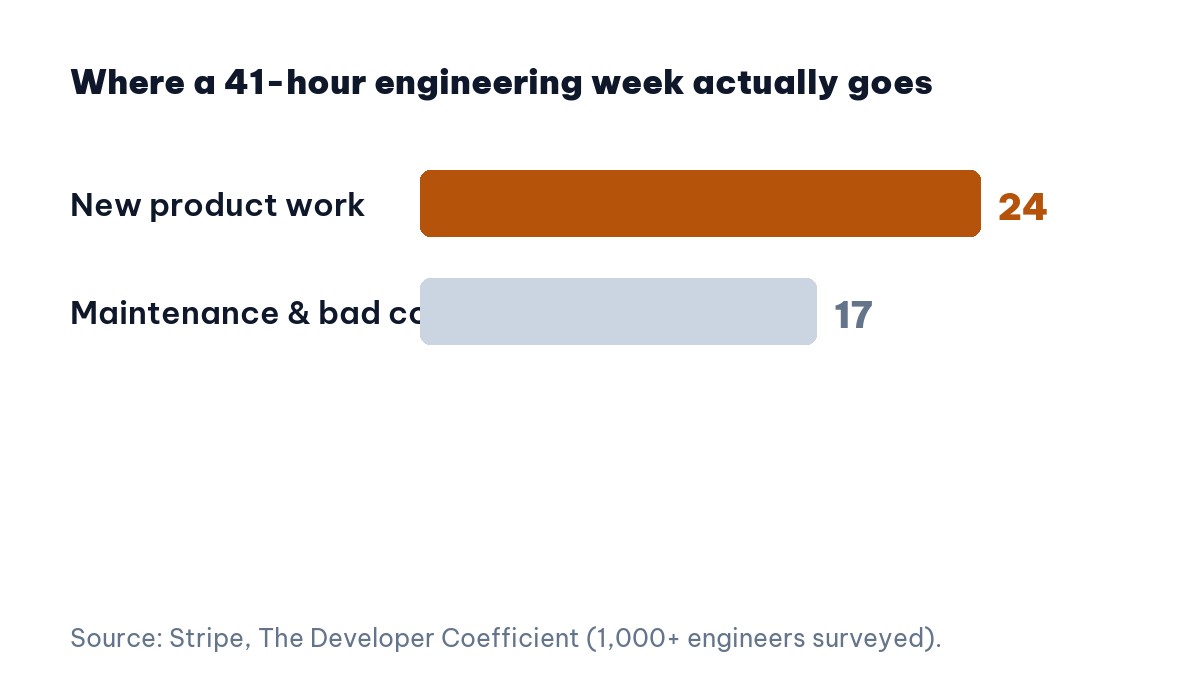
It also helps to know what a normal engineering week looks like. Stripe’s survey of more than a thousand developers found engineers spend roughly 17 of 41 hours a week on maintenance and bad code rather than new work, per The Developer Coefficient. If your offshore squad’s ratio looks worse than that, the problem is usually accumulated shortcuts, not effort – the subject of our guide to technical debt in outsourcing.
Manage Offshore Development Team Context, Not Just Tickets
Engineers who understand who uses the product and what breaks their day make better decisions in the hundred small places you will never review. Engineers who receive only tickets implement exactly what the ticket says, including the parts that make no sense.
This is the cheapest lever available to anyone trying to manage offshore development team quality. Share the business model, the customer segments, the complaints support hears most. Invite the offshore lead to roadmap discussions rather than briefing them afterwards. Let them push back on requirements – a team that never pushes back is either unusually lucky or quietly disengaged.
Contract Terms to Manage Offshore Development Team Risk
Some management problems are really contract problems. Four clauses prevent most of them: named engineers with allocation percentages, so “dedicated” means dedicated; repository and infrastructure ownership on your side from day one; milestone-based checkpoints so continuing is a decision rather than inertia; and a defined response-time commitment for questions raised outside overlap hours.
Without those, you can hold every ritual perfectly and still be unable to manage offshore development team output, because the levers simply are not yours to pull.
The First 90 Days: Manage Offshore Development Team Ramp-Up
The ramp-up is where most engagements are quietly decided, long before anyone reviews the contract again.
Start smaller than feels efficient. Two engineers on a contained, real piece of work for the first month tells you more about a vendor than any reference call. You are testing the working rhythm, not the headcount.
In month two, add scope rather than people, and watch whether the written layer holds as complexity grows. Only in month three, once the team ships predictably, should you scale up – and then by adding engineers to a working rhythm rather than restarting with a bigger group. The dedicated team model is built around exactly this pattern.
Mistakes That Quietly Kill Offshore Teams
Silence read as agreement. In many working cultures, an unanswered question is not consent – it is confusion that nobody wanted to voice. Ask for playback: have the engineer restate the requirement in their own words before work starts.
Reviewing only at the end is the second. A four-week gap between briefing and demo is four weeks of unverified assumptions. Bring the review forward and shorten the loop.
Finally, changing priorities faster than the team can absorb them. Every reshuffle discards partly finished work, and a squad that never finishes anything stops believing that finishing matters. If you want to manage offshore development team morale as well as its output, protect the sprint.
FAQ: How to Manage an Offshore Development Team
How do you manage an offshore development team effectively?
Manage outcomes: sprint demos of working software, your own repository, named engineers in the contract, and decisions recorded in writing.
How much timezone overlap do you need?
Three to four live hours daily is the practical minimum. Vietnam offers full-day overlap with Singapore and five to six hours with Australia.
What metrics matter most?
Shipped increments, defect escape rate, cycle time, and team stability after six months. Hours logged measure motion, not progress.
Should we run daily standups?
Yes – short, inside the overlap window, for unblocking. The written summary is the record, not the call.
What is the biggest mistake?
Treating engineers as ticket-takers. Without business context they implement the ticket exactly, including the parts that are wrong.
Everything above reduces to one idea: to manage offshore development team work well, make progress visible and decisions durable. Distance is not the risk – undocumented assumptions are. See our transparent 2026 rate card →