

Mobile app development outsourcing looks simple from the outside: agree a design, pick a vendor, wait for two apps to appear in the stores. In practice the visible screens are the smaller part of the work, and the decisions that cause the most pain – who owns the store accounts, what happens after launch, how the backend is built – are rarely discussed in the first meeting. This guide covers what mobile app development outsourcing costs in 2026 and how to avoid the mistakes that make it more expensive.
Key takeaways
- Clutch’s pricing data puts the average app development agency at roughly $25-49 per hour; senior Vietnamese engineers bill around $30-40.
- Scope drives cost far more than hourly rate – backend, integrations and real-time features are where budgets move.
- Cross-platform suits most business apps; native earns its cost when performance or device hardware is central.
- Budget for what comes after launch: yearly OS updates, store policy changes and maintenance.
- In mobile app development outsourcing, the store accounts, signing keys and credentials must belong to you from day one.
Table of contents
- Mobile App Development Outsourcing: What It Costs in 2026
- Native, Cross-Platform or Web First
- What Drives Mobile App Development Outsourcing Budgets
- The Budget Lines Buyers Forget
- Mobile App Development Outsourcing Engagement Models
- How to Evaluate a Mobile Vendor
- Own the Store Accounts, Keys and Credentials
- Mobile App Development Outsourcing to Vietnam
- Common Mobile App Development Outsourcing Mistakes
- FAQ
Mobile App Development Outsourcing: What It Costs in 2026
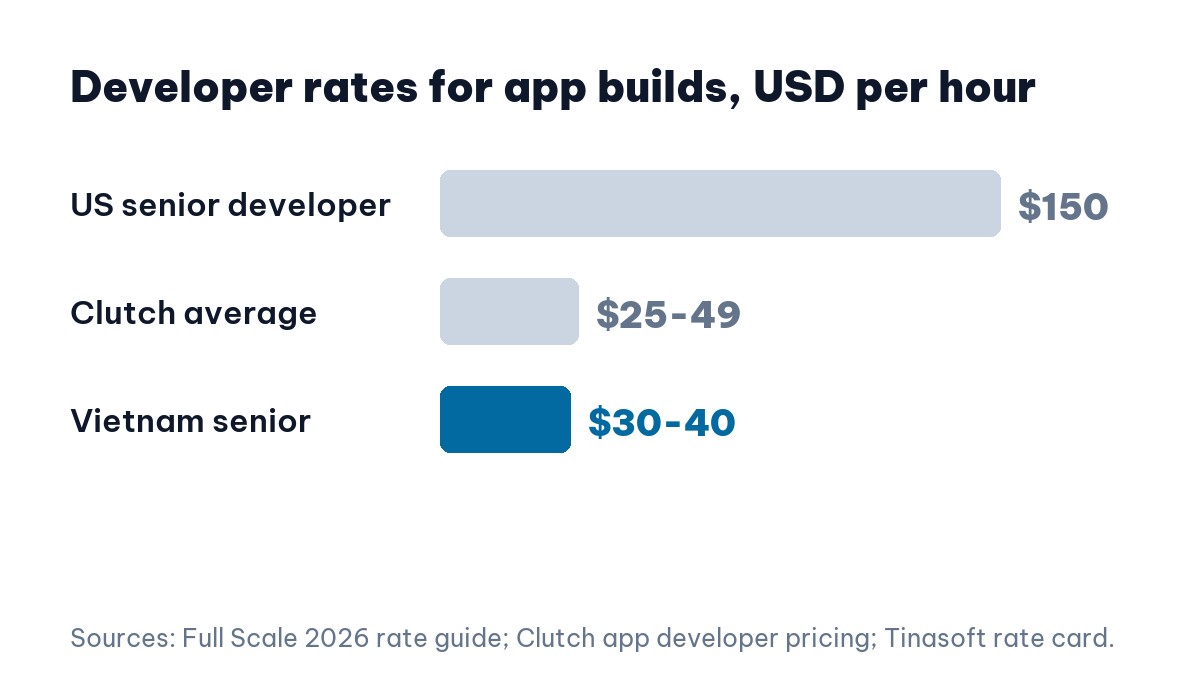
Start with rates, then set them aside. Clutch’s app developer pricing data puts the average agency at roughly $25-49 per hour, with established firms and senior specialists above that range. Senior developers in the United States commonly bill around $150 per hour, while senior Vietnamese engineers bill around $30-40.
Those numbers matter less than they appear. Two vendors with identical rates can quote very different totals for the same idea, because they are pricing different assumptions about the backend, the integrations and how much of the product must exist at launch. Compare the scope each quote describes before comparing the price at the bottom.
Native, Cross-Platform or Web First
For most business apps, cross-platform frameworks are the sensible default: one codebase, one team, iOS and Android released together. The trade-offs are real but usually small for products built around forms, lists, payments and content.
Native development earns its extra cost when performance is part of the product, when the app depends heavily on device hardware such as the camera, Bluetooth or sensors, or when a platform-specific experience is a competitive advantage. And sometimes the right first step is neither: a responsive web app can validate demand before any store submission, which is often the cheapest way to learn whether the mobile app is worth building at all.
Whichever route you choose, settle it before design starts. Moving from cross-platform to native halfway through is effectively a rebuild, and much of the design work usually has to be redone with it.
What Drives Mobile App Development Outsourcing Budgets
Four factors move the total more than anything else. The backend – accounts, data, business rules and the admin panel the business team uses – is frequently as large as the app itself. Integrations with payment providers, maps, messaging or existing company systems add both build time and testing time.
Real-time features such as chat, live tracking or instant notifications raise complexity sharply. And regulated data, in health or finance for example, adds security and compliance work that has to be designed in rather than added later. If a quote seems low, check which of these four it has quietly assumed away.
The Budget Lines Buyers Forget
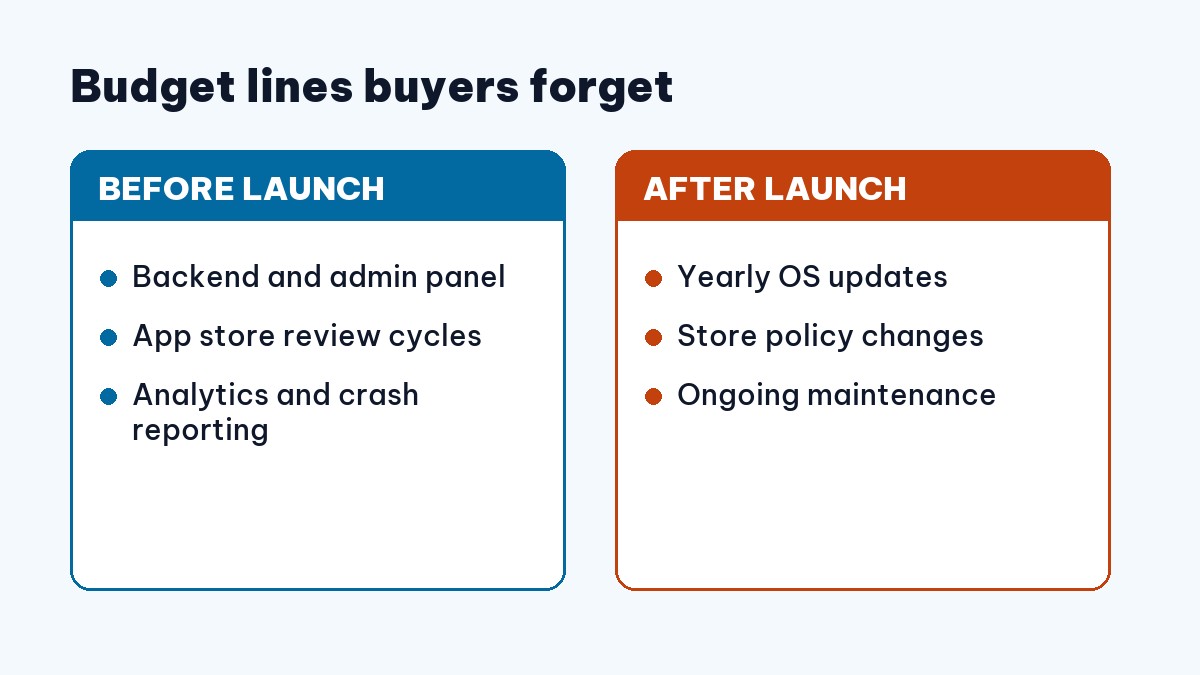
Before launch, three items are routinely missing from early budgets: the backend and admin panel, time for app store review cycles and resubmissions, and analytics plus crash reporting so you know what is happening once real users arrive.
After launch comes the part that never ends. Apple and Google release major operating system updates every year, store policies change, and third-party libraries need upgrading. An app that nobody maintains does not stay still; it slowly stops working. Plan this as recurring work from the beginning – our guide to software maintenance outsourcing covers how to structure it.
Mobile App Development Outsourcing Engagement Models
A fixed-price project fits a small, well-defined first release where the scope is unlikely to move. It gives budget certainty in exchange for flexibility, so it works best after the requirements are genuinely settled.
A dedicated team fits a mobile product that will keep evolving through regular releases, where accumulated knowledge of the users and codebase compounds in value. Many companies combine the two: a fixed scope for the first version, then a small dedicated development team once the app is live. For early products, our MVP development guide explains how to keep that first version deliberately small.
How to Evaluate a Mobile Vendor
Ask to see apps the vendor has released and still maintains, not only screenshots in a portfolio. Download them, read the store reviews, and look at when they were last updated. An app last updated two years ago tells you how that vendor treats life after launch.
Then ask practical questions. Who handles store submission and rejection? How do they test on real devices across screen sizes and operating system versions? What does their release process look like? Clear, specific answers matter more than a long list of technologies.
It is also worth speaking with the engineers who would actually work on your app, not only a sales lead. Mobile work depends heavily on individual experience with store submissions and device testing, and that experience belongs to people rather than to a company brochure.
Own the Store Accounts, Keys and Credentials
This is the most expensive mistake in mobile projects and the easiest to prevent. Apple and Google developer accounts, app signing keys, push notification certificates, backend hosting and the store listings themselves should be registered to your organisation from the first day.
When those assets sit in a vendor’s accounts, changing vendors later can mean re-publishing the app under a new listing and losing ratings, reviews and existing users along the way. If you ever need to move a project, our guide to switching software vendors explains what to secure first – but it is far cheaper never to need it.
Mobile App Development Outsourcing to Vietnam
Vietnam has become a common destination for mobile app development outsourcing for three practical reasons. Senior engineers bill around $30-40 per hour. Mobile and web platforms are a core strength of the local engineering market. And the working day overlaps fully with Singapore and substantially with Australia, which keeps feedback loops short during intensive build phases.
Team stability matters for mobile products in particular, because release knowledge – signing, store history, device quirks – lives with the people who have done it before. At Tinasoft, employee retention above 90% across a team of more than 300 people is how we keep that knowledge in place from one release to the next.
Common Mobile App Development Outsourcing Mistakes
Choosing on hourly rate alone and discovering the quote excluded the backend. Leaving store accounts and signing keys with the vendor. Building every feature for launch instead of the few that prove the idea. Skipping analytics, so nobody can tell which screens users abandon.
And treating launch as the finish line. In mobile app development outsourcing, launch is the moment real users start telling you what to build next, and the budget and team should still be there to listen.
FAQ: Mobile App Development Outsourcing
How much does it cost in 2026?
Clutch data puts the average agency at roughly $25-49 per hour, but total cost depends mainly on scope: backend, integrations, real-time features and regulated data.
Native or cross-platform?
Cross-platform for most business apps; native when performance, hardware access or platform-specific experience is central.
What do buyers forget to budget?
Backend and admin panel, store review cycles, analytics, and post-launch work such as OS updates and maintenance.
Who should own the store accounts?
You should, along with signing keys, credentials and hosting – from the first day.
Is Vietnam a good destination?
For many buyers: senior rates around $30-40 per hour, strong mobile expertise, and good timezone overlap with Singapore and Australia.
Mobile app development outsourcing succeeds when the budget covers the whole product – backend, launch and the years after – and when the accounts that make the app yours actually are yours. Get those two things right and choosing a vendor becomes a much simpler decision. See our transparent 2026 rate card →