

The instinct when you need to scale engineering team output is to add people to the team that is behind. It is also the one move most reliably documented to make things worse. Capacity does not grow by addition, because every person you add has to be told things by someone who was previously building.
Key takeaways
- Communication paths grow quadratically: five engineers have ten, fifteen have one hundred and five.
- To scale engineering team throughput, add teams with clear ownership rather than people to one team.
- Five to eight people per team is the practical sweet spot for context and coverage.
- Written practice is what breaks first – conversation stops carrying the load somewhere around ten people.
- Hire for permanent capability; use a squad when you need capacity faster than hiring allows.
Table of contents
- The Arithmetic That Stops You Scaling
- Scale Engineering Team Capacity by Adding Boundaries
- The Right Team Size When You Scale Engineering Team Structure
- Written Practice Breaks First as You Scale Engineering Team Size
- Seniority Ratios Decide Onboarding Cost
- Hire or Add a Squad to Scale Engineering Team Output?
- The Timeline Nobody Budgets For
- Platform Work Is How You Scale Engineering Team Speed
- Mistakes When Scaling
- FAQ
The Arithmetic That Stops You Scaling
Every pair of people on a team is a potential communication path, and the count grows as n(n-1)/2. Five engineers have ten paths. Ten have forty-five. Fifteen have one hundred and five.
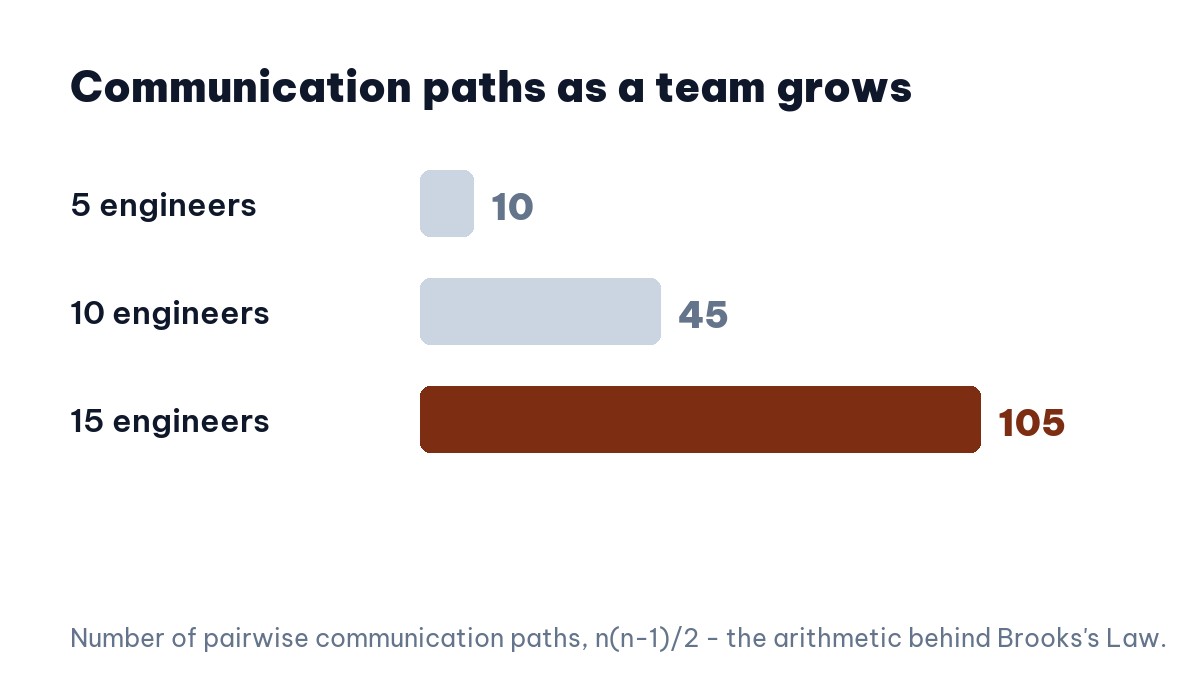
That growth is why a project behind schedule gets later when you add people to it. The new engineers need context, and context lives in the heads of the engineers who were previously delivering. You have converted your most productive people into teachers at exactly the wrong moment.
The effect is temporary but real, and it is worth naming out loud in planning: a team that grows will get slower before it gets faster, and the dip is a cost of the decision rather than a sign the decision was wrong.
None of this argues against growing. It argues against growing by addition to a single team, which is a different thing.
Scale Engineering Team Capacity by Adding Boundaries
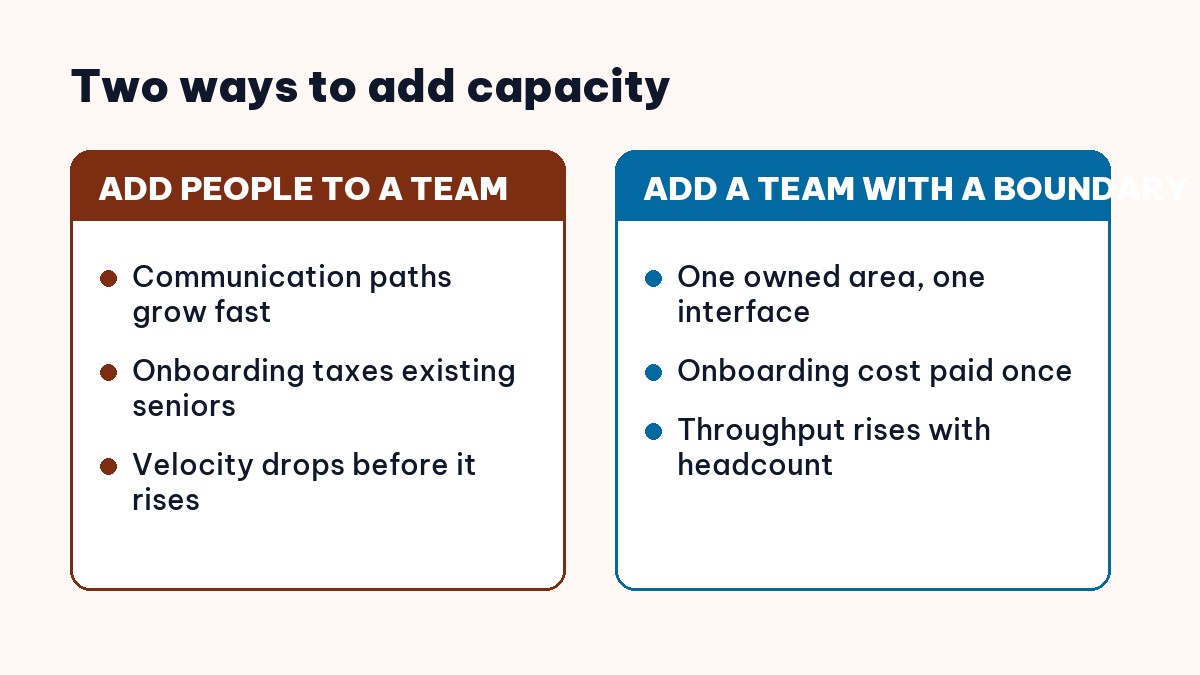
The move that works is to add a team with something of its own to own – a service, a product area, a well-defined domain – and exactly one clear interface to everyone else.
Inside that boundary the new team communicates densely, which is cheap. Across the boundary they communicate through a defined contract, which is also cheap. What you are avoiding is the expensive middle: fifteen people all needing to know what the other fourteen are doing.
This is why the shape of your architecture and the shape of your organisation end up mirroring each other. If you cannot draw a boundary in the system, you cannot draw one in the team either – and that is an architecture problem wearing a hiring costume.
The Right Team Size When You Scale Engineering Team Structure
Five to eight engineers is the range most organisations converge on. Large enough to cover the necessary skills and survive someone being ill or on leave; small enough that everyone can hold the full context of what the team owns.
Ownership matters more than the number. A team of six that owns a product area outperforms a team of six assembled from whoever was available, because the first one knows why last quarter’s decisions were made and the second one does not.
Below four, the team is fragile – one departure removes a quarter of it. Above nine or ten, coordination starts consuming the gains and the honest move is to split into two teams with separate ownership rather than to keep adding.
Written Practice Breaks First as You Scale Engineering Team Size
At five people, everything can be settled in conversation and nothing is lost. At fifteen, the conversations happen in subsets, and the people who were not in them make decisions that contradict decisions made an hour earlier.
The symptom is duplicated work and decisions nobody can trace. The remedy is unglamorous: decisions recorded with their reasoning, interfaces documented before they are used, and meeting outcomes written within the hour. Establish it before you need it – retrofitting written culture into a team that grew without it is genuinely hard.
Seniority Ratios Decide Onboarding Cost
Every new engineer consumes senior time, and the ratio determines whether growth is affordable. Add three juniors to a team with one senior and that senior stops building entirely.
This is also why growing two teams simultaneously usually goes badly. Both draw on the same small pool of people who can explain how things work, and that pool is the actual constraint on how fast an organisation can absorb new engineers.
A workable heuristic is one experienced engineer per two or three less experienced ones, adjusted for how well documented your systems are. Teams with strong written practice can absorb newcomers faster, which is another reason the previous section pays for itself.
Hire or Add a Squad to Scale Engineering Team Output?
Hire for capability you need permanently, for work that differentiates you, and for knowledge you cannot afford to lose. That is worth the four-to-six month timeline hiring genuinely takes end to end.
Use an outsourced squad when you need capacity faster than that, when the need may not be permanent, or when the work is separable enough to hand over with a boundary. A dedicated development team is built for precisely this shape: a group that owns an area, retains context, and does not need your managers to run it day to day.
The two are not alternatives. Running a hiring process while a squad carries the immediate load is usually the sensible answer, as our guide to when to outsource sets out.
The Timeline Nobody Budgets For
Count hiring honestly: writing the role, searching, interviewing, offer, notice period, then ramp-up. Four to six months to productive output is normal for a senior engineer, and longer when the market is tight.
Plans that assume a hire starts contributing next month are not plans. If the deadline is real and the gap is capacity rather than capability, that arithmetic is usually the entire decision.
Platform Work Is How You Scale Engineering Team Speed
At some size, the highest-return engineering work stops being features and becomes the systems that let other engineers ship: build pipelines, test infrastructure, deployment automation, shared libraries, environments that can be created on demand.
The signal that platform investment is overdue is easy to spot: engineers waiting. Waiting for a build, waiting for an environment, waiting for a review, waiting for a deploy window. Each wait is small and none of them appear in any plan, which is exactly why they accumulate unchallenged.
Under-invest here and every new team you add moves slower than the last one. Invest properly and each additional team costs less to onboard than the one before – the only version of scaling that actually compounds.
Mistakes When Scaling
Adding people to a late project. It is the most documented mistake in software management and the most repeated.
Growing before defining ownership. If nobody can say what the new team owns, the new team will spend its first quarter finding out – expensively, and in everyone else’s way.
Ignoring the manager ratio. Engineers scale linearly with headcount; management attention does not, and a team without a manager who has time for it will drift regardless of how good its engineers are.
FAQ: How to Scale Engineering Team Capacity
How do you scale without losing velocity?
Add teams with clear ownership boundaries rather than people to one team, and invest in written practice before you need it.
Why does adding developers slow things down?
Onboarding consumes senior time and communication paths grow quadratically – ten paths at five people, one hundred and five at fifteen.
What size should a team be?
Five to eight. Below four is fragile; above nine or ten, split rather than grow.
Hire or use a squad?
Hire for permanent, differentiating capability. Use a squad for speed or when the need may not be permanent.
What breaks first?
Written communication. Conversation stops carrying the load somewhere around ten people.
To scale engineering team capacity is to design boundaries, not to increase headcount. Get the boundaries right and people help; get them wrong and every new hire makes the existing team slower. See our transparent 2026 rate card →