

Most software outsourcing risks are not exotic. They are the same seven failure modes repeating across industries, and each has a known control that costs almost nothing to put in place before signing. What makes them expensive is that nobody names them until the invoice or the audit arrives.
Key takeaways
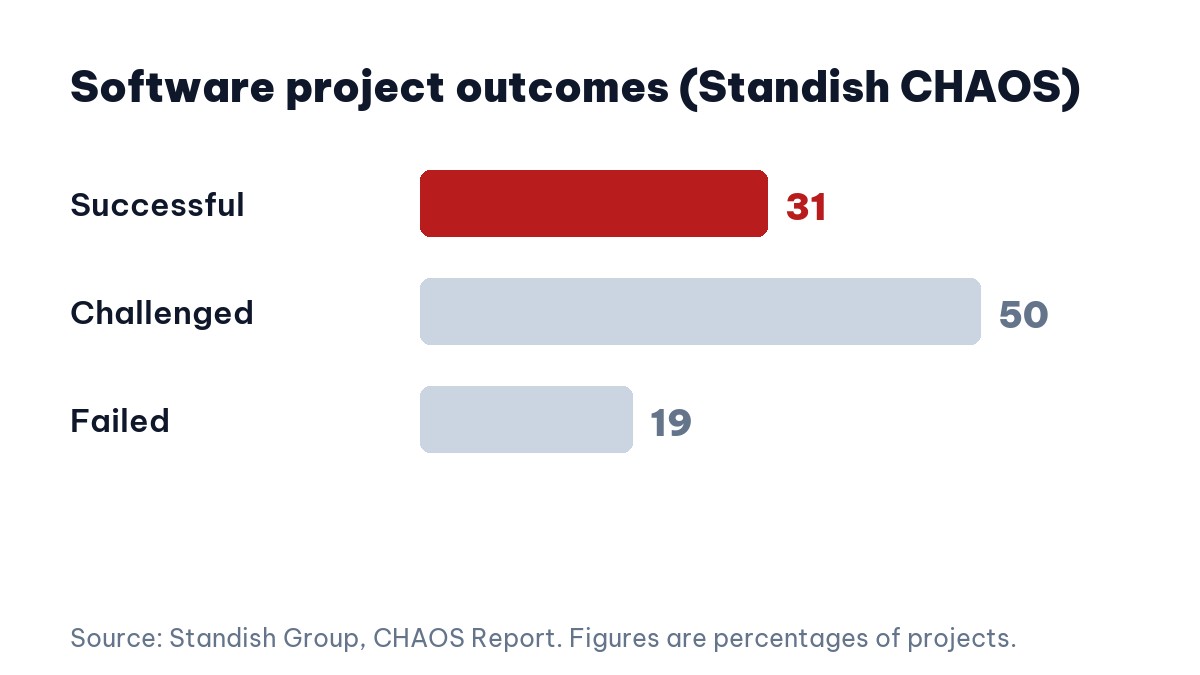
- Only 31% of software projects finish fully successfully, per the Standish CHAOS Report – outsourcing does not create that risk, it inherits it.
- The costliest software outsourcing risks are contract problems first: scope ambiguity, unnamed engineers, and IP assigned only at final payment.
- Key-person dependency is the risk nobody prices – one engineer leaving can cost more than a year of rate difference.
- Distance does not create failure; weak written practice does. A remote vendor that documents beats a local one that does not.
- The earliest warning sign is demos being replaced by status percentages.
Table of contents
- Software Outsourcing Risks #1: Scope Ambiguity
- Risk #2: Key-Person Dependency
- Software Outsourcing Risks #3: Quality Drift
- Risk #4: Intellectual Property Exposure
- Software Outsourcing Risks #5: Security Gaps
- Risk #6: Communication Latency
- Software Outsourcing Risks #7: Vendor Lock-In
- Early Warning Signals
- How to Reduce Software Outsourcing Risks Before Signing
- FAQ
Software Outsourcing Risks #1: Scope Ambiguity
The most expensive sentence in software is one both sides read differently. “The system lets users export reports” sounds specific until you ask which formats, what row limit, which date filters, who is allowed to export, and whether sensitive fields are masked. Five questions, five potential change requests.
Scope problems also compound quietly. Each small addition sounds reasonable in isolation – one extra field, one more report – and none of them individually justifies reopening the contract. Three months later the build is a third larger than what was priced, and neither side can point to the moment it changed.
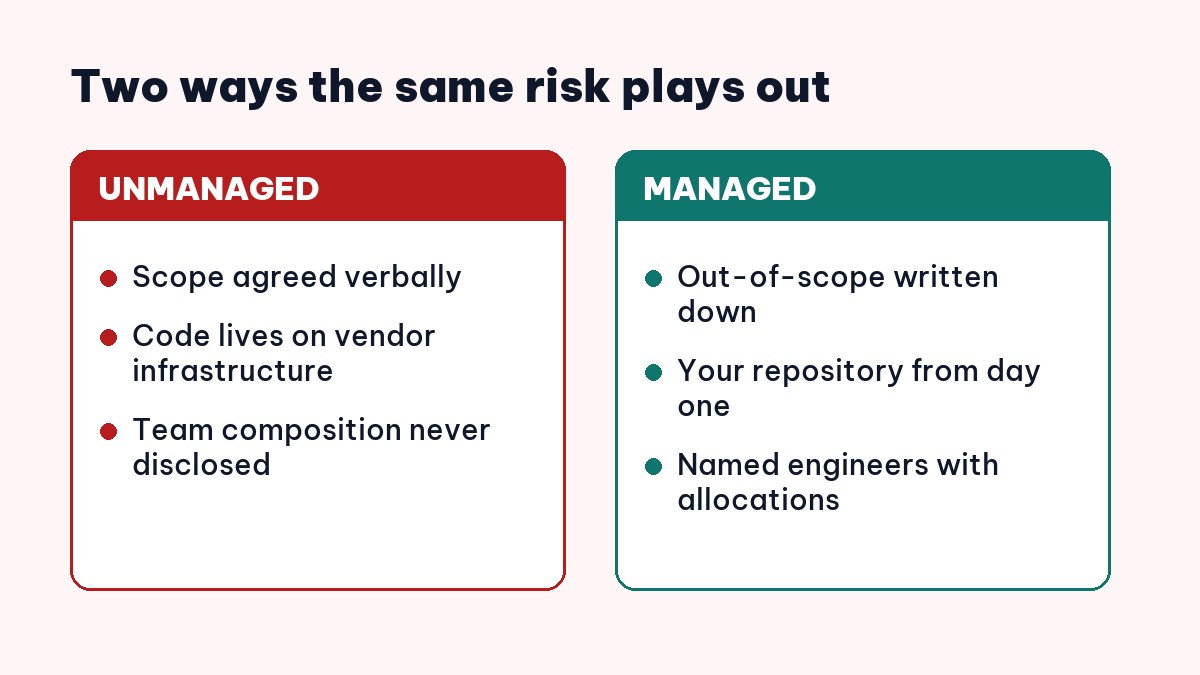
The control is boring and effective: a specification that lists what is out of scope as explicitly as what is in, plus a named decision-maker on the client side for each area. Vagueness always resolves in favour of whoever is billing.
Risk #2: Key-Person Dependency
Six months in, one engineer understands the payment flow, the migration history and the three decisions that must never be undone. When that person rotates off, you pay for the replacement to relearn it – at full rate, on your schedule.
The cost is invisible on invoices because it arrives as slowness rather than as a line item: slightly longer estimates, slightly more bugs, slightly more questions that used to be answered instantly.
This is the risk nobody quotes and everybody eventually pays. Ask for attrition figures and for named engineers with allocation percentages in the contract. Vietnam’s annual attrition runs 10-15% at well-run firms against 20-30% in larger markets; at Tinasoft, retention above 90% across a team of more than 300 people is the mechanism, not a slogan.
Software Outsourcing Risks #3: Quality Drift
Quality rarely collapses. It drifts – a skipped test here, a shortcut there, each one defensible under deadline. Twelve months later the codebase resists every change and nobody can point to the moment it happened.
Drift is hardest to catch precisely because each individual decision was defensible. That is why the control has to be structural rather than a matter of vigilance – a standard that applies whether or not anyone is watching that week.
Controls: a definition of done agreed in writing, automated tests required for merge, and code review by someone who did not write the code. Our guide to technical debt in outsourcing covers how to measure the drift before it compounds.
Risk #4: Intellectual Property Exposure
Many contracts assign intellectual property on final payment. Read that again: until the last invoice clears, the code may not be yours. If the relationship ends at month seven of twelve, the position is uncomfortable and the leverage is not yours.
Fix it at signature. Ownership from the first commit, a repository hosted under your organisation, and written confirmation covering any third-party or open-source components used. The detail is worked through in our IP protection guide.
Software Outsourcing Risks #5: Security Gaps
Your security posture becomes the weakest laptop with production access. Among software outsourcing risks this is the one most likely to appear in a customer audit rather than a status meeting.
The uncomfortable part is that you inherit the answer whether or not you asked the question. Enterprise customers will ask you, and pointing at a supplier is not an answer they accept.
Ask concrete questions: who has production credentials, how are they rotated, is access logged, what happens on an engineer’s last day, and is customer data ever copied into a development environment. Written answers, not reassurance. Our security checklist for outsourcing lists the full set.
Risk #6: Communication Latency
A question asked at 6pm and answered at 9am the next day costs a day. Ten such questions a sprint cost a fortnight, and the team fills the gaps by guessing.
Three to four overlapping hours is the practical minimum. Vietnam gives a fully shared working day with Singapore and five to six live hours with Australia; for US buyers the answer is a strong written layer plus deliberate handoffs, as covered in our guide to managing offshore teams.
Software Outsourcing Risks #7: Vendor Lock-In
Lock-in is rarely malicious. It accumulates: undocumented deployment steps, infrastructure in the vendor’s cloud account, credentials only their team holds. One day you price a switch and discover it costs more than the contract in dispute.
The practical remedy is a runbook that a stranger could follow: how the system is deployed, where the infrastructure lives, which accounts hold which credentials, and what the rollback procedure is. Vendors who keep that document current are not being generous – they are the ones confident enough to be replaceable.
The test is simple and worth running quarterly: if this vendor disappeared on Friday, could another team deploy on Monday? If the honest answer is no, that gap is the real exposure – and among software outsourcing risks it is the one that quietly removes your negotiating position.
Early Warning Signals
Failures announce themselves weeks before they are admitted, usually in the texture of communication rather than in the numbers.
Four signals precede most failures. Demos replaced by status percentages. Questions answered with reassurance rather than specifics. New names appearing in commits that were never introduced. And estimates that stop changing – a sign nobody is re-planning against reality.
Any one of them justifies a direct conversation the same week. All four together mean the gap between reported and actual progress has been open for a while.
How to Reduce Software Outsourcing Risks Before Signing
Five moves cover most of the exposure. Start with a paid pilot of two to four weeks rather than a full engagement – you are buying evidence, not discount. Take repository ownership from the first commit. Require named engineers with allocation percentages. Set milestone-based checkpoints so continuing is a decision rather than inertia. And write the exit clause while everyone is still friendly, because that is the only time it gets written fairly.
None of this requires distrust. It requires treating software outsourcing risks as engineering problems with known controls, rather than as things that happen to less careful buyers. Vendors worth working with agree to all five without argument – the reaction to the request is itself useful information.
FAQ: Software Outsourcing Risks
What are the biggest software outsourcing risks?
Scope ambiguity, key-person dependency, quality drift, IP exposure, security gaps, communication latency and vendor lock-in.
How do I reduce the risk of a failed project?
Paid pilot first, your repository from day one, sprint demos of working software, named engineers, milestone checkpoints.
Who owns the code?
You should, from the first commit – but only if the contract says so. Assignment on final payment leaves you exposed if things end early.
Is offshore riskier than local?
Same failure modes. Distance amplifies weak written practice, so a documenting remote vendor beats a local one that does not document.
What is the earliest warning sign?
Demos replaced by status percentages. Working software is the only honest progress report.
Every item here has a control that costs less than the risk. Handle software outsourcing risks at signature, when they are clauses, rather than at month seven, when they are disputes. See our transparent 2026 rate card →