

The Vietnam vs Philippines outsourcing decision usually comes down to one trade: the Philippines gives you the strongest English in Asia, and Vietnam gives you deeper engineering benches with lower turnover. Rates are close enough that price alone should not decide it. This guide compares both on 2026 numbers and shows which project types fit which country.
Key takeaways
- Senior rates: roughly $30-40/hour in Vietnam versus $20-32/hour in the Philippines – a narrower gap than most buyers expect.
- The Philippines leads clearly on spoken English and customer-facing roles, backed by an IT-BPM sector employing over 1.3 million people.
- Vietnam leads on complex product engineering and on stability, with attrition of 10-15% at well-run firms against 20-30% in larger outsourcing markets.
- Time zones are a non-factor: the two countries sit one hour apart, so both cover Singapore and Australia comfortably.
- The honest answer to Vietnam vs Philippines outsourcing is workload-dependent – support and voice work to the Philippines, product builds to Vietnam.
Table of contents
- Vietnam vs Philippines Outsourcing: The Short Answer
- Vietnam vs Philippines Outsourcing Rates in 2026
- Talent Pools: Depth Versus Breadth
- English and Communication: The Philippines Leads
- Vietnam vs Philippines Outsourcing on Team Stability
- Time Zones: Almost Identical
- Vietnam vs Philippines Outsourcing by Project Type
- The Hybrid Setup Larger Buyers Use
- Vietnam vs Philippines Outsourcing: How to Decide
- FAQ
Vietnam vs Philippines Outsourcing: The Short Answer
If your work is customer-facing – support desks, voice, content moderation, English-heavy QA – the Philippines is the stronger default. If your work is building and maintaining software that has to scale, Vietnam is the stronger default.
Both countries are genuine offshore destinations with mature vendor markets, not emerging bets. The mistake buyers make is treating them as interchangeable low-cost pools and picking on hourly rate. They evolved from different industries, and that history still shapes what each does best.
Vietnam vs Philippines Outsourcing Rates in 2026
Senior developer rates in Vietnam sit around $30-40 per hour, with the full range across seniority levels running roughly $18-30 for junior and $25-40 for mid-level engineers. In the Philippines, senior developers are commonly billed at $20-32 per hour, per Full Scale’s 2026 offshore rate comparison.
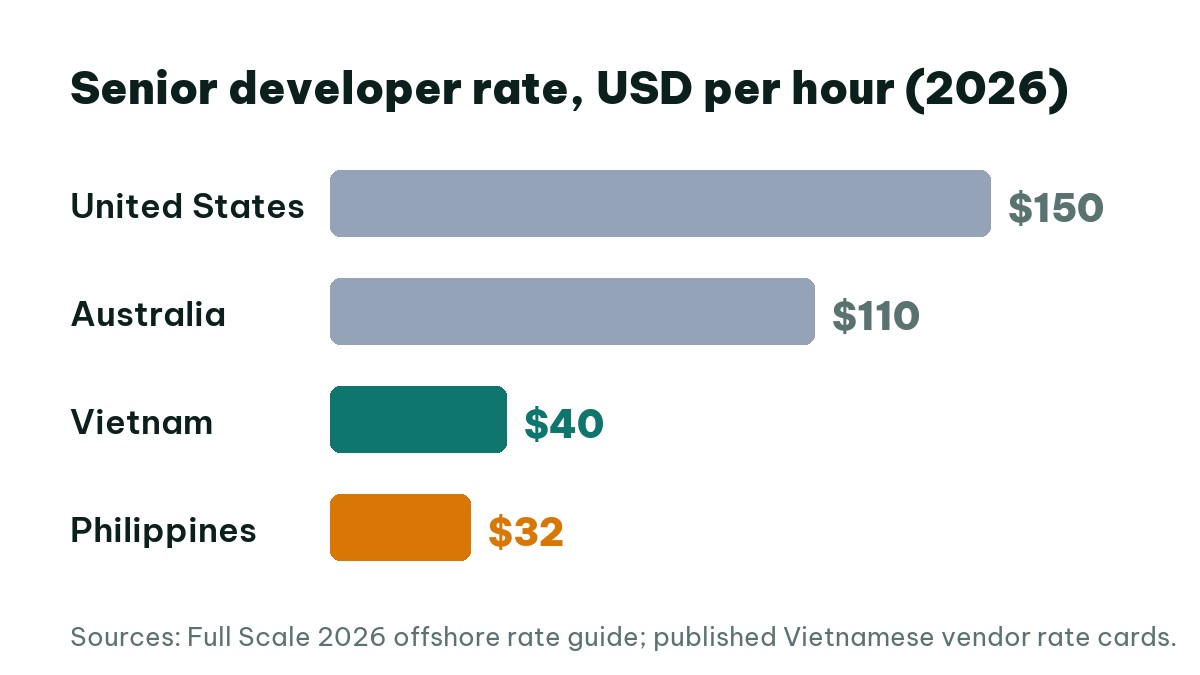
So the Philippines is roughly 10-20% cheaper at the senior end. That sounds decisive until you price the alternative: one avoidable re-architecture, or one senior engineer replaced mid-project, costs more than a year of that hourly difference on a small team. This is why Vietnam vs Philippines outsourcing rarely resolves on rate cards alone.
For context on where both sit against Western pricing, our published 2026 rate card shows the full Vietnamese picture, junior through tech lead.
Talent Pools: Depth Versus Breadth
The Philippine IT-BPM sector employs more than 1.3 million people – one of the largest outsourcing workforces on earth. But most of that headcount sits in business process work: customer service, finance and accounting, healthcare information management. The software engineering slice is real but proportionally smaller.
Vietnam’s base is narrower and more concentrated. Estimates put the engineering workforce somewhere above half a million, with tens of thousands of IT graduates entering each year. Nearly all of that capacity was built for software product work and export development, which is why the senior bench in cloud architecture, fintech, and embedded systems runs deeper than the raw numbers suggest.
English and Communication: The Philippines Leads
This is the Philippines’ clearest structural advantage, and pretending otherwise would be dishonest. The country consistently ranks at the top of Asia in English-proficiency indices, and decades of serving American clients have produced a workforce comfortable with idiom, phone conversations and live customer contact. Vietnam sits in the moderate band nationally.
The caveat matters for software buyers, though. In a development engagement, most communication is written: tickets, pull request comments, specifications, sprint notes. Engineers at Vietnam’s export-focused firms work in English every day, and the fluency gap narrows sharply once you compare software teams rather than national averages. For voice-first work, the Philippine advantage is decisive; for a delivery squad, it is a smaller factor than most buyers assume.
Vietnam vs Philippines Outsourcing on Team Stability
Turnover is the cost nobody quotes. Every engineer who leaves takes context with them, and the replacement bills full rate while relearning what the last one knew. Vietnam’s annual attrition runs 10-15% at well-managed firms, against 20-30% in larger, more saturated outsourcing markets.
The reason is competitive intensity: fewer multinational employers bidding for the same senior engineers means less churn. At Tinasoft, employee retention stays above 90% across a team of more than 300 people, which is the mechanism behind a simple promise – the squad that starts your project is the squad that finishes it. We covered why this metric outranks rate in our Vietnam vs India comparison.
Time Zones: Almost Identical
Vietnam is UTC+7, the Philippines UTC+8. One hour. Whatever you have read about timezone advantages, it does not separate these two countries.
Both give you a full overlapping working day with Singapore, Hong Kong and most of Southeast Asia, and five to six live hours with Sydney and Melbourne. Both require structured overnight handoffs for US clients, and both are inconveniently far from European working hours. If timezone is your deciding criterion, you are choosing between Asia and Latin America, not between these two.
Vietnam vs Philippines Outsourcing by Project Type
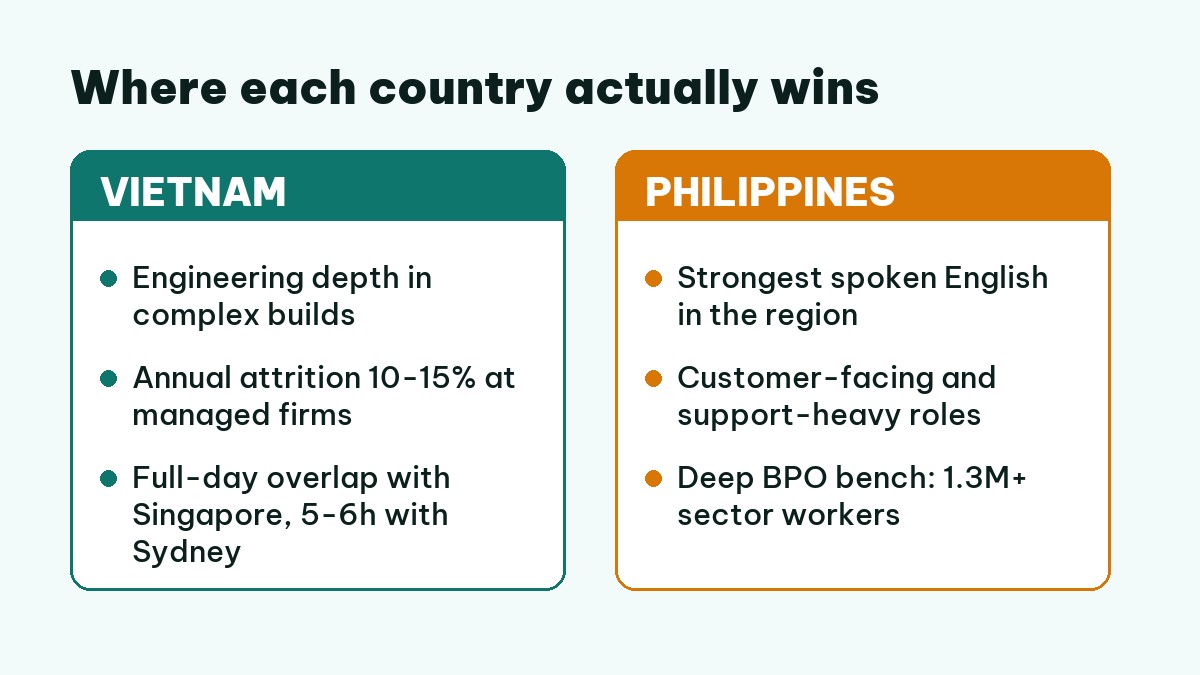
Matching workload to country is more useful than ranking the countries. Send to the Philippines: customer support and helpdesk, voice and chat operations, content moderation, English-heavy manual QA, back-office and data processing.
Send to Vietnam: product engineering and long-running platform work, mobile and web application builds, cloud and DevOps, data engineering, embedded and IoT, and dedicated squads that need to hold context for years. A dedicated development team is the model most product companies land on for that second list.
The Hybrid Setup Larger Buyers Use
Companies past roughly 15-20 offshore staff often stop choosing. They run engineering in Vietnam and support operations in the Philippines, each country doing what its market is built for.
The trade is management overhead: two vendors, two contracts, two escalation paths, and the coordination cost of making them talk to each other. Below about 15 people that overhead swamps the benefit, and you are better off picking the single country that fits your dominant workload. Above it, the specialisation usually pays for itself.
Vietnam vs Philippines Outsourcing: How to Decide
Four questions settle most cases. First: is the output software, or is it a service delivered by people? Software leans Vietnam; human-delivered service leans the Philippines. Second: how much live spoken English does the role need daily? Heavy voice contact leans Philippines.
Third: how long will this team exist? A team meant to run for years makes retention the dominant variable, which favours Vietnam. Fourth: how complex is the technical work? Deep architecture, regulated fintech, and performance-critical systems favour the deeper senior bench.
Whichever way Vietnam vs Philippines outsourcing resolves for you, run the same due diligence in both countries: ask for named engineers with allocation percentages, insist on repository access from day one, and start with a paid pilot rather than a signed year. Vendor quality varies more within each country than the countries vary from each other – a point our guide to evaluating Vietnamese vendors works through in detail.
FAQ: Vietnam vs Philippines Outsourcing
Is Vietnam or the Philippines cheaper for software outsourcing?
The Philippines is typically 10-20% cheaper at senior level – about $20-32/hour against $30-40/hour in Vietnam. The gap is narrow enough that delivery quality outweighs it on most projects.
Which country has better English?
The Philippines, clearly, especially for spoken and customer-facing English. For written technical communication inside a development team, the gap narrows considerably.
Which is better for complex software engineering?
Vietnam, generally – its industry grew from product and export software development rather than voice services, giving it a deeper senior engineering bench.
How different are the time zones?
One hour apart: Vietnam UTC+7, Philippines UTC+8. Time zone is not a differentiator between them.
Can I use both countries at once?
Yes – engineering in Vietnam, support and voice work in the Philippines. The added management overhead usually only pays off above roughly 15-20 offshore staff.
Vietnam vs Philippines outsourcing is not a ranking question, it is a matching question: send people-delivered service work to the Philippines and software engineering to Vietnam. If your next hire is an engineering team meant to last, start with transparent numbers. See our 2026 Vietnam rate card →