

The Vietnam vs India outsourcing decision comes down to a trade-off between scale and stability. India offers the world’s largest IT talent pool and unmatched enterprise delivery capacity; Vietnam offers a younger, less saturated market where senior engineers cost about the same but change jobs less often. This guide compares both honestly, with sourced 2026 data.
Key takeaways
- Vietnam vs India outsourcing rates are nearly identical for seniors: $30–55/hr vs $25–50/hr.
- India’s tech industry (~$300B, per NASSCOM) is roughly 100x Vietnam’s by revenue — scale is India’s advantage.
- Attrition at India’s top-six IT firms stabilised at ~12.7% (NASSCOM); some tech segments report up to 25%.
- Vietnam’s edge in the Vietnam vs India outsourcing comparison: senior-market stability and full AU/SG timezone overlap.
- The right answer depends on project size — not on which country is “better”.
Table of contents
Vietnam vs India Outsourcing: 2026 Rates Compared
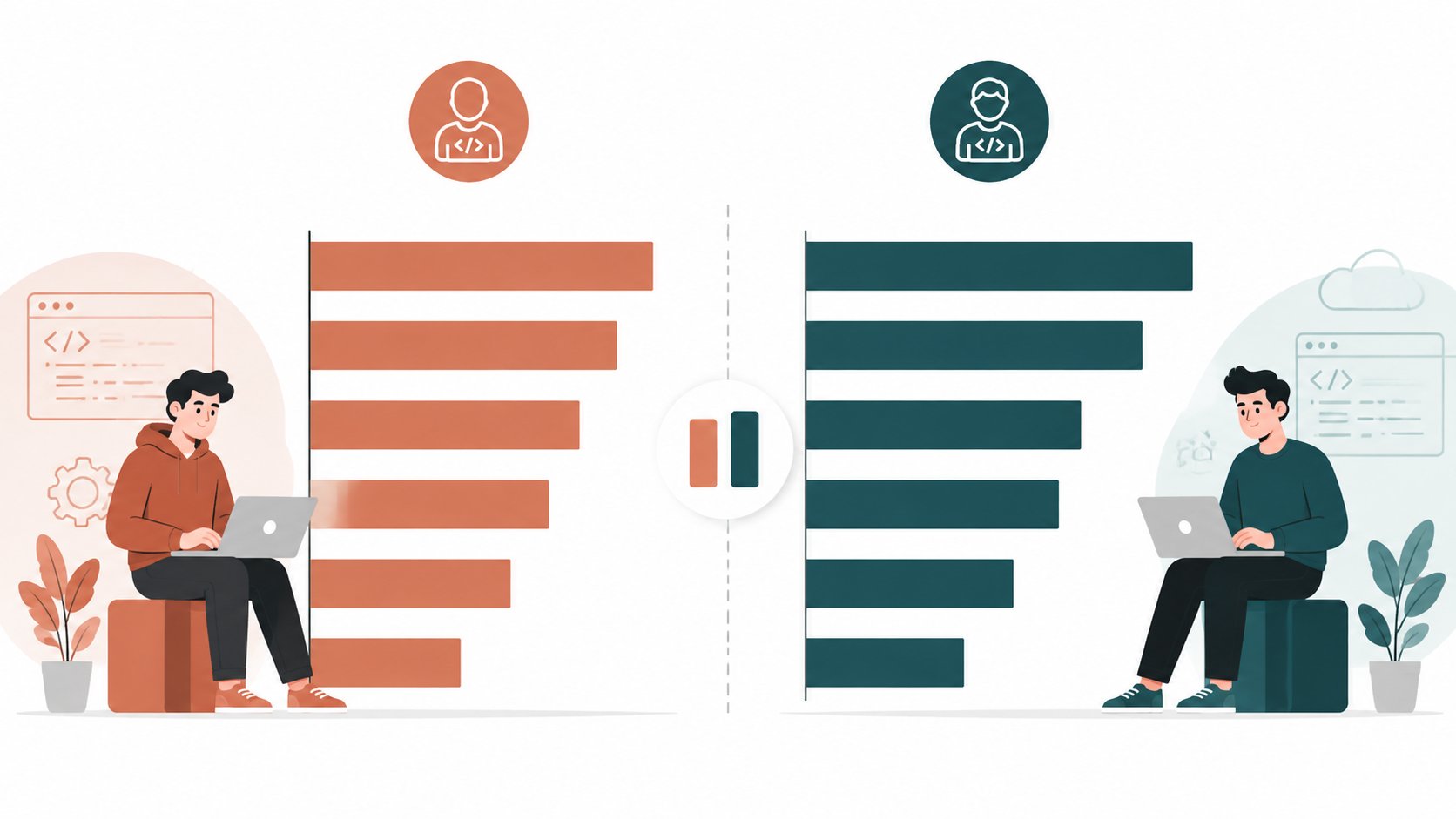
On price alone, the two destinations are nearly interchangeable. Senior developers bill $30–55/hour in Vietnam against roughly $25–50/hour in India. Tech leads run $45–70 in Vietnam and a comparable band in India’s major hubs. Junior rates overlap almost completely at $15–28/hour.
| Role | Vietnam (USD/hr) | India (USD/hr) |
|---|---|---|
| Junior developer | $18–28 | $15–25 |
| Senior developer | $30–55 | $25–50 |
| Tech lead / architect | $45–70 | $40–65 |
| QA engineer | $20–35 | $18–30 |
Because headline rates converge, the Vietnam vs India outsourcing question is decided by everything the rate card doesn’t show: how long your team stays together, how much rework ambiguity creates, and how many hours of live overlap your working day gets. That’s where the two markets genuinely differ.
Vietnam vs India Outsourcing: Talent Pools and Scale
India’s technology industry is projected to reach roughly $300 billion in revenue in FY2026, according to NASSCOM. Vietnam’s software outsourcing market, by comparison, sits near $2.6 billion (Mordor Intelligence) — India’s ecosystem is roughly 100 times larger by revenue.
That scale is not an abstraction. It means India can staff a 400-engineer banking program, offer certified expertise in nearly every enterprise vertical, and run genuine 24/7 support rotations. Vietnam’s pool — 650,000+ IT engineers, with about 55,000 graduates joining annually — is deep for product teams of 3 to 50, but it cannot match India’s capacity at the extreme high end.
Vietnam vs India Outsourcing: Attrition and Team Stability
Attrition is the metric that quietly decides outsourcing outcomes, because every engineer who leaves takes context with them. Here the data favors the smaller market. India’s top-six IT services firms saw attrition stabilise at 12.7% after seven quarters of decline, per NASSCOM’s industry review — a real improvement, though some Indian tech segments still report attrition as high as 25%.
Vietnam’s senior market is simply less saturated: fewer global captive centers competing for the same engineers means less quarterly poaching. Vendor-level numbers vary more than country averages, though — at Tinasoft we hold employee retention above 90%, and we’d encourage you to ask any vendor, in either country, for their retention figure in writing.

Vietnam vs India Outsourcing: Time Zones
Vietnam (GMT+7) and India (GMT+5:30) sit only 90 minutes apart, so for US and European clients the two are functionally equivalent — both rely on structured async handoffs for the west, and both overlap European mornings.
The difference appears for Asia-Pacific buyers. Vietnam shares a full working day with Singapore and sits three hours behind Sydney, giving Australian teams five to six hours of live overlap daily. For the fast-growing AU and SG buyer market, this is often the deciding factor in the Vietnam vs India outsourcing comparison — it converts an offshore engagement into something that feels nearshore.
When India Is Clearly the Better Choice
An honest comparison names the cases where the other side wins. Choose India when your program needs hundreds of engineers under one vendor, when you need deep bench strength in regulated enterprise verticals like banking, insurance, or telecom, or when certified 24/7 support at scale is a hard requirement. India’s mature ecosystem also offers more vendors with formal CMMI Level 5 and industry-specific compliance track records.
If that describes your project, our guide to enterprise-scale Vietnamese vendors is the wrong list — India’s tier-one firms are the right benchmark.
When Vietnam Is Clearly the Better Choice
Choose Vietnam when you’re building a product with a team of 3 to 50 engineers and want the same senior people on it for years, not quarters. Choose it when you’re an Australian or Singaporean company that wants live daily collaboration instead of overnight ticket exchanges. And choose it when budget efficiency matters but you’ve been burned by the churn that saturated markets produce.
This is the profile most of our clients fit — startups and mid-size companies that treat the development team as a long-term asset. Our comparison of Vietnamese vendors and offshore vs nearshore analysis cover how to evaluate the options within Vietnam.
Practical Differences the Numbers Don’t Show
A few operational differences matter more in practice than any rate table, and they cut both ways in the Vietnam vs India outsourcing comparison.
Language: English is an official working language of India’s IT industry, and enterprise-level documentation and communication reflect decades of that practice. Vietnam’s English proficiency is improving fast in the tech sector, but for documentation-heavy enterprise programs, India retains an edge. For product teams working through demos and daily standups, the difference is smaller than most buyers expect.
Holiday calendars: plan for both. Vietnam effectively pauses for a week or more around Tet (late January to mid-February, dates vary by year), while India’s holiday pattern is spread across regional festivals through the year. Neither is a problem — but a delivery schedule that ignores Tet, or assumes uniform Indian holidays across regions, will slip for entirely predictable reasons.
Vendor landscape shape: India’s market has a very tall top end (six firms with hundreds of thousands of engineers) and a vast long tail. Vietnam’s is flatter — a handful of firms above a few thousand people, then many stable mid-size and boutique teams. Practical consequence: in Vietnam, a mid-size buyer is more often a top-tier client of their vendor; in India, the same buyer may be a small account at a large firm, with the attention level that implies.
How to Decide: Three Questions
First, what’s your team size at peak? Under 50 engineers, both countries can serve you and stability should drive the choice; over 100, India’s scale advantage becomes decisive. Second, where are your working hours? Sydney and Singapore point to Vietnam; London and New York make the two nearly equivalent. Third, how long will this team exist? The longer the engagement, the more attrition compounds — and the more the stability question outweighs the rate card.
Whichever way your Vietnam vs India outsourcing decision goes, apply the same contractual checks: named engineers with allocation percentages, a written retention figure, client-owned repositories from day one, and milestone-based payment. Good vendors in both countries will agree to all four without hesitation.
FAQ: Vietnam vs India Outsourcing
Is Vietnam or India better for software outsourcing?
Neither is universally better. India wins on scale and enterprise delivery; Vietnam wins on senior-market stability and APAC timezone overlap. Match the destination to your project size and working hours.
Are Vietnam and India outsourcing rates similar in 2026?
Very close — senior developers run $30–55/hour in Vietnam and roughly $25–50/hour in India. Total cost differences come from team stability and rework, not the rate card.
Which country has lower developer attrition?
India’s top-six IT firms stabilised at about 12.7% (NASSCOM), with some segments up to 25%. Vietnam’s less saturated senior market generally churns less, but vendor-level numbers vary — ask for retention figures in writing.
When is India clearly the better choice?
Programs needing hundreds of engineers, regulated enterprise verticals, or certified 24/7 support at scale. India’s ecosystem is roughly 100x larger and has more of everything.
When is Vietnam clearly the better choice?
Product teams of 3–50 that want the same senior engineers for years, and Australian or Singaporean buyers who want live timezone overlap — see our transparent 2026 pricing for what that costs.
The Vietnam vs India outsourcing debate has no universal winner — but your project has one. Size, hours, and horizon answer it in about five minutes, and both answers are legitimate. If yours points to Vietnam: see our transparent 2026 pricing →