

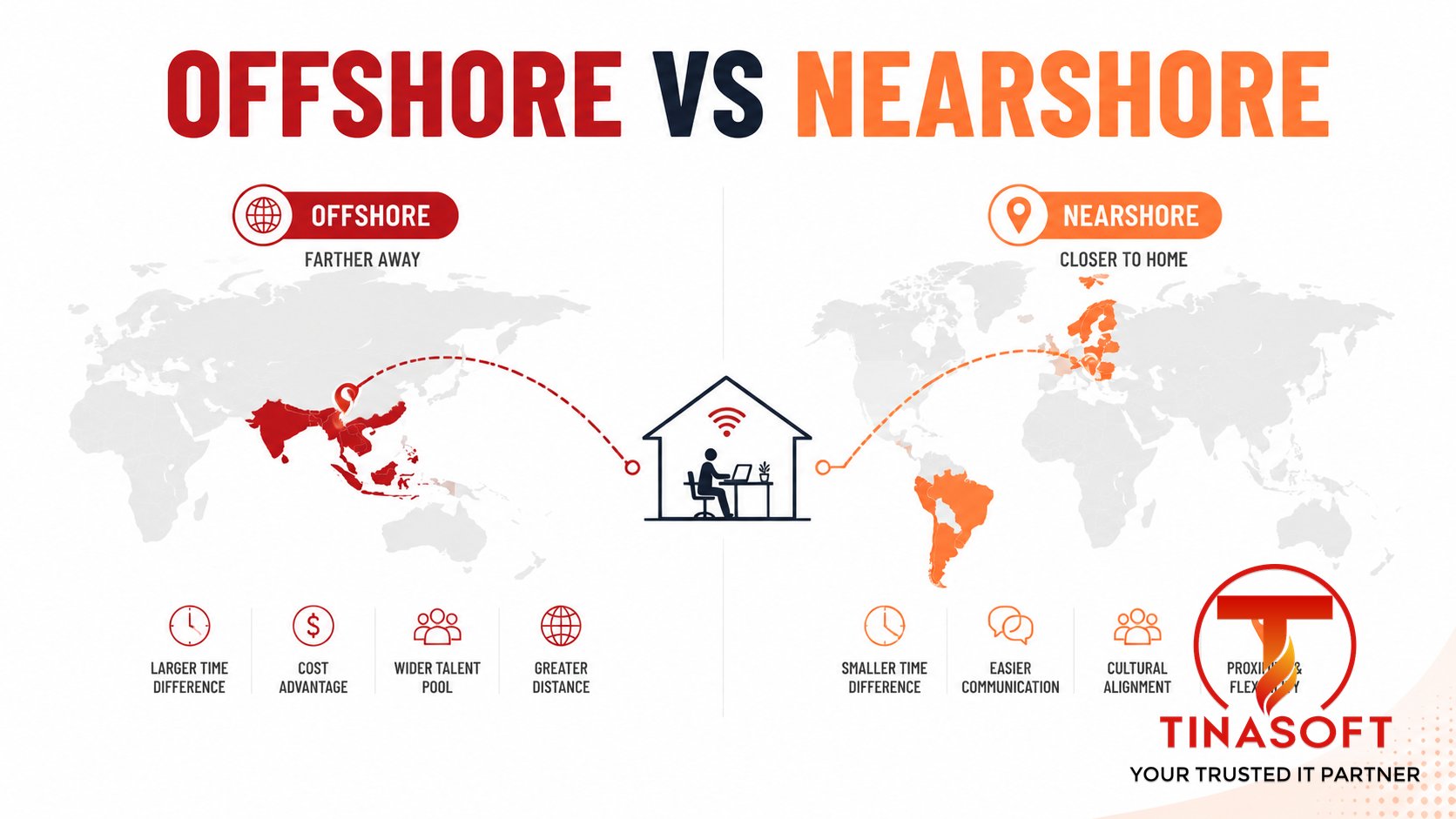
Choosing between offshore vs nearshore software development comes down to one trade-off: nearshore buys you closer time zones and easier culture fit, while offshore buys you deeper talent pools and lower hourly rates. Neither model is “better” in the abstract — the right pick depends on your budget, how much daily overlap your team actually needs, and how mature your outsourcing process already is.
This guide breaks down real 2026 rates, the time zone math that actually matters, and the specific situations where each model wins — so you can match the decision to your project instead of picking whichever term shows up first in a sales pitch.
What Is Offshore Software Development?
Offshore software development means hiring a team in a country far from yours, usually on another continent, with little to no working-hour overlap. Vietnam, India, and the Philippines are the most common offshore hubs for US and European companies. The appeal is straightforward: significantly lower hourly rates without giving up technical depth, since offshore hubs like Vietnam now graduate over 50,000 IT engineers a year.
Offshore rates in 2026 typically run $25–$50 per hour, well below onshore US rates of $100–$200+. The trade-off is a time zone gap of 10–12 hours in many cases, which means real-time daily standups are hard and async communication (written specs, recorded demos, shared docs) becomes the default way of working.
What Is Nearshore Software Development?
Nearshore software development means hiring a team in a nearby or same-region country, typically with 0–4 hours of time difference. For US companies, that means Mexico, Brazil, or other LatAm countries. For Western Europe, it means Eastern Europe or North Africa. The main draw is overlapping business hours for live meetings and faster turnaround on quick questions.
Nearshore rates sit in the middle: roughly $23–$90 per hour depending on seniority and country, with LatAm mid-level developers commonly at $50–$60/hr. You pay a premium over offshore for the convenience of same-day, same-timezone collaboration — useful when a project needs constant back-and-forth rather than well-defined deliverables.

Offshore vs Nearshore: Side-by-Side Comparison
The table below summarizes the practical differences founders and CTOs weigh most often when picking a model.
| Factor | Offshore | Nearshore |
|---|---|---|
| Typical hourly rate (2026) | $25–$50 | $23–$90 |
| Time zone overlap | 0–2 hours (often none) | 4–8 hours |
| Cost savings vs onshore US | 60–80% | 40–60% |
| Best communication style | Async-first (docs, recordings) | Live meetings, quick syncs |
| Talent pool size | Very large (Vietnam, India) | Smaller, more competitive |
| Best fit for | Well-scoped builds, MVPs, dedicated teams | Fast-changing scope, tight daily collaboration |
Real 2026 Cost Numbers
According to Deloitte’s Global Outsourcing Survey, 57% of companies name cost reduction as their primary reason for outsourcing, and most report saving 15–30% on operational costs once a program is running. Offshore delivers the largest raw savings — commonly 60–80% versus an equivalent US hire — while nearshore trades some of that saving for easier coordination.
The global outsourcing market itself reflects this split: offshore still accounts for roughly half of all outsourcing spend, while nearshore is growing faster as companies balance cost against collaboration speed. Neither number tells you which model fits your project — that depends on how much daily, real-time interaction your specific work actually requires.
The Time Zone Trade-off — Why It Matters More Than People Expect
Time zone overlap sounds like a minor detail until a project actually depends on it. A team with zero overlap effectively works async: they write specs instead of talking through them, record demo videos instead of live walkthroughs, and resolve ambiguity a full day later than a nearshore team would.
This is exactly where Vietnam’s position stands out among offshore hubs. Vietnam’s working hours overlap several hours with Europe’s morning, and its evening lines up with the US’s morning — so a well-run offshore team here can hand off work overnight and still join live calls when it matters, without the true zero-overlap problem of some other offshore regions.
The practical rule: if your project needs daily clarification on shifting requirements, weight nearshore or a hybrid model. If your project has a clear spec and needs deep technical execution at lower cost, a well-managed offshore team closes that gap without the nearshore premium.
When Nearshore Wins vs When Offshore Wins
Nearshore tends to win when your team is still discovering the product and requirements change weekly. It also wins when you need daily live standups with the same PM, or when your internal team has never managed a remote engineering team before and wants the safety net of overlapping hours.
Nearshore is also the safer default when client-facing demos happen on short notice during your own business hours, since there’s no overnight delay waiting for the other side’s workday to start. The premium you pay is essentially insurance against miscommunication while your process is still immature.
Offshore tends to win when the scope is well-defined — an MVP, a specific feature set, or a rebuild of an existing system where the requirements rarely shift mid-sprint. It also wins once you have, or can build, a lightweight async process: written specs, a shared backlog, and recorded demos instead of live walkthroughs.
Offshore is the stronger choice when cost efficiency matters more than same-hour turnaround, or when you want a long-term dedicated team rather than short bursts of contractor help. Companies running a second or third project with the same offshore partner almost always report the async process gets easier, not harder, over time.
Common Mistakes When Choosing a Model
The most common mistake is picking nearshore purely for the time zone convenience without checking whether the vendor actually has the technical depth the project needs — proximity doesn’t substitute for expertise. The second most common mistake is the opposite: choosing offshore purely on price, then discovering the vendor has no real async process, so every ambiguous requirement stalls the project for a full day.
A third mistake is treating the decision as permanent. Many companies start nearshore for the discovery phase, then shift the bulk of engineering to an offshore dedicated team once the product direction stabilizes — capturing the cost savings only after the requirements risk has dropped. Locking into one model for the entire product lifecycle usually leaves savings on the table.
How Tinasoft Bridges the Offshore Gap
Tinasoft has delivered 300+ projects as an offshore partner based in Vietnam, and the recurring lesson is that the time zone gap is a process problem, not a distance problem. Every engagement starts with a signed NDA before any project detail is shared, followed by a discovery call that maps out which decisions genuinely need real-time discussion versus which can move async.
From there, teams get a dedicated project manager who works a shifted schedule to cover live overlap hours with US and European clients, written weekly demos for anything that can’t be scheduled live, and a documented handover process so nothing depends on tribal knowledge. See our transparent 2026 pricing for exact offshore rates by engagement model, or explore our dedicated offshore team (ODC) services if you’re planning a long-term build.
Clients typically notice the difference in the first two weeks: instead of waiting a full day for an answer, they get a recorded walkthrough or a written decision log before their own workday even starts, because the Vietnam team already worked through the question overnight. That overnight-handoff rhythm is what turns a 12-hour time zone gap from a liability into a quiet advantage — the work keeps moving while your own team sleeps.
FAQ
Is offshore development riskier than nearshore?
Not inherently — the risk comes from unclear specs and weak async process, not distance itself. A well-run offshore team with documented requirements and a dedicated PM performs as reliably as nearshore for well-scoped work.
Can I mix offshore and nearshore on the same project?
Yes. Many companies keep a small nearshore or onshore team for product discovery and client-facing work, then use an offshore dedicated team for the bulk of engineering execution once scope stabilizes.
Does Vietnam count as offshore or nearshore for US companies?
Offshore. Vietnam sits roughly 12 hours from US Eastern time, but its evening hours overlap with US mornings, which is why many US clients treat a Vietnam-based team more like a “24-hour handoff” partner than a fully disconnected offshore option.
How much can I realistically save going offshore vs nearshore?
Offshore typically saves 60–80% versus onshore US rates; nearshore typically saves 40–60%. The gap between the two models is usually the price of same-timezone convenience, not a difference in code quality.
What size team makes sense to start offshore?
Most companies pilot offshore with a small dedicated team of 2–4 engineers plus a project manager before scaling up. This keeps onboarding overhead low while your internal team builds confidence in the async process, then you add headcount once the working rhythm is proven.
Offshore vs nearshore isn’t a permanent choice — it’s a fit-to-project decision you can revisit as your product matures. If your scope is clear and cost efficiency matters, offshore with a disciplined partner closes the distance gap. See our transparent 2026 pricing →