


Time-to-market software outsourcing works because it removes the two slowest parts of building in-house: hiring qualified engineers and ramping them up on a new codebase. Well-run outsourcing partners skip both steps, which is why outsourced builds routinely launch weeks or months ahead of an equivalent in-house effort.
This guide breaks down what delay actually costs, why internal teams lose the speed race even with good engineers, and exactly how a disciplined outsourcing partner compresses the timeline without cutting corners on quality.
None of this is about working longer hours or skipping steps — the gains come from structural changes: parallel workstreams instead of sequential handoffs, a team that’s already assembled instead of one still being recruited, and decision-making that doesn’t wait on multiple layers of internal sign-off.
What a Slow Time-to-Market Actually Costs
Delayed time-to-market is the single biggest barrier to revenue growth according to 46% of companies surveyed in the 2025 Monetization Monitor. It isn’t a minor inconvenience — it’s the top reason products underperform their revenue targets.
The problem is widespread: VDC Research’s 2024 Voice of the Engineer Survey found that at least 34% of software projects run behind schedule. A three-month delay doesn’t just push your launch date back — it hands competitors a head start to capture the customers, pricing power, and brand recognition that come with being first.
Why Internal Teams Often Lose the Speed Race
It’s rarely a talent problem. Internal teams lose time to three structural issues: hiring takes months even for a strong employer brand, new hires need weeks to become productive on an unfamiliar codebase, and existing staff get pulled into production support instead of focusing fully on the new build.
None of these are signs of a bad team — they’re the fixed overhead of building software with people who also own yesterday’s systems. An outsourcing partner sidesteps all three because the team is already hired, already experienced with similar builds, and has no competing production responsibilities on your stack.
There’s also a decision-speed cost that rarely shows up on a project plan. Internal teams often route architecture and design choices through several layers of internal approval, each adding days of waiting even when the actual decision takes minutes to make. A dedicated outsourcing team typically has a single point of contact empowered to approve day-to-day technical decisions, which removes an entire category of waiting time that has nothing to do with engineering speed at all.

How Outsourcing Compresses the Timeline
According to McKinsey’s research on innovation speed, one company cut its software time-to-market by roughly 25% simply by investing in automated testing, deployment, and infrastructure — the same disciplined delivery practices an experienced outsourcing team brings on day one instead of building from scratch.
A mature partner also runs workstreams in parallel instead of sequentially: backend, frontend, and QA move at the same time rather than waiting on each other, because the team already has the specialized roles filled rather than one generalist context-switching between all three.
Time-to-Market Comparison: Three Common Paths
The table below compares the realistic timeline for the same mid-sized MVP under three common approaches.
| Approach | Typical time to first launch | Main bottleneck |
|---|---|---|
| Hire an in-house team from scratch | 4–7 months | Recruiting + onboarding before any code ships |
| Pull existing staff off other projects | 3–5 months | Constant context-switching, competing priorities |
| Fixed-price MVP with an experienced outsourcing partner | 4–8 weeks | Requires a clear spec before work starts |
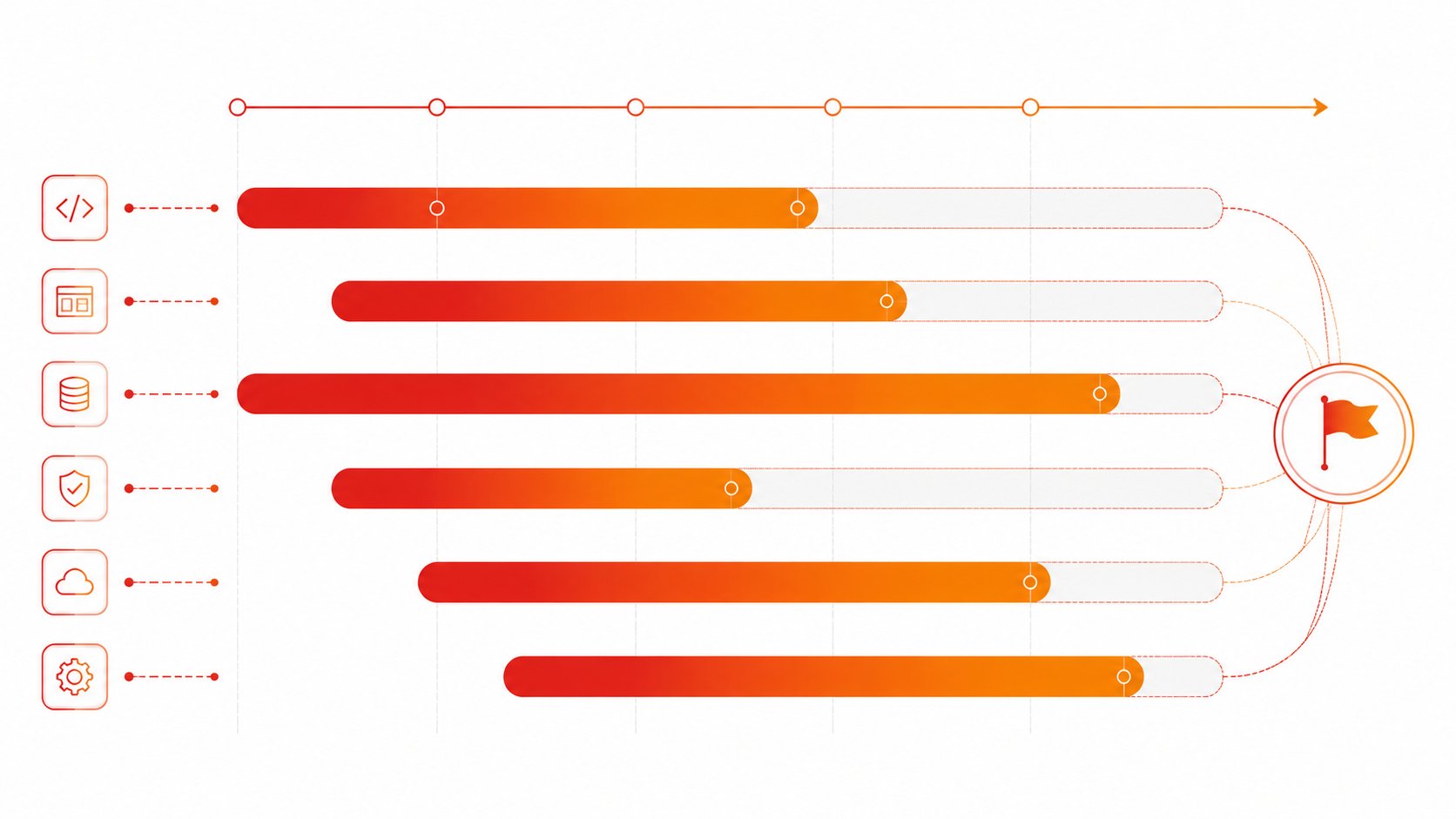
A Week-by-Week Look at a 6-Week MVP Timeline
Concrete numbers make the speed advantage easier to evaluate than a vague “we’re fast” claim. A typical fixed-price MVP under an experienced outsourcing partner breaks down roughly like this, assuming the spec is locked before week one starts.
Week 1 covers technical architecture and UI/UX wireframes in parallel, not sequentially. Weeks 2–4 run backend and frontend development side by side, with QA writing test cases against the agreed spec rather than waiting until code is “done” to start. Week 5 is integration and a first full QA pass. Week 6 is bug-fixing, a client demo, and deployment. Nothing here is unusually fast — it’s simply not sequential, and nothing is waiting on a hiring process that hasn’t finished yet.
Time-to-Market Isn’t the Only Metric That Matters
Speed for its own sake can backfire. A product that launches in three weeks but breaks under real traffic, or ships without basic security review, trades one delay for a worse one — an emergency fix cycle after launch, often with angry users watching. The goal isn’t the fastest possible launch; it’s the fastest launch that still holds up once real customers show up.
This is why the week-by-week breakdown above keeps QA running throughout the build instead of squeezing it into the final days. A team that treats testing as a parallel workstream from week one catches issues while they’re still cheap to fix, rather than discovering them during a rushed pre-launch scramble.
Mistakes That Slow Down Outsourced Projects Anyway
Outsourcing doesn’t automatically guarantee speed. The most common mistake is starting development before requirements are actually settled — every clarification cycle after kickoff adds days, and unclear specs are the top cause of scope creep, which quietly extends timelines further.
The second mistake is picking a vendor without a dedicated, available team — some outsourcing firms stretch developers across multiple clients, which reintroduces the exact context-switching delay you were trying to outsource away from.
A third, subtler mistake is choosing the cheapest bid without checking whether the team has shipped a comparable project before. A team building its first e-commerce checkout flow will hit the same discovery mistakes an in-house team would — the speed advantage of outsourcing comes specifically from reused, battle-tested patterns, not just from being external.
Why Some “Fast” Outsourcing Vendors Actually Aren’t
Not every vendor that promises speed delivers it. A common red flag is a quote that skips a scoping or discovery phase entirely — a team that starts coding on day one without a locked spec is usually setting up for expensive rework later, not moving faster overall.
Another red flag is a vendor unwilling to name the specific engineers on your project before the contract is signed. If a vendor can’t confirm who is actually available to start immediately, “fast” often means fast to sign, not fast to ship — the real ramp-up still happens after the contract, just less visibly.
How Tinasoft Compresses Time-to-Market
Tinasoft has shipped 300+ projects on a standard MVP timeline of 4–6 weeks, which is only possible because the discovery phase happens before the clock starts — not during it. Every engagement begins with a scoping call that locks the spec, followed by parallel backend, frontend, and QA workstreams from day one instead of a sequential handoff between teams.
Clients get a dedicated team that isn’t shared across other projects, so there’s no competing priority pulling engineers away mid-sprint. See transparent 2026 pricing for MVP timelines by project size, or explore our web and app development services for a scoping conversation.
FAQ
How much faster is outsourcing than hiring in-house for an MVP?
An in-house hire-to-launch cycle typically runs 4–7 months once recruiting and onboarding are counted. A fixed-price MVP with an experienced outsourcing partner and a locked spec commonly launches in 4–8 weeks.
Does faster time-to-market mean lower quality?
Not when the speed comes from parallel workstreams and reused delivery processes rather than skipped testing. The riskiest way to go faster is cutting QA; the reliable way is removing hiring and ramp-up time, which outsourcing does without touching quality gates.
What’s the single biggest thing that slows down an outsourced project?
An unclear or shifting spec. Every ambiguous requirement becomes a clarification cycle, and clarification cycles are what turn a planned 6-week build into a 12-week one.
Can outsourcing help speed up a project that’s already behind schedule?
Sometimes, but adding an outsourced team to an already-late project carries the same onboarding tax as adding any new team — see our services overview to discuss whether augmenting or replacing the current approach fits better.
How do I know if a vendor’s speed promise is realistic?
Ask for the week-by-week breakdown, not just a final date. A vendor that can name what happens in week 1 versus week 4 has actually planned parallel workstreams; a vendor that only gives a single end date is more likely estimating optimistically than planning concretely.
Does a locked spec mean the product can never change after launch?
No — locking the spec applies to the initial MVP scope only. Most products evolve significantly after the first launch based on real user feedback, which is exactly why shipping the first version faster matters: it gets real data sooner rather than later.
Time-to-market is rarely lost in one dramatic moment — it leaks away through hiring delays, onboarding time, and context-switching that internal teams absorb as “normal.” A disciplined outsourcing partner removes that overhead by design. See our transparent 2026 pricing →