

AI Coding Tools and Software Outsourcing: What Actually Changes in 2026
AI coding tools like GitHub Copilot, Cursor, and Claude Code have triggered a real question among technology leaders: does software outsourcing still make sense when AI can write code? The honest answer is nuanced — AI coding tools change the economics of software outsourcing significantly, but they don’t eliminate the need for skilled teams. Here’s what genuinely changes in 2026, and what doesn’t.
Why This Question Is Suddenly Urgent
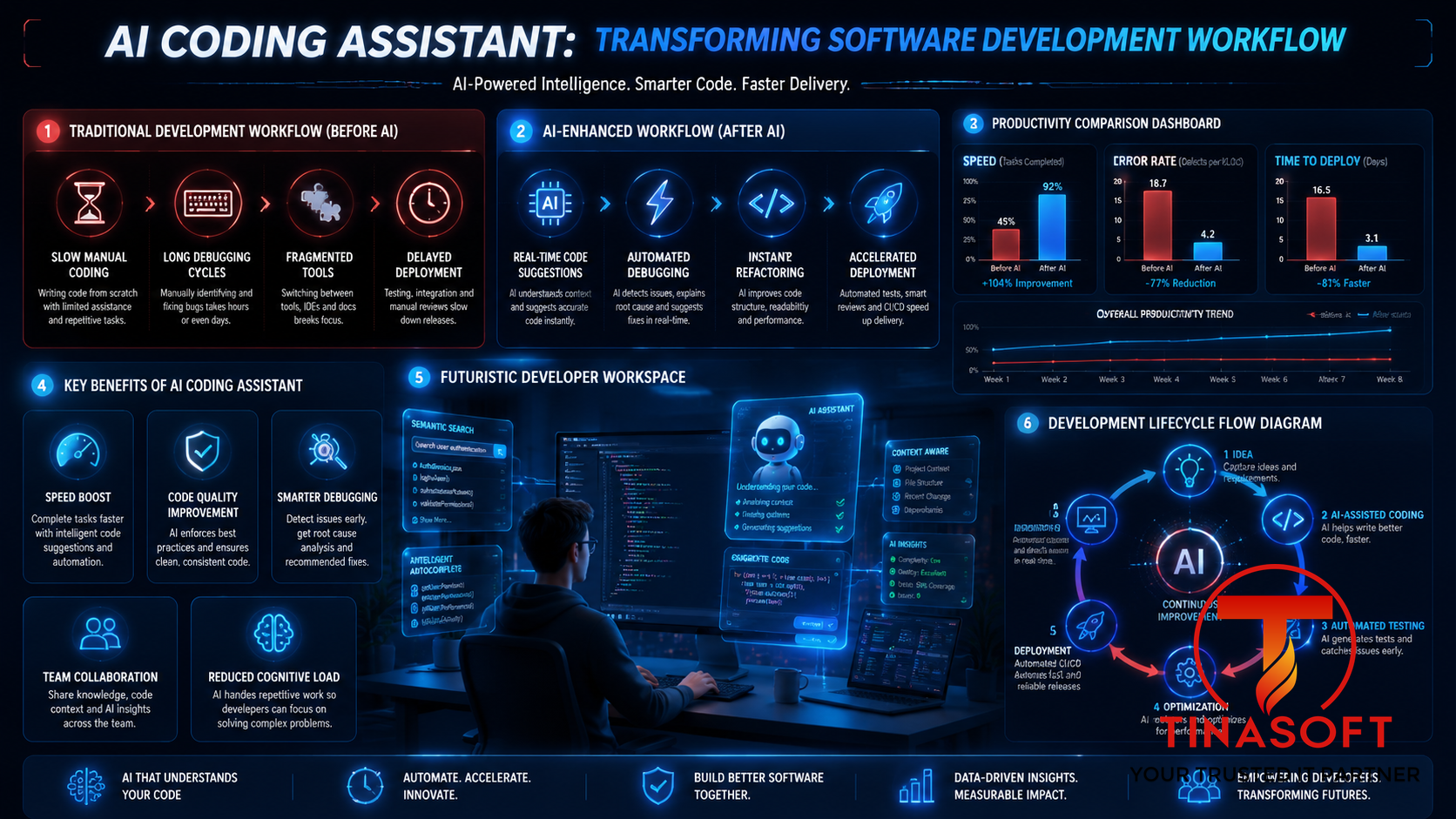
Adoption of AI coding tools crossed a tipping point in 2025: GitHub reported over 90% of Fortune 500 companies using Copilot in some capacity, and independent studies (Stanford, McKinsey) measured 30-55% productivity gains on well-scoped tasks. For companies evaluating software outsourcing budgets, this raises a fair question — if AI writes the code, what exactly are you paying an outsourcing vendor for?
What Genuinely Changes With AI Coding Tools
1. Junior-Level Work Gets Commoditized
Boilerplate code, CRUD operations, standard API integrations, and basic test generation are now largely automated. Vendors that built their pricing model around staffing junior developers for repetitive work are the most exposed — that value proposition has largely evaporated.
2. Delivery Velocity Increases 30-55% for Skilled Teams
Teams that integrate AI coding tools into a disciplined workflow — code review, architecture planning, testing — ship measurably faster. This isn’t hypothetical: Tinasoft’s own delivery data across 2025-2026 projects shows sprint velocity increases in this exact range, without regression in code quality metrics.
3. The Value Proposition Shifts to Judgment
AI writes code; it doesn’t decide what to build, how to architect a system for 10x scale, or when a “quick fix” will create six months of technical debt. The software outsourcing partners that remain valuable are the ones whose engineers make better decisions — not the ones who type faster.
4. Pricing Models Are Adjusting
Some outsourcing vendors have begun shifting from pure hourly billing toward outcome-based or fixed-scope pricing, since AI tools compress the time-to-deliver for well-specified work. Clients should expect this conversation to come up in vendor negotiations increasingly through 2026-2027.
What Doesn’t Change
- Requirements discovery — understanding what a business actually needs still requires human judgment and stakeholder conversations AI cannot conduct alone.
- System architecture — AI suggests patterns; it doesn’t own accountability for a system’s long-term maintainability.
- Security and compliance judgment — AI-generated code still requires human review for security vulnerabilities, especially in regulated industries.
- Client communication and trust — a technology partner’s ability to flag risk early and communicate honestly remains entirely human.
How to Evaluate a Software Outsourcing Partner in the AI Era
| Old Question | 2026 Question |
|---|---|
| How many developers do you have? | How does your team use AI tools in daily workflow? |
| What’s your hourly rate? | What’s your measured delivery velocity on comparable projects? |
| Can you staff this fast? | How do you review and validate AI-generated code? |
How Tinasoft Approaches AI-Augmented Software Outsourcing
Tinasoft has integrated AI coding tools as standard practice across all engineering teams since 2025. Every engineer is trained to use AI as a productivity multiplier — not a substitute for architectural thinking, security review, or client communication. Our approach:
- Senior-led AI workflows: AI accelerates senior engineers; it doesn’t replace their judgment.
- Documented review process: every AI-assisted commit goes through the same code review rigor as human-written code.
- Transparent velocity reporting: clients see real sprint metrics, not vague productivity claims.
Explore Tinasoft’s software outsourcing services →
Frequently Asked Questions
Q: Should I outsource less now that AI coding tools exist?
A: Not necessarily — you should outsource more deliberately. Look for partners who’ve operationalized AI tools with measurable results, not just marketing claims.
Q: Will AI coding tools reduce my outsourcing costs?
A: For well-scoped, standard work — yes, expect this reflected in vendor pricing. For complex, ambiguous, or high-stakes systems, expertise still commands a premium.
Q: How do I verify a vendor actually uses AI tools effectively?
A: Ask for specific before/after velocity metrics on comparable projects, and ask to see their code review process for AI-assisted commits.
Q: Is AI-generated code as secure as human-written code?
A: Only with proper review. AI tools can introduce subtle vulnerabilities; reputable outsourcing partners apply the same security scanning and review standards regardless of how code was drafted.
Q: What skills should outsourcing teams prioritize in the AI era?
A: System design, security expertise, and business domain understanding — the skills AI tools amplify but cannot replace.
Curious how AI-augmented outsourcing could work for your project?
Tinasoft offers a free 30-minute consultation. Book your free consultation →
Further reading: McKinsey Digital insights on AI in software development.