

Two competent vendors read the same brief and return numbers that differ by a factor of three. Buyers usually read that as one being greedy and the other efficient. Almost always, the real explanation is duller: they are pricing different assumptions. This guide explains how software project estimation actually works, what a usable estimate contains, and how to compare two quotes without guessing.
Key takeaways
- An estimate without written assumptions is a guess wearing a suit – the assumptions are the estimate.
- Early numbers are wide by nature; they narrow when unknowns are resolved, not when deadlines get closer.
- PMI found 37% of organisations cite inaccurate requirements gathering as the primary cause of project failure.
- Comparing quotes fairly means normalising scope first: add the missing phases at each vendor’s own rates.
- Good software project estimation states what is excluded as clearly as what is included.
Table of contents
- Why Software Project Estimation Varies So Much
- What a Usable Estimate Contains
- The Cone of Uncertainty
- Software Project Estimation Starts With Requirements
- The Phases Quotes Quietly Omit
- How to Compare Two Software Project Estimations
- Estimate, Quote and Commitment Are Not the Same
- Five Questions to Ask About Any Estimate
- Software Project Estimation Red Flags
- FAQ
Why Software Project Estimation Varies So Much
Rates explain less of the gap than buyers expect. The larger driver is scope interpretation. One vendor assumes you provide finished designs, a test environment and your own project manager. Another assumes they will do discovery, design, QA, deployment and a month of post-launch support.
Seniority assumptions widen the gap further. A quote built around two senior engineers and one built around four juniors can land on similar totals while describing very different projects – and very different outcomes six months later.
Both can be honest. Neither is comparable to the other until someone writes down which phases each number covers. This is why the first question about any estimate is not “how much” but “what is in it”.
What a Usable Estimate Contains
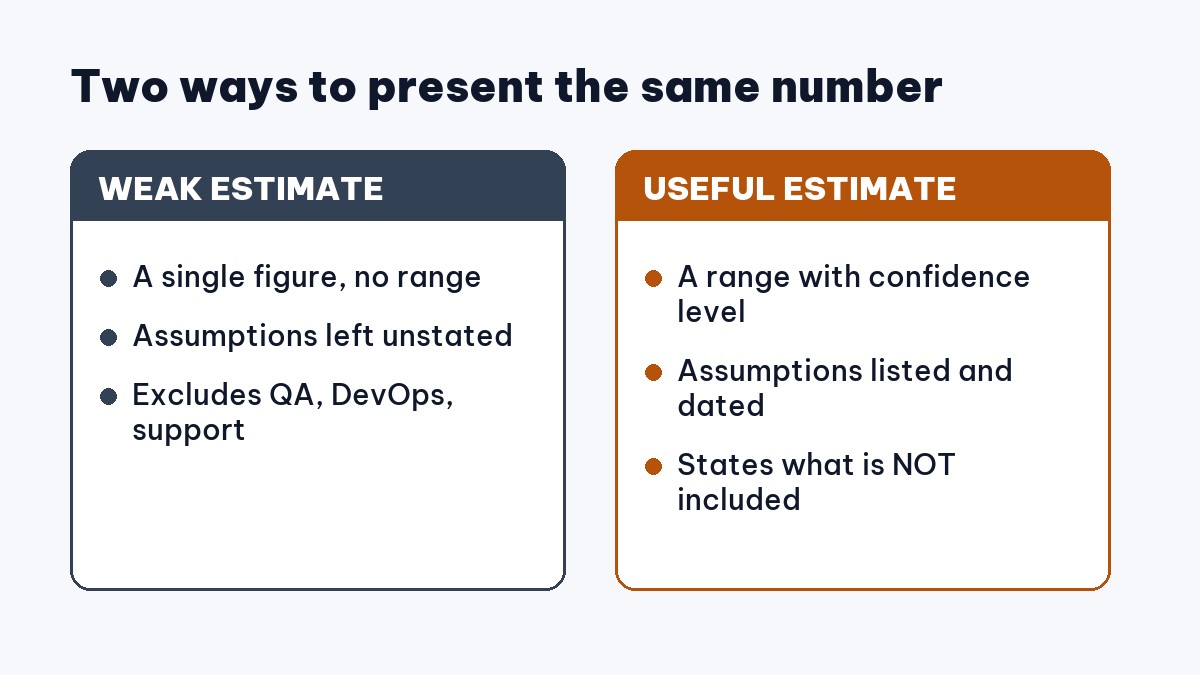
Four elements separate an estimate from a number. A range rather than a point, because a single figure implies a precision nobody has at the start. The assumptions it rests on, written in plain language. An explicit exclusion list. And the date it was produced, because estimates decay as the brief changes.
Ranges also communicate something a single number cannot: how much the team knows. A tight range on a familiar build is credible. A tight range on an unfamiliar integration usually means nobody has looked hard enough yet.
The exclusion list does most of the work in practice. “Does not include data migration from the legacy system” prevents an argument in month four far more reliably than any contract clause written afterwards.
The Cone of Uncertainty
Software engineering literature describes a pattern known as the cone of uncertainty: estimates made before requirements and architecture are settled span a wide range, and the range narrows as real unknowns are resolved.
The practical consequence is uncomfortable but useful. If you want a narrow number, you have to buy the work that narrows it – discovery, a technical spike, a prototype of the risky integration. Demanding precision before that work exists does not produce precision; it produces a confident number that will move later.
Software Project Estimation Starts With Requirements
Most estimation failures are requirement failures wearing a different label. PMI’s Pulse of the Profession research on requirements management found 37% of organisations cite inaccurate requirements gathering as the primary cause of project failure, and 47% of unsuccessful projects missed goals because requirements were managed poorly.
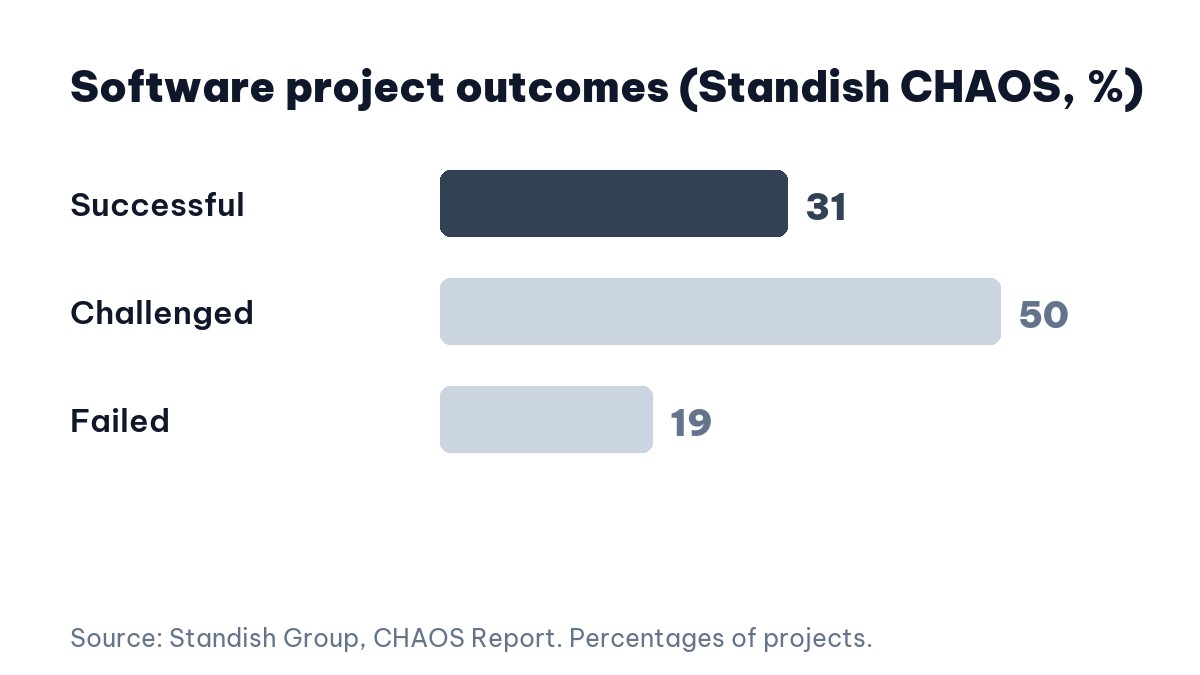
Against that backdrop, the Standish Group’s CHAOS research finds roughly 31% of software projects finish fully successfully, with about half challenged. Estimates are not the cause of those outcomes, but they are where the ambiguity first becomes visible – and the cheapest place to fix it. Our guide to the software discovery phase covers how to remove that ambiguity before the number is fixed.
The Phases Quotes Quietly Omit
Six items disappear from optimistic quotes with striking regularity: discovery and requirements work, UX design, quality assurance, DevOps and deployment setup, third-party licences, and post-launch support.
Post-launch support deserves particular attention, because it is the one item that never ends. A product with no maintenance budget does not stay still – it slowly stops working as operating systems, browsers and libraries move underneath it.
None of these are optional in a working product; they are simply easier to leave out of a document. When one quote is dramatically lower than another, the difference is usually sitting in this list rather than in engineering productivity.
How to Compare Two Software Project Estimations
Normalise before comparing. Write the phases down the left of a sheet, mark which quote covers which, then price the gaps at that same vendor’s own rates. The exercise takes an hour and usually collapses most of the apparent difference.
Keep that comparison sheet after you sign. When scope changes later, the same sheet shows which phase the change belongs to, which turns a potential argument into a short administrative conversation.
Then compare what remains on three things: who does the work and at what seniority, how change will be priced when scope moves, and what happens after launch. A quote that wins on total but has no answer for the second question is not cheaper – the discount simply arrives as change requests later.
Estimate, Quote and Commitment Are Not the Same
An estimate is a professional judgement of likely effort. A quote is a commercial offer at a price. A commitment is a promise with consequences attached. Vendors and buyers routinely blur the three, and most disputes start there.
Writing down which of the three you are holding at each stage costs nothing. The ambiguity, left in place, is what later gets argued about in an email thread nobody enjoys.
Ask explicitly which one you are holding. A useful vendor will say plainly: this is an estimate at this confidence level, it becomes a quote after discovery, and it becomes a commitment when the scope is signed. The commercial model that follows from this choice is covered in our comparison of fixed price and time and materials.
Five Questions to Ask About Any Estimate
What assumptions is this built on? What is explicitly excluded? Which phases does it cover end to end? Who produced it – the engineers who will build it, or a salesperson? And what would have to be true for this number to double?
It is also worth asking how the vendor handled a past estimate that turned out wrong, because every experienced team has one. The answer reveals whether they re-estimate openly or quietly absorb the difference until it surfaces as a delay.
That last question is the most revealing one in the set. A team that has thought seriously about the work answers immediately and specifically, usually naming an integration or a data problem. A team that has not will reassure you instead.
Software Project Estimation Red Flags
A single precise figure with no range. No assumptions attached. An estimate produced without anyone technical reading the brief. A number that arrives within an hour of a complex requirement being sent. And an estimate that never changes as the brief grows – which means nobody is re-estimating, only re-promising.
The opposite pattern is reassuring even when the number is higher: a vendor who returns questions before returning a figure has almost always produced the more reliable software project estimation, because they are pricing your project rather than a generic one. How that estimate then becomes contract language is set out in our software outsourcing contract guide.
FAQ: Software Project Estimation
Why do estimates differ so much?
Different assumptions about scope, not different efficiency. Compare what each number covers before comparing the numbers.
What should an estimate include?
A range, the assumptions behind it, an explicit exclusion list, and the date it was produced.
How accurate can early estimates be?
Wide by nature. They narrow when unknowns are resolved through discovery or prototypes, not when deadlines approach.
Is fixed price safer?
Only when scope is settled. Otherwise the risk premium is priced in, and moving scope returns as change requests.
How do I compare two quotes fairly?
List the phases, mark coverage, price the gaps at each vendor’s own rates, then compare totals.
Read software project estimation as a description of assumptions rather than a price tag, and most of the confusion disappears. The number matters less than the reasoning that produced it. See our transparent 2026 rate card →