

SaaS development outsourcing fails for a reason that has nothing to do with vendor quality: most engagements are structured as projects, and a SaaS product is not a project. It is a system that will be released continuously for years, and the engagement model has to match that or it quietly bleeds money at every handover.
Key takeaways
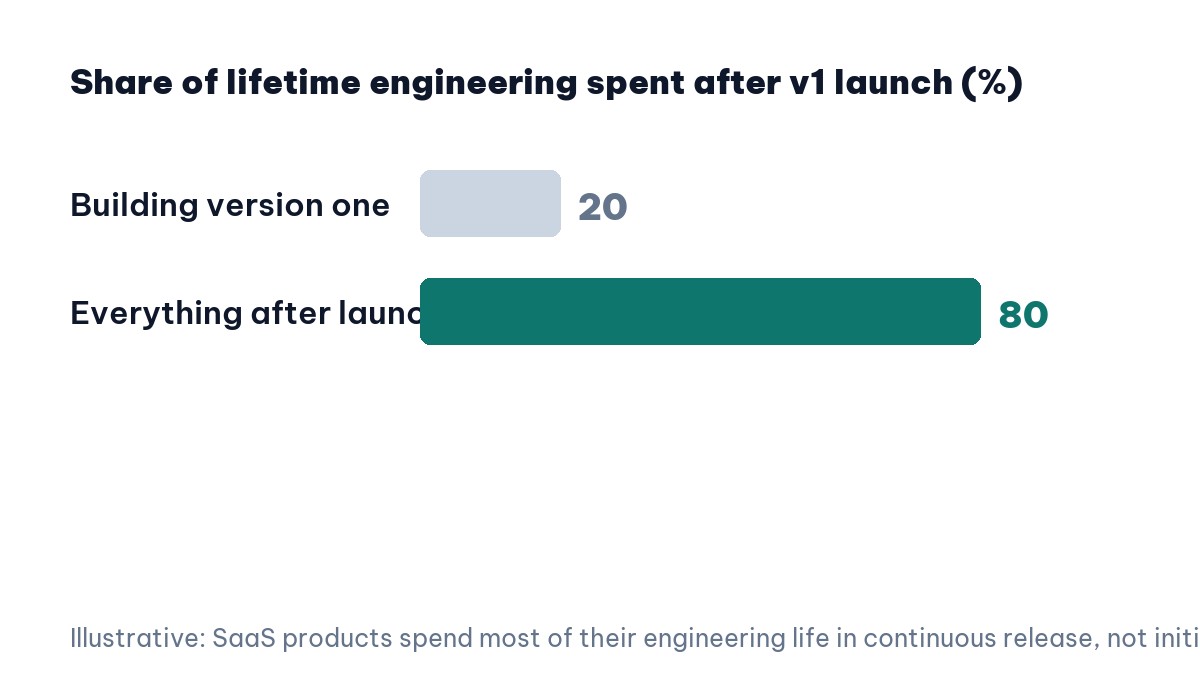
- Version one is a minority of lifetime engineering spend – budget for what comes after launch.
- Multi-tenancy, billing and configuration are early architectural decisions that are painful to reverse.
- SaaS development outsourcing works as a continuous dedicated squad, not as a fixed-scope project.
- Keep product direction, pricing and your differentiator in-house; platform work travels well.
- Enterprise requirements – SSO, audit logs, data residency – arrive with your first large customer, not before.
Table of contents
- Why SaaS Development Outsourcing Breaks Project Thinking
- SaaS Development Outsourcing Starts With Multi-Tenancy
- Billing Is Product Logic, Not Plumbing
- Per-Customer Configuration Without Forking
- Continuous Release Changes the Engineering Contract
- Enterprise Demands That Reshape SaaS Development Outsourcing
- SaaS Development Outsourcing: Choosing the Model
- What to Keep In-House
- SaaS Development Outsourcing Mistakes
- FAQ
Why SaaS Development Outsourcing Breaks Project Thinking
A project has an end. You specify, build, accept, and the team moves on. That works for an internal tool with a stable purpose.
A SaaS product never reaches that state. Customers arrive with requirements, competitors move, scale exposes assumptions, and every release changes the ground the next one stands on. Most of the engineering happens after launch, not before it.
Structuring that as a sequence of projects means paying the onboarding tax repeatedly – a new team relearning the same architecture every phase, plus the decisions nobody wrote down. This is the specific reason SaaS development outsourcing has a bad reputation among founders who tried it as a project.
SaaS Development Outsourcing Starts With Multi-Tenancy
How customer data is separated – shared tables with a tenant column, a schema per tenant, or a database per tenant – shapes every query, permission check, migration and backup procedure you will ever write.
The choice is a trade rather than a ranking. Shared tables are cheapest to operate and hardest to isolate; a database per tenant is the reverse, and it is what regulated or enterprise buyers frequently insist on. Most products land in the middle, and the middle is only comfortable if it was chosen rather than inherited.
Retrofitting isolation into a system built single-tenant is the most expensive reversal in SaaS engineering, because it touches everything at once and cannot be done incrementally with confidence. Decide it deliberately in week one, with the enterprise customers you eventually want in mind rather than the ones you have.
Billing Is Product Logic, Not Plumbing
Subscription billing looks like an integration and behaves like core product logic. Plan changes mid-cycle, proration, trials that convert, usage-based components, annual contracts paid upfront, dunning on failed cards, tax by jurisdiction, and refunds that must reconcile with revenue recognition.
The failure mode is subtle: entitlement logic scattered across the codebase, so that what a customer can do depends on three checks in three places that gradually disagree. Centralise it early, behind one question the rest of the product asks.
Use a billing platform rather than building it – almost always the right call – but design the boundary carefully. Your product needs to know what a customer is entitled to right now, and that entitlement logic is yours whether or not the invoicing is.
Per-Customer Configuration Without Forking
The first large customer will ask for something specific. The temptation is to branch the code for them; the consequence is a product you can no longer release in one operation.
Saying no is part of the discipline. Every bespoke behaviour you accept becomes something you maintain, test and migrate forever, and the customer who requested it rarely pays for that tail.
Build configuration as a first-class capability early: feature flags, tenant-level settings, and extension points that let one deployment behave differently for different customers. Teams that skip this end up maintaining several near-identical products while charging for one.
Continuous Release Changes the Engineering Contract
SaaS means everyone is on the current version, and a bad release affects every customer simultaneously. That raises the value of automated testing, staged rollouts, feature flags and fast rollback from good practice to operational necessity.
Database migrations deserve particular attention. In a single-tenant world a migration is an event; in a multi-tenant world it runs against everyone at once, and a slow one is an outage with a friendly name.
It also changes what you should expect from a vendor. Ask how they deploy, how often, how they roll back, and what their last incident looked like. A team that ships weekly with a rollback path is a materially different proposition from one that ships quarterly with a maintenance window – regardless of hourly rate.
Enterprise Demands That Reshape SaaS Development Outsourcing
The first enterprise deal brings a security questionnaire, and behind it a list: single sign-on, role-based permissions, audit logs, data residency, retention policies, an incident process, and often SOC 2 evidence.
None of these are hard individually. All of them are slow when unplanned, and they arrive at the least convenient moment – with a signature waiting. Building audit logging and SSO before the first enterprise conversation is cheap insurance, as our security guide sets out.
SaaS Development Outsourcing: Choosing the Model
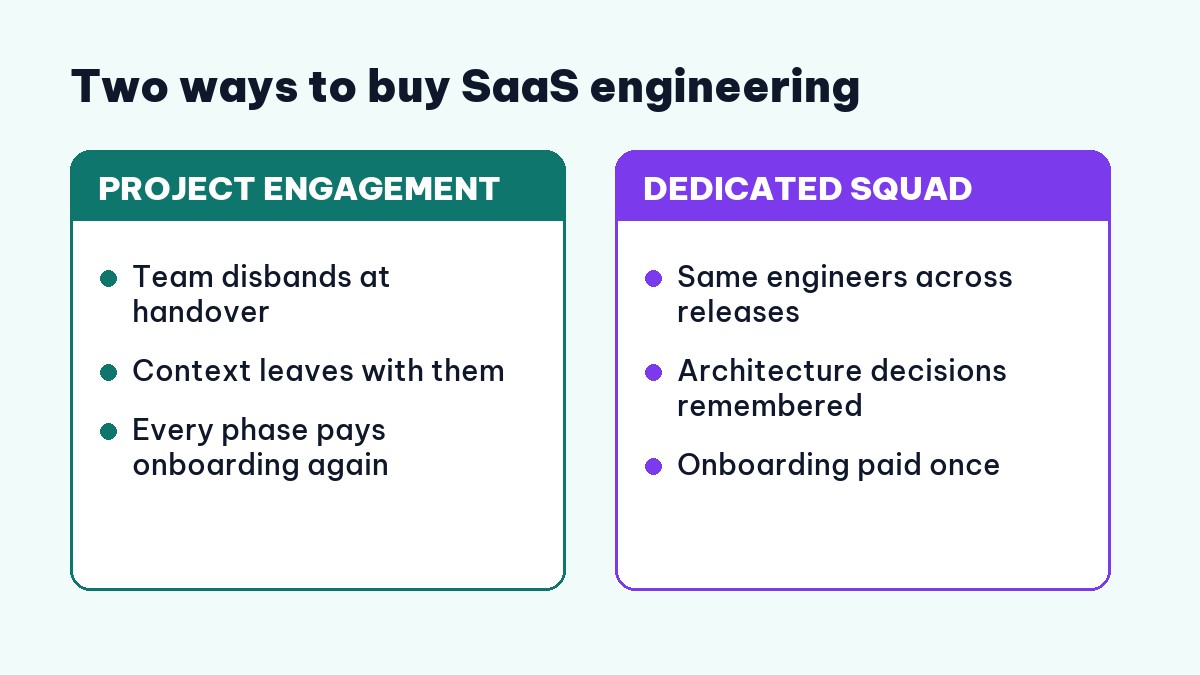
A fixed-price project suits a well-bounded first version when you genuinely intend to stop and reassess. Beyond that, a dedicated development team fits the shape of the work: the same engineers across releases, accumulating the context that makes each subsequent change cheaper.
The economics follow the context. In a project model you pay the ramp-up tax every phase; in a continuous model you pay it once. For a product with a multi-year roadmap, that difference usually exceeds any rate difference between vendors.
What to Keep In-House
Product direction, pricing, and whatever genuinely differentiates you. If your matching engine or your data model is the reason customers choose you, own it – the rest of the platform can be delivered by a squad without weakening your position.
A practical arrangement many SaaS companies settle on: one or two senior people in-house who own architecture and product decisions, with the squad delivering against those decisions. It keeps the thinking close without paying local rates for the whole build.
Notice this is not a statement about difficulty. Plenty of hard engineering travels perfectly well; plenty of simple work should stay close because of what it teaches you about your customers.
SaaS Development Outsourcing Mistakes
Treating the MVP as the product. The MVP answers whether anyone wants this; the product is what you build once they do, and the two rarely share an architecture.
Deferring observability. In a multi-tenant system, “it is slow for one customer” is unanswerable without per-tenant metrics, and adding them later means instrumenting code you have already forgotten.
Letting the vendor own the infrastructure accounts. Your cloud, your domains, your repository – always. It costs nothing at the start and it is the difference between changing partners and rebuilding, a point our risk guide returns to.
There is one more decision worth making explicitly at the start, because it quietly shapes everything else: what happens to the product when the engagement pauses. SaaS is unusual in that the software has customers using it right now, so a gap in coverage is not a delay – it is an operational risk.
Agree who answers a production alert at 2am, what the escalation path looks like during a holiday period, and how much runway you would have if the squad became unavailable for a month. Teams that answer those three questions before signing rarely need the answers; teams that do not tend to discover them during their first serious incident.
FAQ: SaaS Development Outsourcing
Can SaaS development be outsourced?
Yes, as a continuous dedicated squad rather than a fixed-scope project that disbands at handover.
What is different from a normal build?
Multi-tenancy, subscription billing, per-customer configuration and continuous release – early decisions that are expensive to reverse.
Design multi-tenancy from the start?
Yes. Retrofitting tenant isolation touches every query, permission check and migration in the system.
How much to budget after launch?
Most of the lifetime spend. Version one is the minority of the engineering a SaaS product consumes.
What stays in-house?
Product direction, pricing, and the capability that differentiates you.
SaaS development outsourcing works when the engagement matches the product’s shape: continuous, context-heavy, and architected on day one for the customers you intend to win. See our transparent 2026 rate card →