

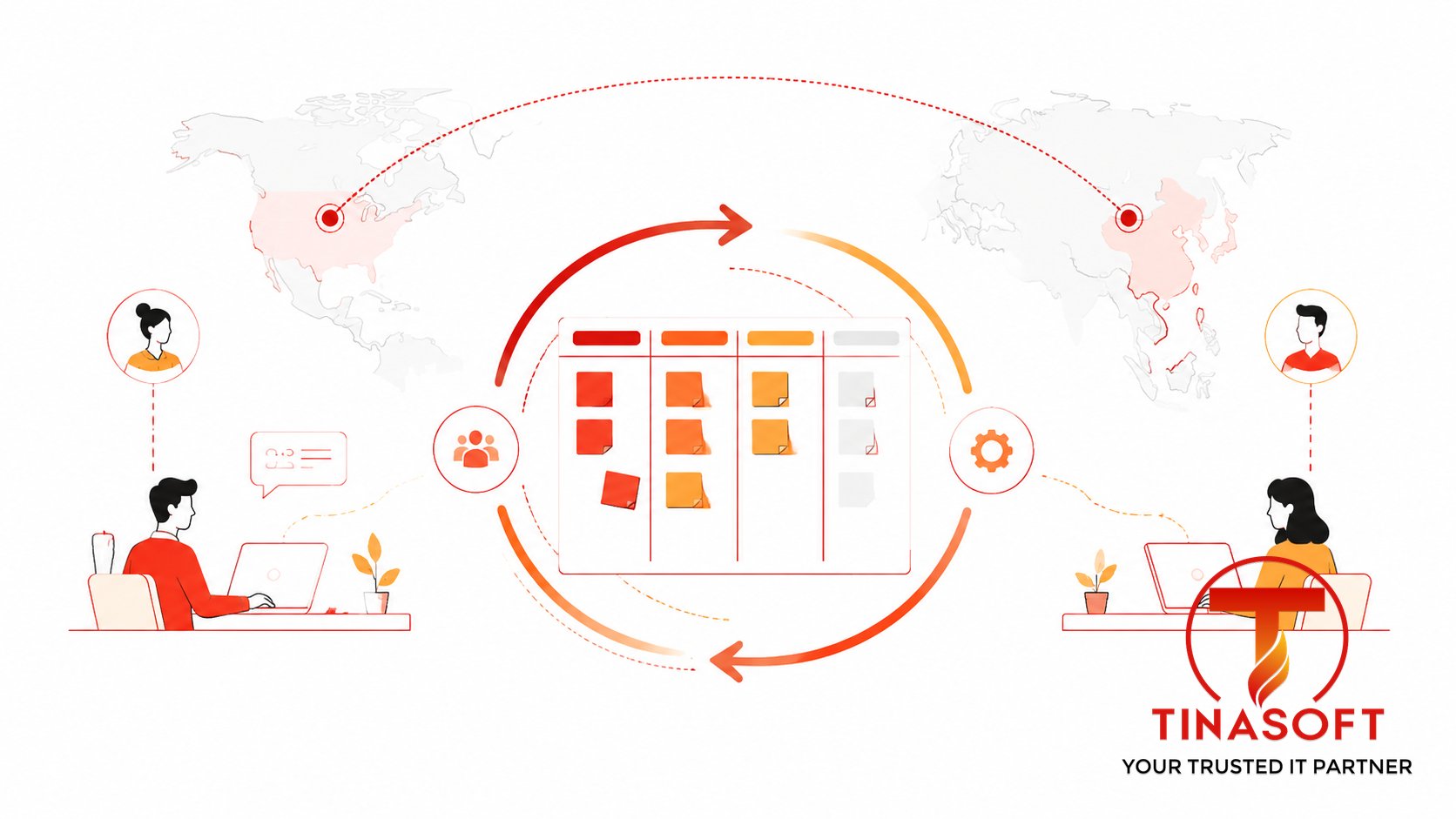
Agile software outsourcing is the practice of running an external development team on the same short feedback loops you would use in-house: one backlog, fixed-length sprints, working software at the end of each one. Done well, distance stops being the problem. Done badly, you get status reports instead of software.
This playbook covers what changes when the team is offshore, the six things that decide whether it works, and a 90-day rollout you can start on Monday.
Key takeaways
- Agile software outsourcing works when one prioritised backlog, one product owner and a fixed sprint cadence sit on your side of the table.
- Four hours of daily overlap turns a one-day blocker into a ten-minute question.
- A written Definition of Done — including QA and a staging deploy — is what stops “done” from meaning “compiles”.
- Contract shape is an agile decision: fixed scope for twelve months and agile software outsourcing cannot coexist.
- Judge the engagement on sprint goal hit rate, cycle time and escaped defects — never on hours logged.
What this guide covers
- What agile software outsourcing actually means
- Agile software outsourcing vs a fixed-scope project
- Why agile software outsourcing fails with an offshore team
- The operating model that works: six elements
- A 90-day rollout plan
- How Tinasoft runs agile software outsourcing
- FAQ
What agile software outsourcing actually means
Most vendors say they do agile software outsourcing. Far fewer actually do. The word gets attached to any project with a stand-up and a Jira board, which is why buyers stop trusting it.
A useful test: can you change your mind about a feature in week six without renegotiating the contract? If not, you are running a waterfall project with daily meetings.
Real agile software outsourcing means three concrete things. Your priorities drive the next sprint, not a scope document signed in month one. You see working software every two weeks, not a slide deck. And the vendor’s team is measured on outcomes shipped, not hours logged.
The Agile Manifesto principles put this plainly: deliver working software frequently, and welcome changing requirements even late in development. Neither principle cares where the developers sit.
Agile software outsourcing vs a fixed-scope project
The two models are not better and worse — they answer different questions. Fixed scope suits work where requirements genuinely cannot move: a regulatory deadline, a migration with a known end state, an integration against a frozen API.
Everything else, especially anything user-facing, benefits from being able to change direction cheaply.
| Agile engagement | Fixed-scope project | |
|---|---|---|
| Scope | Prioritised backlog, reordered each sprint | Signed up front, changed by variation order |
| First working software | Sprint 1–2 | Near the end of the project |
| Cost model | Time and materials or dedicated team | Single agreed price |
| Risk carried by | Shared, reviewed every sprint | Vendor prices it in as a buffer |
| Best for | Products, discovery, evolving requirements | Fixed, well-understood deliverables |
A common misconception is that agile software outsourcing costs more. It usually does not — but it moves the cost of uncertainty out of a hidden risk buffer and into a visible sprint rate. That trade is worth making when you expect to learn something from your users.
Why agile software outsourcing fails with an offshore team
When agile software outsourcing breaks down across a vendor relationship, the cause is almost never the engineers. In our experience across 300+ delivery projects, four patterns account for most of the damage.
1. Two backlogs instead of one
The client keeps a “real” roadmap internally and hands the vendor a filtered version. The vendor then builds against stale priorities and nobody notices for a sprint or two. Every decision needs a translation step, and translation loses information.
2. Zero overlap hours
A team eleven time zones away with no shared working window cannot ask a question and get an answer the same day. A blocker that costs ten minutes to resolve in an office costs a full day here. Multiply that by a sprint.
3. A contract that punishes change
Fixed-scope contracts make every change request a commercial negotiation. Product owners learn to stop asking, requirements freeze, and the team ships the thing that was right in January. Contract shape is an agile decision, not just a procurement one.
4. No shared definition of “done”
The vendor calls a story done when the code compiles. You call it done when it is tested, reviewed and deployable. Sprint reviews turn into arguments, and the gap surfaces as a bug backlog three months later.
The operating model that makes agile software outsourcing work
Fixing the four failures above is mostly mechanical, and it is the part of agile software outsourcing you control. Here are the six elements we set up before sprint one on every engagement.
One backlog, one product owner
There is exactly one prioritised backlog and one person empowered to reorder it. That person should sit on your side — outsourcing delivery is reasonable, outsourcing product judgement rarely is.
The vendor supplies a business analyst or delivery lead who keeps stories ready, but priority stays with you. If your product owner can only give three hours a week, say so up front and staff a proxy on the vendor side. An absent product owner is the single most common reason offshore sprints drift.
Four hours of real overlap
Set a contractual overlap window and protect it. Four hours is enough for a stand-up, ad-hoc questions, pairing and a review. Vietnam sits well here: an afternoon in Ho Chi Minh City overlaps the morning in Sydney and Singapore, and an early start reaches European mornings.
Use the overlap for conversation and the rest of the day for focused work. Written async updates fill the gaps — decisions in writing, always.
A sprint cadence you can set a watch by
Two-week sprints, same ceremonies, same times, no exceptions — cadence is the backbone of agile software outsourcing. The Scrum Guide keeps sprint length fixed for a reason: predictability is what lets you plan around a team you cannot see.

Keep the ceremony set small and non-negotiable: daily stand-up in the overlap window, sprint planning, a demo of running software, and a retrospective that produces one change per sprint. Skip the retrospective and the same problems repeat all quarter.
A Definition of Done that includes QA and deploy
Write it down in sprint zero and put it in the statement of work. Ours typically requires: code reviewed by a second engineer, unit tests written, acceptance criteria verified by QA, documentation updated, and the build deployed to a staging environment.
This is where outsourced software testing earns its place — a Definition of Done without an independent QA step is a wish, not a gate.
A contract model that matches the method
Agile assumes scope will change. Time and materials or a dedicated-team model absorbs that; a fixed-price contract fights it. If procurement requires a ceiling, use a capped T&M arrangement or fixed-price sprints with a variable backlog.
Rates and team-composition options are laid out on our Vietnam software outsourcing rates page, including what a typical squad costs per sprint. For longer programmes, an offshore development centre gives you a stable team rather than rotating contractors.
Metrics both sides actually look at
Pick a handful of agile software outsourcing metrics and review them every sprint. The point is not a dashboard — it is a shared, unarguable picture of delivery health.

| Metric | What it tells you | Warning sign |
|---|---|---|
| Sprint goal hit rate | Whether commitments are realistic | Missed three sprints running |
| Velocity stability | Whether the team has settled | Swings above 30% sprint to sprint |
| Cycle time per story | Where work actually queues | Long waits in code review or QA |
| Escaped defects | Whether Definition of Done holds | Bugs found by users, not QA |
| Blocker age | Whether the overlap window works | Blockers older than 24 hours |
Notice what is missing: hours logged and lines of code. Both reward activity over outcome, and both are easy to game.
A 90-day agile software outsourcing rollout plan
Agile software outsourcing does not need a transformation programme. It needs a disciplined first quarter.
| Phase | Focus | Output |
|---|---|---|
| Days 1–15 | Discovery and setup | Backlog for two sprints, Definition of Done, overlap window, access and environments |
| Days 16–45 | Sprints 1–2 | First deployable increment, baseline velocity, first retrospective actions |
| Days 46–75 | Sprints 3–4 | Stable cadence, CI/CD pipeline, QA gate enforced |
| Days 76–90 | Review and scale | Metric review, team-size decision, roadmap for next quarter |
Treat day 90 as a genuine decision point. If the sprint goal hit rate is poor and retrospectives keep raising the same issue, the model needs changing — not another month of hope.
How Tinasoft runs agile software outsourcing with offshore teams
Tinasoft has delivered 300+ projects for 100+ clients from Vietnam, and our default engagement shape reflects what survived contact with reality.
We staff a delivery lead who owns cadence and unblocking, not just resourcing. We commit to a written overlap window in the statement of work. We run sprint zero as a paid, short engagement so the Definition of Done, environments and backlog exist before anyone writes production code.
We also keep teams stable. Rotating engineers off a project resets domain knowledge and velocity, which is why our dedicated-team and ODC models exist alongside IT staff augmentation for shorter capacity gaps.
If speed is the driver, the mechanics matter more than the label — our guide to time to market in software outsourcing covers where weeks are usually lost.
Agile software outsourcing readiness checklist
Run through this before sprint one. Every unticked box is a risk you are carrying into the engagement.
- One prioritised backlog exists, and one named product owner can reorder it.
- A daily overlap window is written into the statement of work, not just agreed verbally.
- The Definition of Done names QA sign-off and a staging deploy.
- The contract model absorbs scope change rather than penalising it.
- Environments, repository access and credentials are ready on day one.
- Five delivery metrics are agreed, and both sides review them each sprint.
Teams that tick all six reach stable velocity in three to four sprints. Teams that skip the first two rarely get there at all, and agile software outsourcing gets blamed for what is really an onboarding failure.
FAQ
Can agile software outsourcing really work with a team in a different time zone?
Yes, provided you fix a daily overlap window of at least three to four hours and write decisions down. The failure mode is not distance — it is waiting a full day for an answer.
Is fixed-price ever compatible with agile software outsourcing?
It can be, at the sprint level. Fix the price of a sprint and let the backlog vary. Fixing both price and scope for twelve months is where agile stops being possible.
Who should be the product owner — us or the vendor?
You. The vendor can supply a proxy or business analyst to keep stories ready, but the person deciding what matters most should sit with the business that owns the outcome.
How long before an offshore team reaches stable velocity?
Typically three to four sprints, assuming environments and access are ready on day one. Onboarding delays, not engineering skill, are the usual cause of a slow start.
What is the single best early warning sign of trouble?
Blockers that stay open longer than a day. It almost always means the overlap window or the decision-making chain is broken, and velocity follows within two sprints.
Getting started
Agile software outsourcing is not a cultural achievement. It is a set of decisions about backlog ownership, working hours, done-ness, contract shape and metrics — most of which you make before sprint one.
If you are scoping agile software outsourcing and want to know what a properly staffed squad costs, our pricing guide lists team compositions, rates and a 24-hour quote form.