
Through MVP Development, startups can reduce risk, shorten time-to-market, attract investors, and gather real user feedback before scaling further.
In this article, we’ll explore what MVP is, why it matters, and how startups use it to launch products faster in 2026.
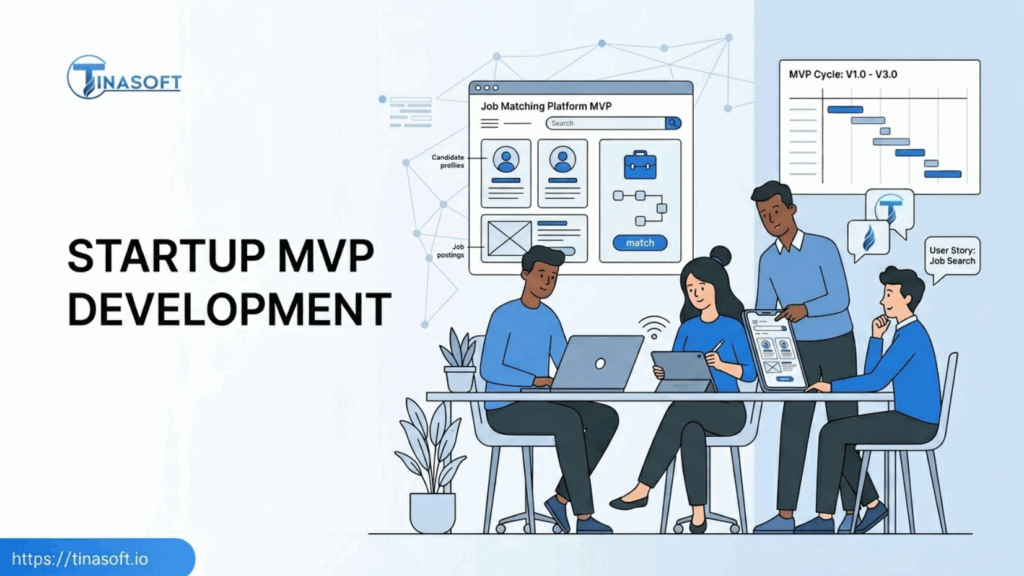
What Is MVP Development?
MVP Development is the process of building a product with the minimum set of essential features required to validate a business idea and deliver value to early users.
The goal is not to create a perfect product immediately.
Instead, MVP Development focuses on:
- Testing market demand
- Validating assumptions
- Gathering user feedback
- Reducing development risk
- Accelerating product launch
An MVP allows startups to learn quickly without investing excessive time or money upfront.
Why MVP Development Is Critical for Startups
Many startups fail because they spend too much time building products customers may not actually need.
1. Faster Time-to-Market
Launching quickly is one of the biggest advantages of MVP Development.
Instead of building every possible feature, startups focus only on:
- Core functionality
- Key user problems
- Essential product value
This significantly reduces development time.
By entering the market earlier, startups can:
- Gain early users
- Collect feedback faster
- Build momentum before competitors
In competitive industries, speed often becomes a startup’s greatest advantage.
2. Lower Development Costs
Building a full-featured product from day one can be extremely expensive.
MVP helps startups reduce initial investment by limiting scope and prioritizing only the most critical features.
Benefits include:
- Smaller development budgets
- Reduced technical complexity
- Lower operational risk
- More efficient resource allocation
For startups with limited funding, this cost efficiency is essential.
3. Validate Product-Market Fit Early
One of the biggest reasons startups fail is the lack of product-market fit.
MVP enables businesses to test whether customers actually want the product before scaling.
Instead of relying on assumptions, startups gain:
- Real user feedback
- Usage data
- Customer insights
- Feature validation
This data-driven approach helps founders make smarter product decisions.
4. Easier to Attract Investors
Investors prefer startups that demonstrate:
- Market demand
- User traction
- Scalable business models
An MVP provides proof that the product has potential.
Through MVP Development, startups can showcase:
- Active users
- Early revenue
- Customer engagement
- Market validation
This increases credibility during fundraising.
Key Stages of MVP Development
Successful MVP requires more than simply building a basic product.
It involves a structured process focused on solving real user problems efficiently.
1. Define the Core Problem
The first step is identifying the specific problem the product aims to solve.
Startups should ask:
- What pain point exists?
- Who are the target users?
- Why is the current solution insufficient?
Clear problem definition is critical for effective MVP Development.
2. Identify Essential Features
A common mistake is trying to include too many features in the MVP.
Instead, startups should focus only on features necessary to deliver the product’s core value.
Questions to prioritize features:
- Does this solve the main user problem?
- Is this feature essential for launch?
- Can this be added later?
Minimalism is a key principle of MVP Development.
3. Build a Prototype or Wireframe
Before coding begins, teams often create:
- Wireframes
- User flows
- Interactive prototypes
This helps visualize the product experience and identify usability issues early.
4. Develop the MVP
The development phase focuses on speed, efficiency, and scalability.
Modern startups often use:
- Agile methodologies
- Rapid iteration cycles
- Cloud infrastructure
- Cross-platform technologies
Efficient MVP Development emphasizes flexibility and future scalability.
5. Launch and Collect Feedback
After launch, startups should monitor:
- User behavior
- Engagement metrics
- Customer feedback
- Retention rates
This data becomes the foundation for future product improvements.
Common MVP Development Mistakes
While MVP Development offers many advantages, startups often make avoidable mistakes.
Building Too Many Features
Many founders try to create a “mini full product” instead of a true MVP.
This increases:
- Development time
- Costs
- Complexity
The goal is validation—not perfection.
Ignoring User Feedback
An MVP only works if startups actively learn from users.
Ignoring customer feedback defeats the purpose of MVP Development.
Choosing the Wrong Technology
Using unsuitable technologies can create:
- Scalability issues
- Technical debt
- Performance limitations
A strong technical foundation remains important even for MVPs.
Why Startups Outsource MVP Development
Many startups choose external development partners to accelerate product launches.
Outsourcing MVP Development provides several benefits:
- Faster team setup
- Access to experienced developers
- Reduced hiring challenges
- Lower operational costs
- Faster execution
For early-stage startups, outsourcing also allows founders to focus on business strategy and growth.
How AI Is Changing MVP Development in 2026
AI-powered tools are transforming how startups build products.
Modern MVP Development increasingly includes:
- AI-assisted coding
- Automated testing
- Rapid UI generation
- AI-powered analytics
- Workflow automation
These technologies help startups launch products even faster while reducing development overhead.
Conclusion
In today’s competitive startup environment, speed, flexibility, and validation are more important than perfection.
MVP Development enables startups to:
- Launch faster
- Reduce costs
- Validate ideas
- Gather real feedback
- Improve investor confidence
Rather than spending excessive resources building large-scale products upfront, startups can use MVPs to learn, iterate, and scale strategically.
As technology continues evolving in 2026, MVP Development remains one of the smartest approaches for turning ideas into successful digital products.
Looking to turn your startup idea into a scalable digital product?
Tinasoft provides professional MVP Development services, helping startups build fast, cost-efficient, and market-ready solutions tailored to their business goals.
Contact Tinasoft today to start building your MVP faster.
🌐 Website: [Tinasoft]
📩 Fanpage: Tinasoft Vietnam