
Discover the key differences between Super Apps and traditional mobile apps. Learn their benefits, use cases, development challenges, and how businesses can choose the right approach in 2026.
Super App vs Traditional Mobile App: What’s the Difference?
Introduction
Mobile applications have become an essential part of modern business strategies. From e-commerce and banking to healthcare and transportation, organizations rely on mobile apps to engage customers and deliver services efficiently.
However, as user expectations continue to evolve, a new trend has emerged: the Super App.
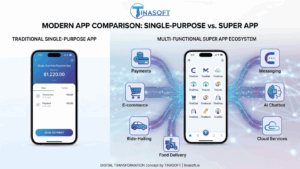
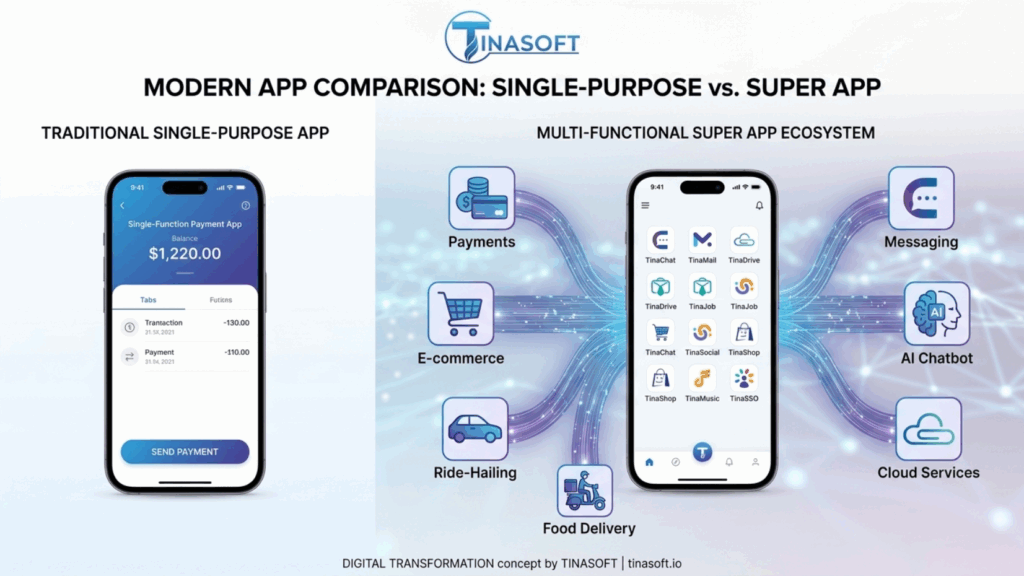
While traditional mobile applications are designed to solve a specific problem or provide a single service, Super Apps aim to create a complete digital ecosystem by integrating multiple services into one platform.
So, what exactly is the difference between a Super App and a traditional mobile app, and which approach is best for your business?
Let’s explore.
What Is a Traditional Mobile App?
A traditional mobile app is designed to perform a specific function or solve a particular user problem.
Examples include:
- Food delivery apps
- Ride-hailing apps
- Fitness apps
- Banking apps
- E-commerce apps
Each application focuses on a single purpose and delivers a specialized user experience.
For example:
- A food delivery app helps users order meals.
- A banking app enables financial transactions.
- A fitness app tracks workouts and health metrics.
Users often need multiple apps installed on their devices to fulfill different needs.
What Is a Super App?
A Super App is a mobile platform that combines multiple services and mini-applications within a single ecosystem.
Instead of downloading separate apps, users can access various services from one platform.
A Super App may include:
- Digital payments
- E-commerce
- Ride-hailing
- Food delivery
- Messaging
- Financial services
- Loyalty programs
- AI-powered customer support
The goal is to provide a seamless digital experience where users can accomplish multiple tasks without leaving the application.
Leading examples include Grab, WeChat, and Paytm.
Super App vs Traditional Mobile App: Key Differences
1. Functionality
The biggest difference lies in the scope of services offered.
Traditional Mobile App
- Focuses on one core service
- Specialized functionality
- Simple user journey
Super App
- Integrates multiple services
- Provides a unified ecosystem
- Supports diverse user needs
Traditional apps solve one problem exceptionally well, while Super Apps aim to become a one-stop digital platform.
2. User Experience
Traditional applications typically offer a streamlined experience because they focus on a single purpose.
For example, a ride-hailing app only needs to optimize booking and transportation workflows.
In contrast, a Super App must balance multiple services while maintaining usability and intuitive navigation.
When designed correctly, a Super App can significantly improve convenience by reducing the need to switch between different applications.
3. Customer Retention
Customer retention is one of the strongest advantages of Super Apps.
Because users can access multiple services from a single platform, they tend to spend more time within the ecosystem.
For example, a user may:
- Order food
- Pay bills
- Book transportation
- Purchase products
all within one application.
This increases engagement and creates more opportunities for businesses to build long-term customer relationships.
4. Data Collection and Personalization
Traditional apps collect data related to a specific service.
A fitness app understands workout habits, while an e-commerce app understands shopping behavior.
A Super App, however, gathers insights from multiple user activities.
This broader dataset enables businesses to:
- Deliver personalized recommendations
- Improve customer experiences
- Develop targeted marketing campaigns
- Enhance AI-powered services
Data becomes a strategic asset within the Super App ecosystem.
5. Business Opportunities
Traditional mobile apps usually generate revenue through a single business model.
Examples include:
- Subscription fees
- Product sales
- Service commissions
- Advertising
A Super App creates multiple revenue streams through an integrated ecosystem.
Potential opportunities include:
- Payment processing
- Marketplace commissions
- Financial services
- Advertising
- Premium memberships
- Third-party partnerships
This diversification can significantly increase long-term business value.
6. Development Complexity
One major advantage of traditional mobile apps is simplicity.
Development teams can focus on:
- One service
- One workflow
- One customer journey
Building a Super App is far more complex.
It requires:
- Scalable architecture
- Cloud infrastructure
- API integrations
- Security frameworks
- Data management systems
- Multi-service coordination
As a result, Super App development typically demands greater investment, planning, and technical expertise.
When Should a Business Choose a Traditional Mobile App?
A traditional mobile app is often the best choice when:
- The business focuses on a single service
- Budget is limited
- Market validation is needed
- The company is launching a new product
- User needs are highly specialized
For startups and early-stage companies, launching a focused application can be an effective way to test the market before expanding.
When Should a Business Build a Super App?
A Super App may be the right choice when:
- The business operates multiple services
- Customer retention is a strategic priority
- Digital ecosystem expansion is planned
- Cross-selling opportunities exist
- Large-scale growth is expected
Companies that already have an established customer base can benefit significantly from integrating multiple services into a unified platform.
The Role of AI in Modern Super Apps
Artificial Intelligence is becoming a core component of next-generation Super Apps.
AI can enhance:
Personalized Recommendations
Suggest relevant products and services based on user behavior.
Intelligent Chatbots
Provide instant customer support 24/7.
Predictive Analytics
Forecast customer needs and purchasing patterns.
Marketing Automation
Deliver personalized campaigns in real time.
As AI technology continues to evolve, Super Apps will become even more intelligent, personalized, and efficient.
The Future of Super Apps
The demand for convenience, personalization, and integrated digital experiences continues to grow.
As businesses seek to improve customer engagement and maximize ecosystem value, Super Apps are expected to become increasingly popular across industries such as:
- Retail
- Healthcare
- Fintech
- Logistics
- Telecommunications
- Travel
While traditional mobile applications will remain important, many organizations are now exploring how to evolve beyond standalone apps and create comprehensive digital ecosystems.
Conclusion
Both traditional mobile apps and Super Apps serve important roles in today’s digital landscape.
A traditional mobile app offers simplicity, focus, and faster development, making it ideal for businesses with a single core service.
A Super App, on the other hand, provides an integrated ecosystem that enhances customer engagement, unlocks new revenue streams, and creates long-term competitive advantages.
The right choice depends on your business goals, customer needs, and growth strategy.
At Tinasoft Vietnam, we help businesses design, develop, and scale mobile applications ranging from focused business apps to enterprise-grade Super Apps. Our team specializes in mobile development, cloud architecture, AI integration, and digital transformation solutions tailored to modern business needs.
Ready to build your next-generation mobile platform?
Contact Tinasoft today to discuss your Super App development strategy and turn your vision into a scalable digital ecosystem.
🌐 Website: [Tinasoft]
📩 Fanpage: Tinasoft Vietnam