
Discover what a super app is, how it works, key features, benefits, and why super apps are shaping the future of digital ecosystems in 2026.

In recent years, the term super app has become one of the most talked-about concepts in digital transformation. From Southeast Asia to global markets, businesses are shifting from standalone applications to integrated ecosystems.
But what exactly is a super app—and why is it becoming essential in 2026?
This guide will break down everything you need to know, from definition and features to real-world use cases and business benefits.
What Is a Super App?
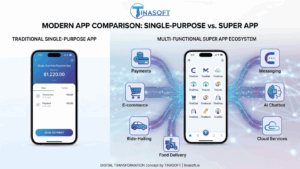
A super app is a single mobile application that combines multiple services into one unified platform. Instead of downloading and switching between different apps, users can access everything they need within one ecosystem.
Typical services in a super app include:
- Messaging and communication
- Digital payments and wallets
- E-commerce and marketplaces
- Transportation and on-demand services
- Content and entertainment
The goal of a super app is simple:
👉 Create a seamless, all-in-one user experience
How Does a Super App Work?
At its core, a super app operates as a platform with multiple integrated modules.
Rather than building one large monolithic system, modern super apps use a modular architecture where services can be added, updated, or scaled independently.
Key components include:
1. Core Platform Layer
Handles authentication, user management, and data synchronization.
2. Service Modules
Each service (payments, shopping, chat, etc.) operates as a module within the ecosystem.
3. Integration Layer
Connects internal services and third-party systems through APIs.
4. User Interface Layer
Provides a unified experience across all services.
Key Features of a Super App
To succeed in 2026, a super app platform must include several essential features:
1. Single Sign-On (SSO)
Users log in once and access all services without repeated authentication.
2. Integrated Payment System
A built-in payment solution enables seamless transactions across services.
3. Messaging & Notification System
Real-time communication keeps users engaged and informed.
4. Content & Entertainment Layer
Music, video, or other content helps increase user engagement and retention.
5. Scalable Architecture
A flexible system that allows businesses to expand services over time.
Super App Examples
Several well-known platforms have successfully implemented the super app model:
- WeChat: Messaging, payments, mini-programs, and more
- Grab: Transportation, food delivery, and financial services
- Gojek: Ride-hailing, payments, and lifestyle services
These platforms demonstrate how super apps can dominate user engagement by offering multiple services in one place.
Why Super Apps Are Growing in 2026
1. Changing User Behavior
Users prefer convenience and speed. Managing multiple apps creates friction.
Super apps simplify this by offering everything in one place.
2. Mobile-First Markets
In regions like Southeast Asia, mobile devices are the primary gateway to digital services.
Super apps are perfectly suited for these environments.
3. Ecosystem Strategy
Businesses are moving from single-product models to ecosystem-based strategies.
Super apps enable companies to own the entire user journey.
Benefits of a Super App for Businesses
1. Increased User Retention
By combining high-frequency services, super apps encourage users to return daily.
2. Multiple Revenue Streams
Businesses can monetize through:
- Transactions
- Subscriptions
- Advertising
- Cross-selling
3. Better Customer Insights
With all services in one platform, businesses gain deeper insights into user behavior.
4. Improved User Experience
A seamless and integrated experience leads to higher satisfaction and loyalty
|
Feature |
Traditional App |
Super App |
|---|---|---|
|
Functionality |
Single-purpose |
Multi-service |
|
User Experience |
Fragmented |
Unified |
|
Retention |
Low |
High |
|
Scalability |
Limited |
High |
👉 In short:
Traditional apps solve one problem.
Super apps build an entire ecosystem.
Challenges of Building a Super App
Despite the benefits, there are challenges:
- Technical complexity: Requires strong architecture
- High initial investment: Especially for full-scale deployment
- User adoption: Needs a compelling value proposition
- Security concerns: Must ensure data protection
However, with the right strategy and technology partner, these challenges can be overcome.
How to Build a Super App
If your business is considering building a super app, follow these steps:
- Start with a core service
- Identify user needs and behavior
- Build a scalable platform
- Integrate additional services gradually
- Focus on user experience and retention
The Future of Super Apps
By 2026, super apps are expected to expand beyond consumer services into:
- Enterprise solutions
- Telecom ecosystems
- Financial platforms
The future is not about building more apps—it’s about building connected digital ecosystems.
Conclusion
A super app is more than just a trend—it’s a fundamental shift in how digital platforms are built and used.
By integrating multiple services into a single ecosystem, super apps:
- Improve user experience
- Increase engagement
- Unlock new business opportunities
As digital competition intensifies, businesses that adopt the super app model early will have a significant advantage.
🌐 Website: [Tinasoft]
📩 Fanpage: Tinasoft Vietnam