
Introduction
In today’s rapidly evolving digital landscape, businesses are under increasing pressure to innovate, improve operational efficiency, and deliver better customer experiences. While off-the-shelf software may work for some organizations, many companies eventually realize that generic tools cannot fully support their unique workflows or long-term growth goals.
Unlike ready-made software solutions, Custom Software Development allows businesses to build applications tailored specifically to their operational needs, customer expectations, and future scalability requirements.
From startups building MVPs to enterprises modernizing legacy systems, organizations across industries are investing heavily in custom-built software to stay competitive in 2026.
In this guide, we’ll explore everything businesses need to know about Custom Software Development, including its benefits, development process, costs, challenges, and how to choose the right development partner.
What Is Custom Software Development?
Custom Software Development is the process of designing, building, deploying, and maintaining software applications specifically tailored to a company’s unique business requirements.
Unlike commercial off-the-shelf software, custom solutions are built from the ground up to:
- Solve specific business problems
- Automate workflows
- Improve operational efficiency
- Support scalability and innovation
Examples of Custom Software Development include:
- Enterprise management systems
- CRM platforms
- ERP software
- SaaS applications
- Mobile apps
- Customer portals
- AI-powered business solutions
Because the software is built specifically for the organization, businesses gain greater flexibility and long-term control.
Why Businesses Choose Custom Software Development
Many companies initially rely on pre-built software because it is faster to implement. However, as businesses grow, limitations begin to appear.
This is one of the main reasons organizations turn to Custom Software Development.
1. Tailored to Business Needs
Every company has unique workflows, operational structures, and customer requirements.
Generic software often forces businesses to adapt their processes around the tool.
With Custom Software Development, the software is designed around the business instead.
This leads to:
- Better workflow alignment
- Improved productivity
- Reduced manual tasks
- More efficient operations
2. Scalability and Flexibility
As businesses grow, their software requirements evolve.
Off-the-shelf platforms may struggle to support:
- Increased users
- Complex integrations
- Advanced features
- New business models
Custom Software Development provides the flexibility to scale systems as the business expands.
Companies can continuously add new functionalities without being limited by third-party software restrictions.
3. Competitive Advantage
Custom-built software enables businesses to create unique digital experiences that competitors may not have.
Examples include:
- Personalized customer journeys
- Proprietary automation systems
- Industry-specific workflows
- AI-driven business intelligence
Through Custom Software Development, organizations can differentiate themselves in highly competitive markets.
4. Better Integration Capabilities
Modern businesses often use multiple tools and platforms simultaneously.
Custom solutions can integrate seamlessly with:
- CRM systems
- ERP platforms
- Payment gateways
- Cloud services
- Analytics tools
- Third-party APIs
This integration capability is a major benefit of Custom Software Development.
5. Long-Term Cost Efficiency
Although initial development costs may be higher, Custom Software Development can reduce long-term operational expenses.
Businesses avoid:
- Expensive licensing fees
- Unnecessary features
- Vendor dependency
- Scalability limitations
Over time, custom solutions often deliver stronger ROI compared to generic software subscriptions.
Types of Custom Software Solutions
Businesses invest in Custom Software Development for many different use cases.
Enterprise Software
Enterprise applications help organizations manage large-scale operations, including:
- HR management
- Finance systems
- Supply chain management
- Internal communication platforms
Web Applications
Custom web applications allow businesses to deliver digital services directly through browsers.
Examples:
- SaaS platforms
- Customer portals
- Booking systems
- E-commerce solutions
Mobile Applications
Mobile-first experiences are increasingly important in 2026.
Custom Software Development supports:
- iOS app development
- Android applications
- Cross-platform mobile solutions
AI-Powered Solutions
Businesses are integrating AI into software to improve:
- Customer service
- Data analytics
- Workflow automation
- Recommendation systems
AI integration is becoming a major trend in Custom Software Development.
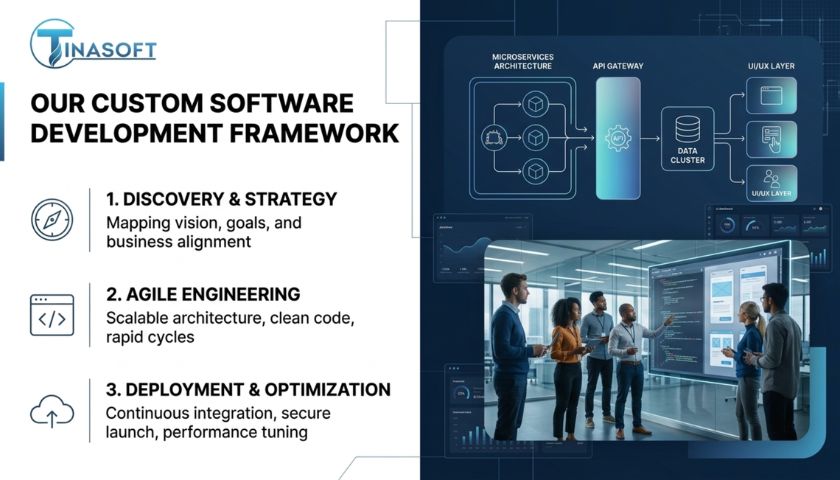
The Custom Software Development Process
A successful Custom Software Development project typically follows several key stages.
1. Requirement Analysis
The development team gathers:
- Business goals
- User requirements
- Technical specifications
- Feature priorities
This phase ensures alignment between business needs and technical execution.
2. Planning and Architecture
The team defines:
- System architecture
- Technology stack
- Database structure
- Development roadmap
Strong planning reduces risks later in the project.
3. UI/UX Design
User experience plays a critical role in software success.
Design teams create:
- Wireframes
- User flows
- Interactive prototypes
- Responsive interfaces
Good UI/UX improves user adoption and satisfaction.
4. Software Development
Developers begin building the application using agile methodologies.
This phase includes:
- Frontend development
- Backend development
- API integration
- Database implementation
5. Testing and Quality Assurance
Testing ensures software reliability and performance.
QA teams perform:
- Functional testing
- Security testing
- Performance testing
- Compatibility testing
Quality assurance is essential in Custom Software Development.
6. Deployment and Maintenance
After launch, businesses must continue:
- Monitoring performance
- Fixing bugs
- Updating features
- Improving security
Long-term support ensures software remains scalable and secure.
Challenges of Custom Software Development
While Custom Software Development offers many advantages, businesses should also understand the challenges involved.
Budget Management
Poor planning can increase development costs.
Businesses should define:
- Clear scope
- Prioritized features
- Realistic timelines
Communication and Alignment
Successful projects require strong collaboration between:
- Stakeholders
- Product owners
- Developers
- Designers
Misalignment can delay delivery.
Choosing the Right Technology Stack
Selecting unsuitable technologies may create scalability or maintenance issues later.
An experienced development partner can help avoid these risks.
How to Choose the Right Development Partner
Choosing the right vendor is critical for successful Custom Software Development.
Businesses should evaluate:
- Technical expertise
- Industry experience
- Communication processes
- Portfolio and case studies
- Agile development capability
- Post-launch support
A reliable software partner should understand both business objectives and technical execution.
Why Businesses Are Outsourcing Custom Software Development
Many companies now outsource Custom Software Development to external technology partners.
Benefits include:
- Faster team scaling
- Access to global talent
- Lower operational costs
- Reduced hiring burden
- Faster project delivery
Outsourcing also allows businesses to focus more on strategy and growth.
Conclusion
As digital transformation accelerates across industries, Custom Software Development has become a key driver of business innovation and operational efficiency.
Unlike generic software solutions, custom-built applications provide businesses with:
- Greater flexibility
- Better scalability
- Improved integrations
- Stronger competitive advantages
Whether you are a startup building an MVP or an enterprise modernizing operations, investing in Custom Software Development can help future-proof your business in 2026 and beyond.
Looking for a reliable partner for your custom software project?
Tinasoft provides end-to-end Custom Software Development services, helping businesses build scalable, secure, and high-performance digital solutions tailored to their unique needs.
Contact Tinasoft today to discuss your software development goals.
🌐 Website: [Tinasoft]
📩 Fanpage: Tinasoft Vietnam