
Moving from vibe coding to production is possible, but AI coding tools only get you part of the way. The short answer: a vibe-coded prototype proves the idea and the user flow; production needs security review, a real data model, integrations, monitoring, load testing and a named owner. This guide lists the 6 gaps and when to bring in developers.
Key takeaways
- AI tools are excellent at turning an idea into a clickable, working prototype in days.
- Veracode found AI-generated code introduced OWASP Top 10 flaws in 45% of test cases, so security review is not optional.
- The 6 gaps between vibe coding to production are security, data, integration, operations, load and accountability.
- Bring in developers once real users, money or personal data depend on the app.
- Treat the prototype as a living specification: continue when the core is sound, rebuild when it is not.
What can AI coding tools really do before vibe coding to production?
“Vibe coding” means describing what you want in plain language and letting an AI tool write most of the code. For founders and product owners, that has changed the first month of a product. A working demo that used to need a small team and several weeks can now appear over a weekend.
AI tools are genuinely strong at a few things. They scaffold screens and forms quickly. They wire up standard libraries. They write boilerplate, tests for simple functions and first drafts of documentation. They also let non-technical founders test a user flow with real people before spending serious money.
That is real value, and it is the right first step from vibe coding to production. The trouble starts when a demo that impressed investors or early users is treated as a finished product. The step from vibe coding to production is not about writing more code. It is about making the code safe, reliable and someone’s responsibility.
We covered the wider shift for buyers in AI coding tools and software outsourcing in 2026. This article focuses on one narrow question: what is still missing when you take a vibe-coded prototype live.
What does the data say about vibe coding to production risks?
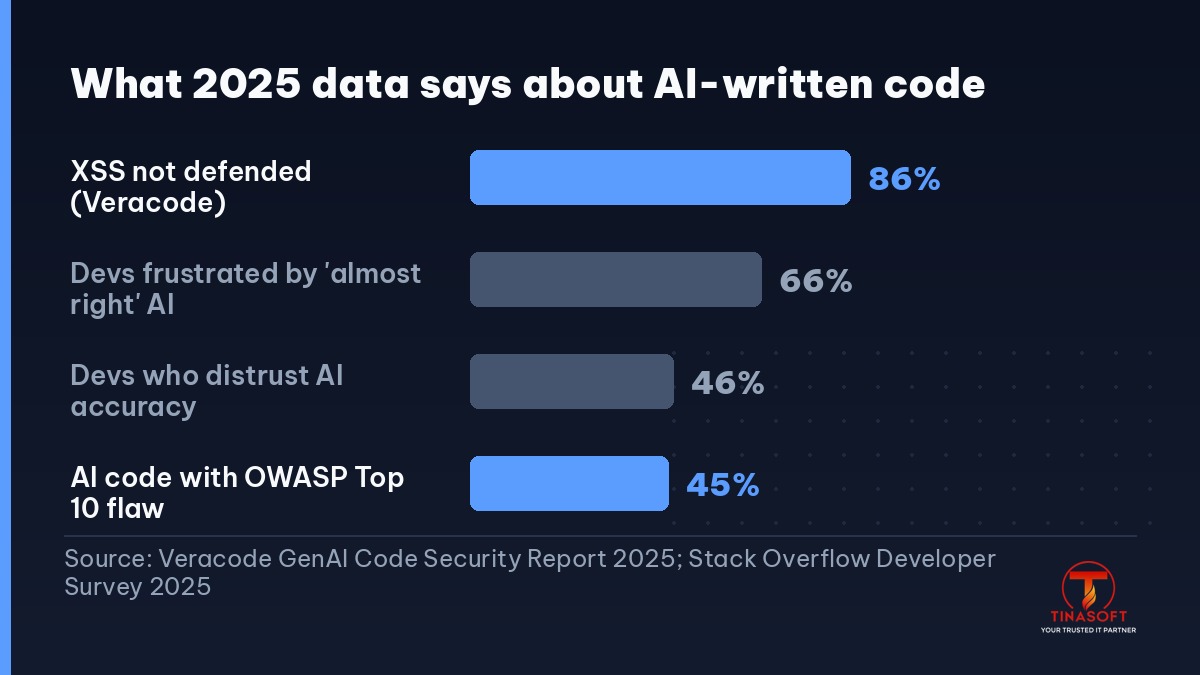
The research from 2025 is consistent: AI-written code works more often than it is safe, and people overestimate how much time it saves. The Veracode 2025 GenAI Code Security Report tested more than 100 large language models on 80 coding tasks. In 45% of cases the models introduced a vulnerability from the OWASP Top 10.
The same study found that models failed to defend against cross-site scripting in 86% of relevant tasks, and Java code had a security failure rate above 70%. Veracode also reported that newer, larger models did not write noticeably more secure code, even though their syntax kept improving.
For anyone planning vibe coding to production, that is the headline risk. Productivity numbers are mixed too. In a randomised trial by METR, 16 experienced open-source developers took 19% longer on real tasks when AI tools were allowed. They had expected a 24% speed-up. METR calls this a point-in-time result, not a verdict on all developers.
Developers themselves are cautious about vibe coding to production. In the Stack Overflow 2025 Developer Survey, 66% named “AI solutions that are almost right, but not quite” as their top frustration, and 46% said they do not trust the accuracy of AI output.
| Finding | Figure | Source |
|---|---|---|
| AI-generated code with an OWASP Top 10 flaw | 45% of test cases | Veracode, 2025 |
| Cross-site scripting not defended | 86% of relevant tasks | Veracode, 2025 |
| Change in task time for experienced developers using AI | +19% (slower) | METR, 2025 |
| Developers frustrated by “almost right” AI output | 66% | Stack Overflow, 2025 |
| Developers who distrust AI accuracy | 46% | Stack Overflow, 2025 |
| Developer time spent on technical debt and bad code | about 42% | Stripe, The Developer Coefficient, 2018 |
What are the 6 things AI can’t do when moving from vibe coding to production?
Each gap below is a place where a prototype usually works in a demo and fails with real users. None of them is about whether AI can type the code. They are about judgement, context and responsibility, which is what vibe coding to production really requires.
1. Security you can defend
AI tools often hard-code API keys, skip input validation, trust data from the browser and leave admin routes open. The Veracode numbers above show this is the norm, not the exception. On the way from vibe coding to production, someone has to review authentication, authorisation, secrets handling and dependencies.
A good rule: if the app stores passwords, personal data or payment details, it needs a human security review. Our guide to cybersecurity in software outsourcing lists the minimum controls to ask for.
2. A data model that survives change
Prototypes tend to grow their database one prompt at a time. The result is duplicated fields, missing constraints and no migration history. That is fine for a demo. Once you move from vibe coding to production, it means corrupted records, painful reporting and risky upgrades.
Engineers design the data model around how the business works: who owns which record, what must never be deleted, what needs an audit trail and how backups are restored.
3. Integrations with messy real systems
Payment gateways, accounting software, CRMs and legacy databases rarely behave like their documentation. AI can call an API. It cannot negotiate test credentials with a bank, handle a partner’s undocumented rate limits or decide what to do when two systems disagree about a customer.
4. Operations after launch
Production software needs logging, monitoring, alerts, backups, a deployment pipeline and a rollback plan. Vibe-coded prototypes usually have none of these, so operations is often the largest piece of work in vibe coding to production. When something breaks at 2 a.m., nobody knows, and nobody knows how to undo the last change safely.
5. Performance under real load
A prototype that is fast with ten test users can collapse with a thousand. Common causes are unindexed queries, chatty API calls and large files served from the app server. Load testing as part of vibe coding to production is cheap compared with losing users on launch day.
6. Accountability
The biggest gap between vibe coding to production is ownership. An AI tool does not sign a contract, carry an on-call phone or explain an incident to your customers. Someone must understand the codebase well enough to change it safely, and must be accountable when it fails.
Do Claude Code agent teams change vibe coding to production?
Agentic tools are moving fast. Multi-agent setups such as Claude Code agent teams can split a task across several AI agents working in parallel, with one coordinating the others. Gartner predicts that 40% of enterprise applications will feature task-specific AI agents by the end of 2026, up from less than 5% in 2025.
So is AI taking over software development? For writing code, AI is taking over a growing share. For deciding what to build, checking it is safe and owning the result, the 2025 evidence says no. Agent teams multiply the output of people who can judge that output. They do not remove the need for that judgement in vibe coding to production.
In practice, agent teams make the six gaps more visible, not smaller. More code arrives faster, so review, testing and architecture become the bottleneck.
When should you hire developers after an AI prototype?
You do not need a team on day one. You need one at specific trigger points. If two or more of these apply, it is time to plan the move from vibe coding to production with engineers involved:
- Paying customers or external users rely on the app every day.
- The app stores personal data, health data or payment details.
- You need integrations with payments, accounting, ERP or a partner API.
- Each new AI-generated change breaks an older feature.
- You cannot explain how a key part of the code works.
- Investors, enterprise buyers or regulators ask for a security review.
For vibe coding to production, the right first hire is often not a full team. A senior engineer or a small outside team can review the prototype, harden the critical paths and set up the pipeline, then decide with you what the long-term team should look like.
Continue or rebuild: what does vibe coding to production cost?
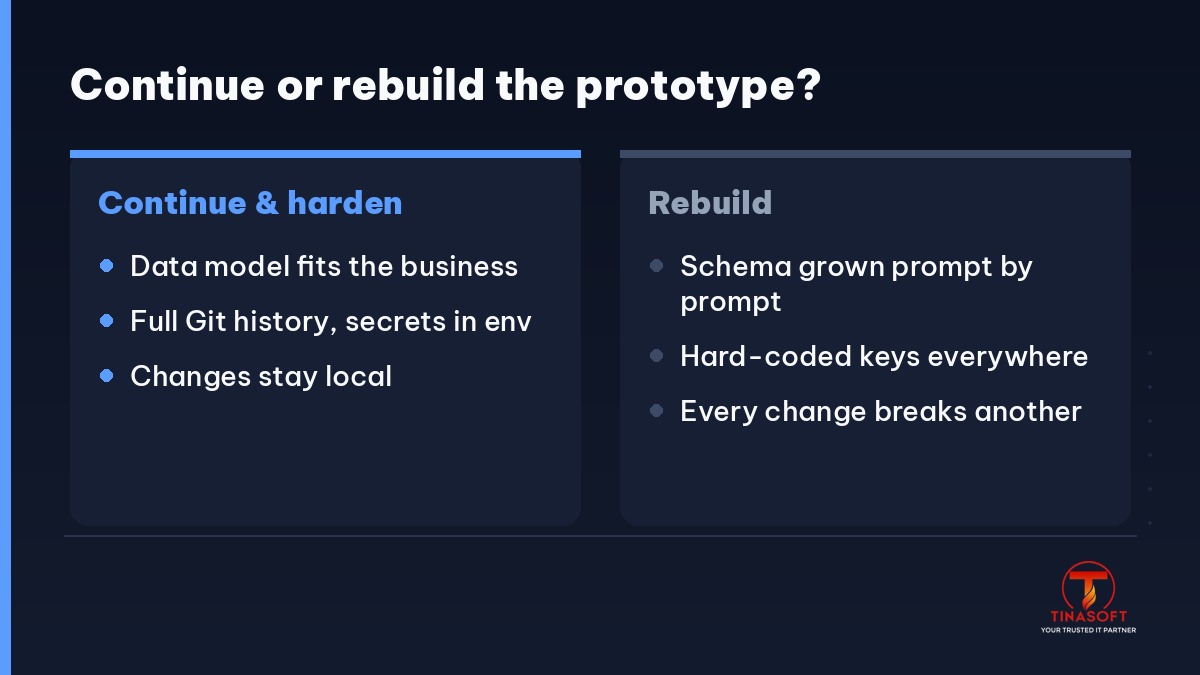
Founders usually ask whether they must throw the prototype away. Often they do not. In vibe coding to production, the decision depends on the quality of the core, not on how the code was written. Stripe’s Developer Coefficient survey estimated that developers spend about 42% of their time on technical debt and bad code, which is the cost you inherit if a weak prototype is pushed live as it is.
| Signal in the review | Lean towards continue | Lean towards rebuild |
|---|---|---|
| Data model | Matches the business, few duplicates | Grown by prompt, no constraints |
| Version control | Full history in Git | Copies of files, no history |
| Secrets | In environment variables | Hard-coded across the code |
| Change safety | Small changes stay local | Every change breaks something else |
| Main flows | Work end to end | Work only on the happy path |
Even a rebuild is not wasted work. The prototype is a tested specification: real screens, real flows and feedback from real users. That removes much of the guesswork in vibe coding to production that makes estimates slip. For the long-term cost of skipping clean-up, see our article on technical debt in software outsourcing.
What should a vibe coding to production checklist include?
Use this short list before you open the app to the public. It turns vibe coding to production into a list of concrete tasks. If you cannot tick an item, that is where engineering time should go first.
- All code in a Git repository you own, with a working build from a clean machine.
- No secrets in the code; keys rotated since the prototype phase.
- Authentication and authorisation reviewed by a person, not only by AI.
- Dependency scan and basic static analysis run, critical issues fixed.
- Database schema documented, with migrations and tested backup restore.
- Logging, monitoring and an alert that reaches a real person.
- Load test at a realistic multiple of expected users.
- A named owner for the system and a written incident process.
If the project already went wrong with a previous team or freelancer, our software project rescue playbook covers how to secure the code and run an audit first.
How Tinasoft approaches vibe coding to production reviews
Tinasoft has built custom software since 2018 and has more than 300 people. When a client brings an AI-built prototype, our process starts with a review, not a quote for a rebuild. Engineers read the code, map the data model, run security and dependency scans and test the main flows.
The output is a short written report: what can be kept, what must be fixed before launch and what can wait. The client then chooses whether to harden the prototype, rebuild parts of it or continue with their own team. We also encourage clients to keep using AI tools, with a human review step in the pipeline.
Vibe coding to production FAQ
Can I launch a vibe-coded app without any developers?
You can launch a demo or an internal tool used by a few trusted people. For anything that stores customer data, takes payments or must stay online, plan at least one experienced developer review before launch. Moving from vibe coding to production without that review means nobody has checked security, data handling or recovery.
How long does it take to move from vibe coding to production?
It depends on what the prototype already does well. A short review of one to two weeks usually tells you whether the code can be hardened or should be rebuilt. Hardening a sound prototype then takes weeks rather than months; a rebuild of the same scope takes longer but starts from a clear specification.
Is it cheaper to rebuild or continue a vibe-coded prototype?
Continue when the data model fits the business, the code is in version control and the main flows already work. Rebuild when secrets are hard-coded everywhere, there is no clear data model or each change breaks something else. The prototype still has value either way, because it is a working specification.
Are Claude Code agent teams enough to replace a development team?
Multi-agent tools such as Claude Code agent teams can split work across parallel agents and speed up delivery for people who already know what good output looks like. They do not take responsibility for a production system. Someone still has to review the code, own the architecture and answer the phone when the system goes down.
When should I hire developers after an AI prototype?
Hire or contract developers when real users depend on the app, when it touches money or personal data, when you need integrations with other systems, or when each new AI-generated change starts breaking older features. Those are the points where moving from vibe coding to production needs engineering judgement.
A question before you go live
Vibe coding to production is a real path in 2026, but the last mile is engineering, not prompting. Before your next release, ask yourself one question: if this app failed for your best customer tonight, who would notice first, and who would know how to fix it?