

Software project rescue means taking control of a late, broken or abandoned build and getting it back to a working release. The short answer: freeze new scope, secure your code and accounts, run a five-day independent audit, then decide with numbers whether to rescue, refactor or rebuild. This 10-step software project rescue playbook shows how.
Key takeaways
- Only 31% of software projects fully succeed, so a software project rescue is a normal business risk, not a personal failure.
- Secure the repository, cloud accounts and credentials before you confront the vendor.
- A 5-day technical audit turns opinions into a cost estimate you can act on.
- Rescue when the core is sound; rebuild when the data model or security is broken at the core.
- Milestone payments and weekly demos are the cheapest insurance against the next failure.
Why do so many projects end up needing software project rescue?
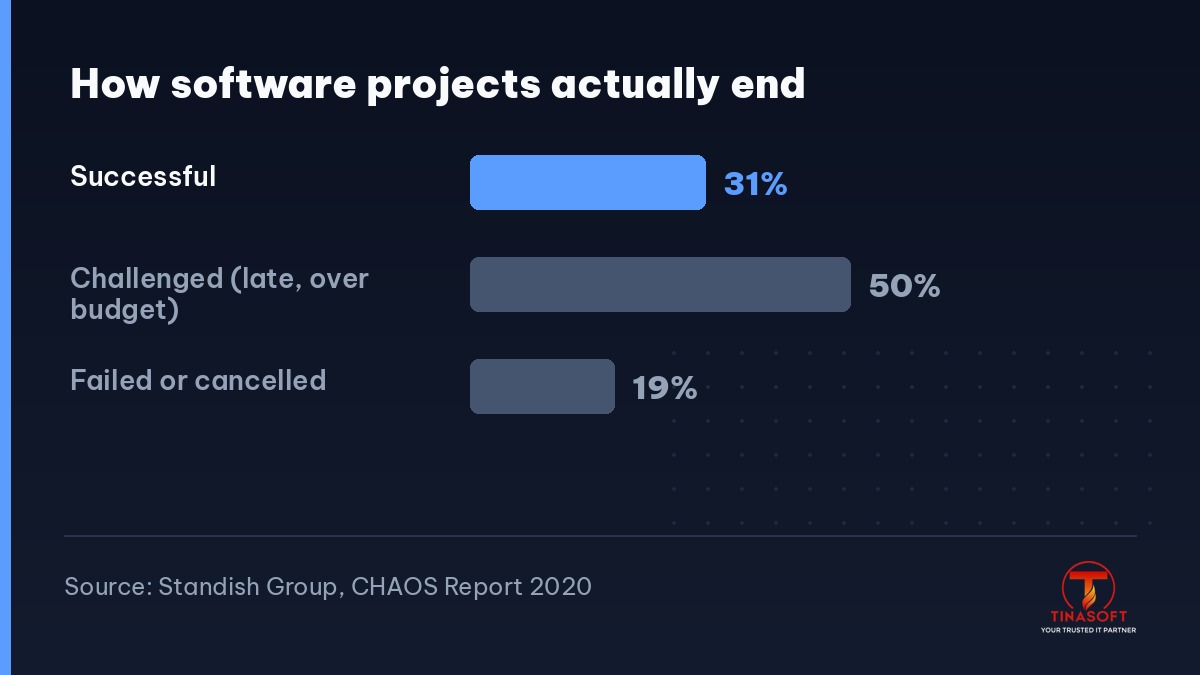
Because most software projects do not go to plan. The Standish Group’s CHAOS Report 2020 classed only 31% of software projects as fully successful: on time, on budget and with the agreed scope. Half were “challenged” and 19% failed or were cancelled.
Large projects are worse. A study by McKinsey and the University of Oxford of more than 5,400 IT projects found that large IT projects run 45% over budget and 7% over time on average, while delivering 56% less value than predicted.
So if you are reading about software project rescue, you are in a large group. The question is not whose fault it is. The question is how fast you can get back to facts and a working product.
| Metric | Figure | Source |
|---|---|---|
| Software projects fully successful | 31% | Standish Group, CHAOS Report 2020 |
| Projects challenged (late, over budget or reduced scope) | 50% | Standish Group, CHAOS Report 2020 |
| Projects failed or cancelled | 19% | Standish Group, CHAOS Report 2020 |
| Average budget overrun on large IT projects | 45% | McKinsey and University of Oxford, 2012 |
| Value shortfall on large IT projects | 56% | McKinsey and University of Oxford, 2012 |
| Organisations naming inaccurate requirements as the main cause of failure | 37% | PMI, Pulse of the Profession 2014 |
Which software vendor red flags mean you need software project rescue?
Vendors rarely announce that a project is failing. They go quiet. Watch for these software vendor red flags, and treat any two together as a trigger for a software project rescue review:
- Demos keep slipping. “Next week” for three weeks in a row usually means nothing works end to end.
- Status reports get vaguer. Percentages replace working features you can click.
- The team keeps changing. A new project manager or lead developer every month means knowledge is leaking out.
- No repository access. If you cannot see the code you are paying for, you cannot verify progress.
- Bugs come back. Issues marked fixed reappear in the next build, a sign of no automated tests.
- Invoices without deliverables. Payments are tied to time passing, not to accepted milestones.
Failed software projects are rarely surprising in hindsight. The signals were there; nobody had a rule for acting on them.
What should you do in the first 48 hours of a software project rescue?
Protect your assets before you protect anyone’s feelings. In the first 48 hours of a software project rescue, focus on access, not blame.
- Check that you are an owner or admin on the code repository, not just a viewer.
- List every cloud, hosting, domain, email, app store and payment account, and confirm who holds the master login.
- Download a full copy of the repository, including all branches and tags.
- Export the issue tracker, design files and shared documents.
- Re-read the contract clauses on intellectual property, handover and termination.
Do not announce a vendor change until access is secured. Most vendors behave professionally, but a calm, prepared client gets a far smoother handover.
What does a 5-day software project rescue audit cover?
The audit is the heart of any software project rescue. Its goal is a short written report with an effort estimate, not a list of complaints. An experienced independent team can usually produce one in five working days.
| Day | Focus | Output |
|---|---|---|
| 1 | Build and run the system from source | Can a new team deploy it at all? |
| 2 | Architecture and data model review | Does the structure fit the business? |
| 3 | Code quality, tests and security scan | List of critical, major and minor issues |
| 4 | Gap analysis against requirements | What is done, half done or missing |
| 5 | Estimate and recommendation | Rescue, refactor or rebuild, with effort ranges |
Day 4 matters more than most teams expect. According to PMI’s Pulse of the Profession research, 37% of organisations named inaccurate requirements gathering as the primary cause of project failure. Many failed software projects were built correctly to the wrong specification.
Should you rescue, refactor or rebuild a failed software project?
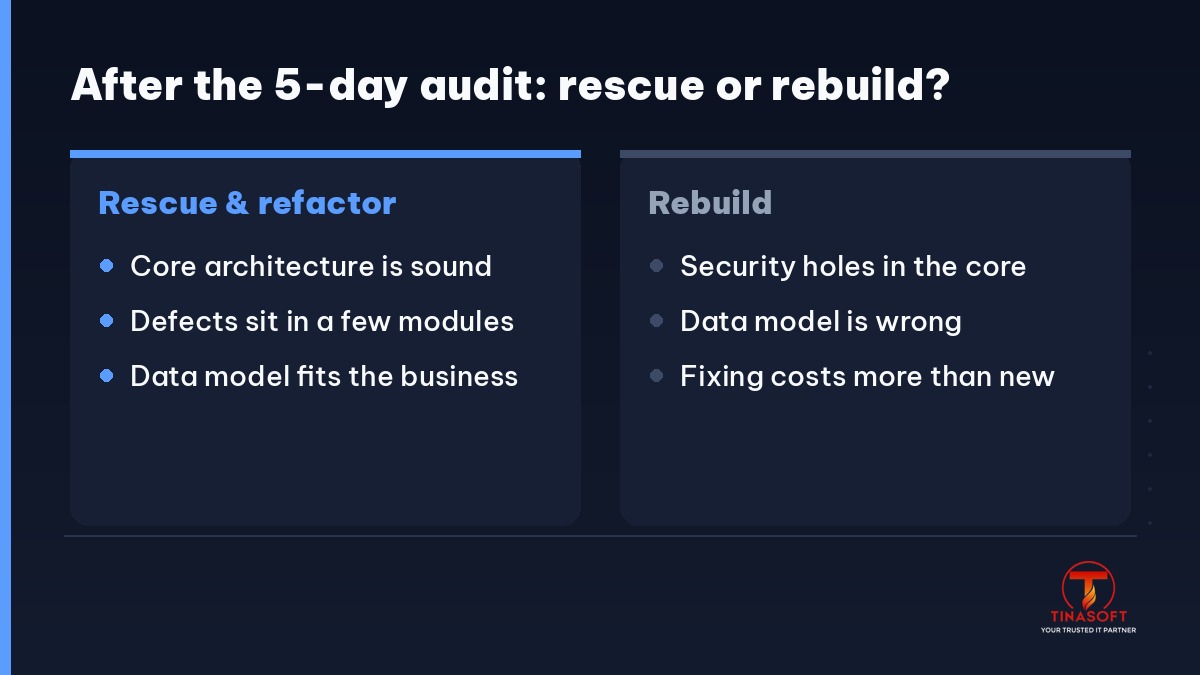
To rescue a failed software project, you need evidence that the foundations are worth keeping. The audit gives you three options, and each has a clear profile.
| Option | Choose it when | Main risk |
|---|---|---|
| Rescue | Architecture and data model are sound; defects sit in a few modules | Hidden issues surface later |
| Refactor | The product works but is fragile, with few tests and debt in key modules | Scope creep during clean-up |
| Rebuild | Security holes in the core, wrong data model, or fixing costs more than new | Second-system over-engineering |
A simple rule: if the estimated cost to fix approaches the cost to rebuild the same agreed scope, rebuild. If it is well below, keep the code. Software project rescue is not about saving face for the code; it is about the cheapest path to a release you can trust.
The 10-step software project rescue playbook
Here is the full software project rescue sequence we recommend to clients whose vendor has gone quiet. Steps 1 to 4 take about two weeks; steps 5 to 10 run over the following weeks.
- Freeze new feature work. Stop adding scope. Every new feature built on an unstable base raises the cost of the software project rescue. Tell stakeholders that the next two weeks are about facts, not features.
- Secure code, accounts and credentials. Confirm you have admin rights to the repository, cloud console, domain registrar, app store accounts, CI/CD and third-party APIs. Rotate shared passwords. This is the single most important step when you need to take over a software project.
- Collect every document that exists. Gather the contract, statement of work, change requests, invoices, specs, designs, test reports and chat history. Missing documents are themselves a finding.
- Run a 5-day technical audit. An independent team reviews architecture, code quality, test coverage, security, infrastructure and the deployment pipeline, then estimates the effort to reach a stable release.
- Rebuild the requirements baseline. List what the product must do for the next release, agreed by the business owner. The PMI finding on requirements suggests this is where many failed software projects started going wrong.
- Decide: rescue, refactor or rebuild. Use the audit numbers, not gut feeling. Compare the cost to fix with the cost to rebuild the same agreed scope.
- Agree a handover with the old vendor. Ask for a written handover: source, environments, documentation and a short knowledge-transfer session. Keep the tone professional; you may need their cooperation.
- Stabilise before you build. Fix critical security issues, set up automated builds and add tests around the most-used flows. Ship one small, safe release to prove the pipeline works.
- Reset the contract model. Move to short milestones with clear acceptance criteria and payment on acceptance, so the next slip is visible in weeks, not months.
- Install an early-warning rhythm. Weekly demos of working software, a shared backlog, and access to the repository at all times. These habits stop the next software project rescue before it is needed.
None of these steps needs heroics. A software project rescue succeeds through order and visibility: everyone sees the same backlog, the same builds and the same numbers.
How do you take over a software project without a fight?
When you take over a software project from another vendor, the old vendor’s goodwill is worth a lot. Keep the conversation factual and short.
- Thank them, state that you are moving the work, and give a clear handover date.
- Send a written checklist: repository, environments, credentials, documentation, open issues.
- Offer to pay for a short knowledge-transfer session at their normal rate.
- Settle outstanding invoices that match accepted deliverables; dispute the rest in writing.
We cover the commercial side in more depth in our guide to switching software vendors. If you are rethinking the contract model, read our comparison of fixed price vs time and materials before signing again.
How do you choose the team for a software project rescue?
The new team needs different skills from a greenfield team. Look for people who are comfortable reading other people’s code and saying “we don’t know yet” until the audit is done.
- Audit first, quote second. Be wary of any vendor that quotes a fixed price for software project rescue before seeing the code.
- Transparent access. You keep admin rights to every repository and account from day one.
- Short cycles. Weekly demos and fortnightly releases, so progress is visible.
- Named people. Ask who will actually write the code, and how continuity is handled.
If the new team is offshore, the working rhythm matters as much as rates. Our article on how to manage an offshore development team covers the rituals that keep a remote team accountable.
How Tinasoft approaches software project rescue
Tinasoft is a Vietnam-based software company founded in 2018, with 300+ engineers and staff and 300+ projects delivered for about 100 clients. Our software project rescue process starts with access and an audit rather than a quote.
We share the audit report with you in full, whether or not you continue with us. Our rates are public, starting from USD 12 per hour, so you can compare the cost to fix against the cost to rebuild before you commit.
Software project rescue FAQ
How long does a software project rescue take?
The stabilisation phase of a software project rescue usually takes 30 days: one week to secure assets, one week to audit, and two weeks to fix the most dangerous defects. Getting back to a predictable release rhythm often takes two to three months, depending on how much of the codebase can be kept.
Can a new vendor take over a software project without the old vendor’s help?
Yes, if you hold the source code, the infrastructure accounts and the credentials. A new team can take over a software project from the repository alone, but it is slower and riskier. That is why step 2 of any software project rescue is securing access before you announce anything.
Is it cheaper to rescue or rebuild a failed software project?
Rescue is usually cheaper when the architecture and data model are sound and defects sit in a few modules. Rebuild wins when there are security flaws in the core, the data model does not fit the business, or the audit estimates that fixing will cost more than building the same scope again.
What are the most common software vendor red flags?
Missed demos, vague status reports, a new project manager every month, no access to the repository, invoices without matching deliverables and a growing list of bugs marked fixed that reappear. Two or more of these together justify starting a software project rescue review.
Who owns the code if I end the contract with my vendor?
It depends on your contract. Most well-written agreements transfer intellectual property to the client on payment. Check the IP, handover and termination clauses before you act, and take legal advice if ownership is unclear.
Next step for your software project rescue
If your vendor has gone quiet, start with step 2 today: secure your code and accounts. Then get an independent view of what you have. To budget the software project rescue or a rebuild, see our public Vietnam software outsourcing rates and compare them with your current spend.