

Hiring engineers in Australia got measurably harder this year, and that is the context in which most offshore development team decisions are now made.
This article covers what the workforce data shows, when a dedicated remote team makes sense against the alternatives, and the questions worth asking before signing anything.
In this article
- What the Australian workforce data shows
- Three realistic responses to the shortage
- When an offshore development team is the right answer
- What time zone actually changes
- Questions to ask before signing
- Frequently asked questions
The short answer on an offshore development team
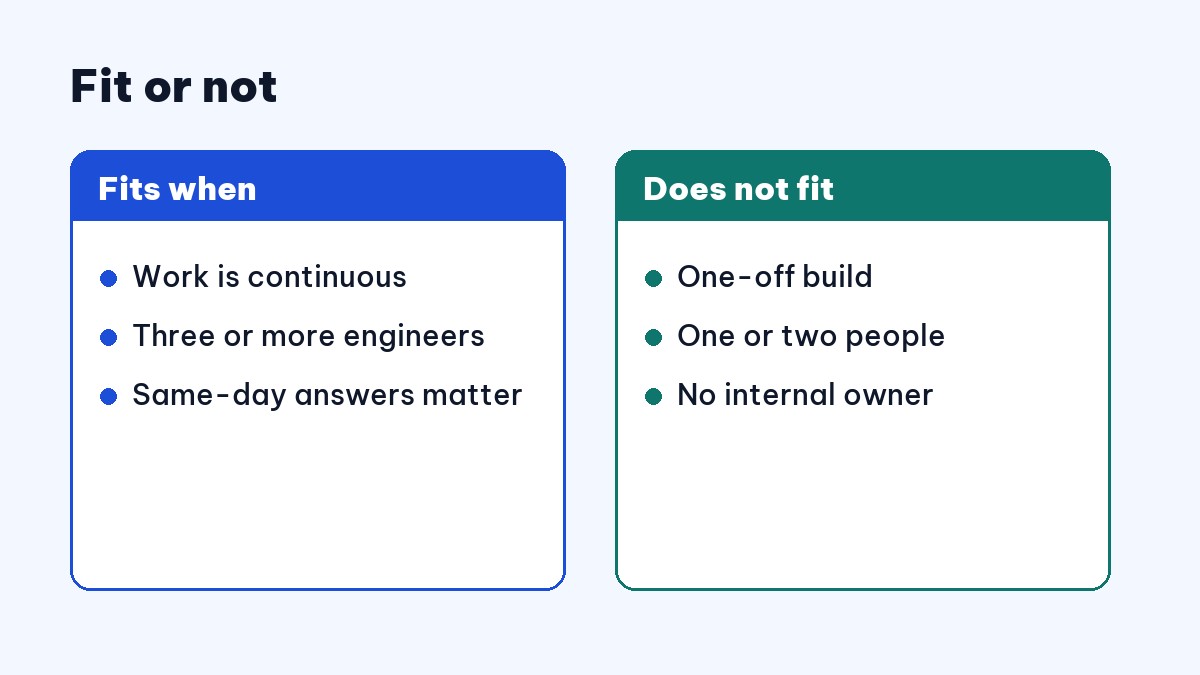
An offshore development team is worth it when two conditions hold at the same time: the work is continuous rather than a single build with a finish line, and the time zone gap is small enough that a question asked in the morning is answered the same morning.
Below roughly three engineers, the management overhead usually costs more than the arrangement returns. The hourly rate is the least useful number in the comparison, because coordination time from your own team, a slower first six weeks and documentation that did not exist before all sit outside it.
What the Australian workforce data shows
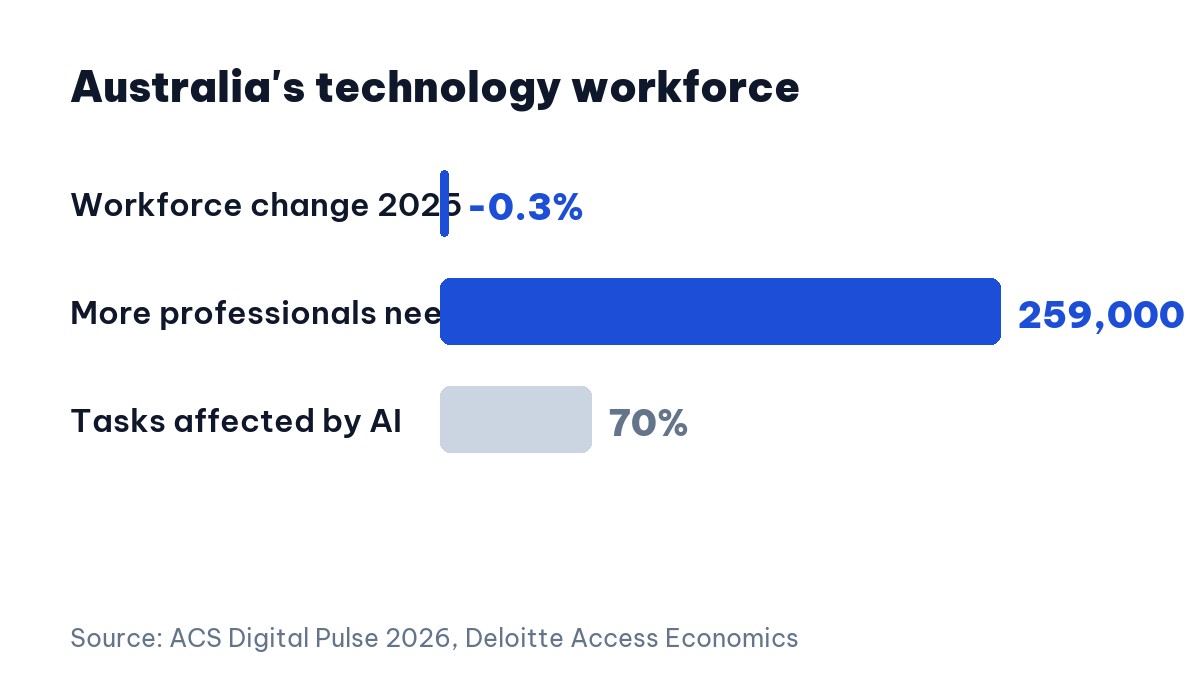
The ACS Digital Pulse 2026 report, prepared by Deloitte Access Economics, found that Australia’s technology workforce shrank for the first time on record, down 0.3% to around 967,000 workers in 2025.
The same report projects that Australia will need an additional 259,000 technology professionals by 2035. For that to happen, the tech workforce would have to grow at roughly twice the rate of employment across the economy.
A third figure explains why the gap is not simply about headcount: around 70% of tech workers’ tasks are now affected by AI. The shortage is partly a mismatch between the skills available and the skills now in demand.
For a company that has had a senior engineering role open for three months, this is the background to that experience. It is a market condition, not a recruitment failure.
Three realistic responses to the offshore development team question
Only three options exist, and they are not mutually exclusive:
- Pay above market and accept a long search. Works if the role is genuinely senior and the budget allows it. Expect three to six months and a salary that resets expectations for the rest of the team.
- Narrow the role until it is fillable. Split one senior position into two more junior ones, or remove the requirements that eliminate most candidates. Cheaper, but it shifts load onto whoever supervises.
- Build part of the team elsewhere. An offshore development team in a nearby time zone, working the same hours as the local team.
We provide the third option, so read what follows as disclosure rather than neutral advice. The arguments below are the ones we would apply to our own decision.
When an offshore development team is the right answer
An offshore development team fits when the work is continuous
A product that changes every month needs people who accumulate context. Repeated fixed-scope contracts force the context to be rebuilt each time, and the rebuilding is invisible in the quote but very visible in the schedule.
It does not fit for a single well-defined build
If the work has a clear finish line and will then be handed to someone else to maintain, a fixed-scope project is simpler to manage and easier to price.
When an offshore development team is too small to pay off
One or two remote engineers usually cost more in management overhead than they return. The arrangement typically starts paying off from around three people, when the team can absorb a task without the client managing each assignment.
What time zone changes for an offshore development team
Time zone gets discussed as a convenience. It is really about how long a question takes to answer.
With a gap of one to four hours, a question asked in the morning is answered the same morning. With a gap of eight to ten hours, a question asked at 10am is answered the following day, which means every clarification costs a full working day. Across a three-month project, that difference compounds into weeks.
Vietnam sits three to four hours behind Australia’s east coast depending on daylight saving. A 9am standup in Sydney is 5am or 6am in Hanoi. That is workable with a team that has agreed to it, and it should be stated explicitly in the contract rather than assumed.
Questions to ask an offshore development team provider before signing
- Who exactly will work on this, and can I meet them before signing? If the answer is a profile rather than a person, ask again.
- If that person leaves, who replaces them and how long is the handover? People move on everywhere. The answer should describe a process, not express confidence that it will not happen.
- What hours does the team actually work, and does that overlap with ours?
- How do I see progress, and how often? A demo of something runnable every two weeks is a reasonable expectation.
- If we want to stop, what notice is required and how do we get everything back? A long-term contract without a clear exit is a risk regardless of how well it starts.
The last question matters most and is asked least. Our note on choosing business software and vendors covers the ownership side, and why software projects go over budget covers what happens when scope is not tracked.
How to judge whether the offshore development team worked
Set the measure before the team starts, not after the first invoice arrives:
- Time from a feature being specified to it running in production.
- Number of defects found after release, compared with before.
- Hours the local team spends on coordination each week.
Record today’s value, then compare after ninety days. The method is set out in measuring software ROI in 90 days. If the number has not moved, the problem is usually the working arrangement rather than the people.
On cost, published starting rates are a useful reference point before any vendor conversation. Ours are listed at software outsourcing rates in Vietnam.
What an offshore development team costs to manage, beyond the rate
The hourly rate is the number everyone compares. Three costs sit outside it and decide whether the arrangement is worth it.
Coordination time from your own team. Someone local has to answer questions, review work and set priorities. Budget four to six hours a week for a team of three, more in the first month. If nobody has that time, the arrangement will underperform regardless of who you hire.
The first six weeks. A new team is slower while it learns the domain and the codebase. This is normal and should be in the plan. Judging output in week two measures the learning curve, not the team.
Documentation that did not exist before. Remote work forces decisions to be written down. Most companies find this is a benefit rather than a cost, but it is work that someone has to do, and it falls early in the engagement.
Counting these three honestly usually changes the comparison between an offshore development team and a local hire more than the hourly rate does.
One more cost is worth naming because it is rarely discussed: the cost of changing your mind. A team built around one product direction cannot be redirected overnight. If the roadmap is still being decided, a shorter fixed-scope engagement buys time to settle it before committing to a standing team.
A practical way to handle that: start with a three-month commitment rather than twelve, with an agreed review at the end. Vendors who are confident in the work will accept it, and the ones who insist on a long lock-in are telling you something useful.
None of this argues against the arrangement. It argues for entering it with the real number rather than the advertised one, which is also the only way to tell later whether it paid off.
Counting those three costs honestly changes the decision more than the hourly rate does.
Frequently asked questions
Is an offshore development team worth it for a small Australian company?
It depends on whether the work is continuous. For a one-off build, a fixed-scope project is usually simpler. For a product that needs changes every month, a dedicated team becomes cheaper than repeated project contracts once you pass roughly three engineers.
What time zone difference works for an offshore development team?
A gap of one to four hours allows a shared standup and same-day answers. Vietnam sits three to four hours behind the east coast depending on daylight saving, which means a 9am Sydney standup is 5am to 6am in Hanoi — workable, but it should be agreed explicitly rather than assumed.
How do you keep quality consistent with an offshore development team?
Three mechanisms do most of the work: the same code review standard for everyone, a demo of something runnable every two weeks, and one named person accountable for the outcome rather than for the hours billed.
In short: the case for an offshore development team rests on two things — whether the work is continuous, and whether the time zone lets a question be answered the same day. Everything else, including the hourly rate, matters less than those two.