
Web application development is the primary engine driving global business transformation and customer engagement in the fast-paced economy of 2026. As digital ecosystems become increasingly crowded, simply having an online presence is no longer sufficient for market leadership. Organizations must now leverage cutting-edge technical trends to create immersive, high-performance, and secure environments that resonate with the modern consumer. Those who master the synergy between technology and business strategy are seeing unprecedented growth trajectories and sustained competitive advantages.

1. The Proliferation of AI-Native Ecosystems
In 2026, artificial intelligence is no longer a “plugin”—it is the foundation of modern web application development. Businesses have moved beyond basic chatbots to Generative UI and Predictive User Paths. By analyzing user behavior in real-time, modern web apps can dynamically restructure their interface to highlight the most relevant features for each individual user.
Research indicates that companies integrating AI-driven personalization into their web platforms have seen a 35% increase in conversion rates and a significant reduction in bounce rates. From automated code generation to AI-assisted debugging, the speed of deployment has accelerated, allowing firms to iterate their digital products faster than ever before.
2. The Dominance of Progressive Web Apps (PWA)
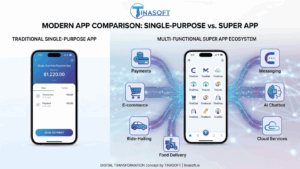
The line between native mobile apps and web platforms has completely blurred. High-end web application development now prioritizes Progressive Web Apps to ensure a seamless experience across all devices without the friction of app store downloads.
PWAs in 2026 offer offline functionality, push notifications, and near-instant loading speeds even on restricted networks. Major global retailers have reported that switching to a PWA architecture resulted in a 20% boost in mobile revenue. For businesses targeting emerging markets with varied connectivity, this trend is a strategic necessity to ensure accessibility and brand loyalty.
3. Serverless Architecture and Microservices
The backend of web application development has undergone a radical shift toward Serverless Computing and Microservices Architecture. Instead of maintaining bulky, monolithic servers, businesses now utilize cloud functions that trigger on demand.
This approach offers infinite scalability and a “pay-as-you-go” financial model, which has helped startups and enterprises alike reduce infrastructure costs by up to 40%. By breaking down applications into smaller, independent services, developers can update specific features without risking the stability of the entire system. This modular flexibility is what allows tech giants to deploy updates thousands of times per day without downtime.
4. WebAssembly (Wasm) and Native Performance
Performance is the currency of the digital age. Advanced web application development is now leveraging WebAssembly to bring heavy-duty computational power to the browser. Wasm allows developers to run high-performance languages like C++, Rust, and C# alongside JavaScript.
This trend has opened the door for complex data visualization, in-browser video editing, and 3D rendering that was previously only possible in native desktop software. For industries like FinTech and Healthcare, Wasm provides the computational speed required for real-time data processing and high-security encryption, directly within the web interface.
5. The Zero Trust Security Paradigm
Cybersecurity has reached a critical tipping point. In 2026, elite web application development follows the Zero Trust Security model, where no entity—inside or outside the network—is trusted by default. With the average cost of a data breach exceeding $5 million, businesses are prioritizing multi-factor authentication (MFA), biometric logins, and end-to-end encryption.
Security is no longer an afterthought; it is integrated into the CI/CD pipeline (DevSecOps). By automating security audits and vulnerability scanning, developers can identify and neutralize threats before they reach the production environment. This proactive defense strategy is essential for maintaining consumer trust in an era of sophisticated AI-powered cyberattacks.
6. Motion UI and Immersive Interactivity
User experience in 2026 is defined by Motion UI. Modern web application development uses sophisticated animations and transitions to guide the user’s eye and provide feedback. However, these are not just aesthetic choices; they are functional tools used to decrease perceived load times and simplify complex navigation.
Interactive elements such as 3D product previews and augmented reality (AR) integrations are becoming standard in E-commerce. Brands that utilize immersive web experiences report a 40% increase in user engagement time, as customers can “try on” products or visualize furniture in their homes directly through their web browser.
7. Low-Code and No-Code Integration
To democratize the digital transformation process, many organizations are adopting Low-Code/No-Code platforms for internal web application development projects. This allows non-technical team members to build functional prototypes or automate internal workflows without waiting for the IT department.
While professional developers still handle the complex architecture, these platforms allow for rapid experimentation and lower the barrier to entry for innovation. Organizations that empower their staff with these tools have seen a 25% improvement in operational efficiency and a faster internal response to market changes.
8. Sustainable and Green Web Development
Sustainability is a major business driver in 2026. Ethical web application development now includes optimizing code for energy efficiency. From reducing the payload of images to choosing green hosting providers, businesses are actively seeking ways to lower their digital carbon footprint.
Investors and consumers alike are favoring brands that demonstrate Environmental, Social, and Governance (ESG) responsibility. By optimizing web performance, companies not only improve the user experience but also contribute to global climate goals, making it a win-win for both business and the planet.
9. ROI and Business Impact of Modern Trends
Investing in modern web application development is no longer viewed as an expense, but as a high-yield investment. The Return on Investment (ROI) for a well-executed web strategy manifests through:
- Increased Customer Lifetime Value (CLV) through personalized experiences.
- Reduced Operational Costs via serverless scaling and AI automation.
- Enhanced Brand Authority through high-speed, secure, and accessible platforms.
Market leaders in 2026 are those who view their web app as a living entity that evolves alongside technological breakthroughs and shifting consumer expectations.
10. Partnering for Elite Digital Growth
Navigating the complexities of modern web application development requires more than just technical skill—it requires a partner who understands the intersection of innovation and business ROI. As a leading provider in the tech space, Tinasoft serves as a strategic extension of your team, helping you navigate these trends with precision.
With a portfolio of over 300 successful projects and a deep expertise in AI, IoT, and Cloud-native architectures, we empower businesses to achieve elite growth in the 2026 market. Our commitment to Agile delivery, absolute data security, and high-performance engineering ensures that your digital presence is not just current, but future-proof. Whether you are scaling a complex ERP or launching a revolutionary PWA, we turn these global trends into your measurable success.
🚀 Ready to lead your industry with a world-class digital platform?
Don’t let the technical curve pass you by. Partner with a team that delivers excellence and drives growth in every line of code.
👉 [Click here to receive an elite consultation and a tailored quote for your project!]
🌐 Website: [Tinasoft]
📩 Fanpage: Tinasoft Vietnam
WebApplicationDevelopment #BusinessGrowth #Tinasoft #TechTrends2026 #AI #PWA #CloudNative #DigitalTransformation #Innovation